| Record Information |
|---|
| Version | 2.0 |
|---|
| Created at | 2022-09-01 21:08:43 UTC |
|---|
| Updated at | 2022-09-01 21:08:43 UTC |
|---|
| NP-MRD ID | NP0142569 |
|---|
| Secondary Accession Numbers | None |
|---|
| Natural Product Identification |
|---|
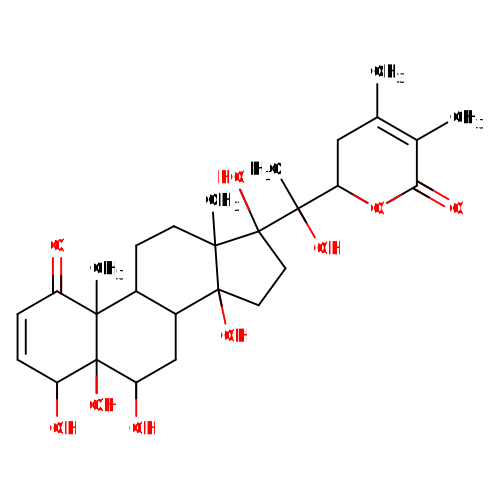
| Common Name | 6-(1-{1,3a,5,5a,6-pentahydroxy-9a,11a-dimethyl-9-oxo-2h,3h,3bh,4h,5h,6h,9bh,10h,11h-cyclopenta[a]phenanthren-1-yl}-1-hydroxyethyl)-3,4-dimethyl-5,6-dihydropyran-2-one |
|---|
| Description | Glycolic acid, also known as 2-hydroxyacetate or glycolate, belongs to the class of organic compounds known as alpha hydroxy acids and derivatives. These are organic compounds containing a carboxylic acid substituted with a hydroxyl group on the adjacent carbon. A 2-hydroxy monocarboxylic acid that is acetic acid where the methyl group has been hydroxylated. Glycolic acid is an extremely weak basic (essentially neutral) compound (based on its pKa). Glycolic acid exists in all living species, ranging from bacteria to humans. In humans, glycolic acid is involved in rosiglitazone metabolism pathway. Outside of the human body, Glycolic acid has been detected, but not quantified in, several different foods, such as sunburst squash (pattypan squash), sweet oranges, cereals and cereal products, bog bilberries, and mixed nuts. This could make glycolic acid a potential biomarker for the consumption of these foods. Glycolic acid is a potentially toxic compound. 6-(1-{1,3a,5,5a,6-pentahydroxy-9a,11a-dimethyl-9-oxo-2h,3h,3bh,4h,5h,6h,9bh,10h,11h-cyclopenta[a]phenanthren-1-yl}-1-hydroxyethyl)-3,4-dimethyl-5,6-dihydropyran-2-one is found in Physalis peruviana. 6-(1-{1,3a,5,5a,6-pentahydroxy-9a,11a-dimethyl-9-oxo-2h,3h,3bh,4h,5h,6h,9bh,10h,11h-cyclopenta[a]phenanthren-1-yl}-1-hydroxyethyl)-3,4-dimethyl-5,6-dihydropyran-2-one was first documented in 2002 (PMID: 18498500). Glycolic acid, with regard to humans, has been found to be associated with several diseases such as branched-chain keto acid dehydrogenase kinase deficiency, ethylene glycol poisoning, and transurethral resection of the prostate; glycolic acid has also been linked to several inborn metabolic disorders including glutaric acidemia type 2 and glycolic aciduria (PMID: 14585457) (PMID: 15662707) (PMID: 15716481) (PMID: 15716482). |
|---|
| Structure | CC1=C(C)C(=O)OC(C1)C(C)(O)C1(O)CCC2(O)C3CC(O)C4(O)C(O)C=CC(=O)C4(C)C3CCC12C InChI=1S/C28H40O9/c1-14-12-21(37-22(32)15(14)2)25(5,33)27(35)11-10-26(34)17-13-20(31)28(36)19(30)7-6-18(29)24(28,4)16(17)8-9-23(26,27)3/h6-7,16-17,19-21,30-31,33-36H,8-13H2,1-5H3 |
|---|
| Synonyms | | Value | Source |
|---|
| 2-Hydroxyacetic acid | ChEBI | | 2-Hydroxyethanoic acid | ChEBI | | alpha-Hydroxyacetic acid | ChEBI | | Glycollic acid | ChEBI | | HOCH2COOH | ChEBI | | Hydroxyacetic acid | ChEBI | | Hydroxyethanoic acid | ChEBI | | 2-Hydroxyacetate | Generator | | 2-Hydroxyethanoate | Generator | | a-Hydroxyacetate | Generator | | a-Hydroxyacetic acid | Generator | | alpha-Hydroxyacetate | Generator | | Α-hydroxyacetate | Generator | | Α-hydroxyacetic acid | Generator | | Glycollate | Generator | | Hydroxyacetate | Generator | | Hydroxyethanoate | Generator | | Glycolate | Generator | | Glycocide | HMDB | | GlyPure | HMDB | | GlyPure 70 | HMDB | | Sodium glycolate | HMDB | | Glycolic acid, 2-(14)C-labeled | HMDB | | Glycolic acid, 1-(14)C-labeled | HMDB | | Glycolic acid, potassium salt | HMDB | | Glycolic acid, monopotassium salt | HMDB | | Glycolic acid, calcium salt | HMDB | | Glycolic acid, monoammonium salt | HMDB | | Glycolic acid, monolithium salt | HMDB | | Glycolic acid, monosodium salt | HMDB | | Potassium glycolate | HMDB |
|
|---|
| Chemical Formula | C28H40O9 |
|---|
| Average Mass | 520.6118 Da |
|---|
| Monoisotopic Mass | 520.26723 Da |
|---|
| IUPAC Name | 6-(1-hydroxy-1-{6,7,8,11,14-pentahydroxy-2,15-dimethyl-3-oxotetracyclo[8.7.0.0²,⁷.0¹¹,¹⁵]heptadec-4-en-14-yl}ethyl)-3,4-dimethyl-5,6-dihydro-2H-pyran-2-one |
|---|
| Traditional Name | 6-(1-hydroxy-1-{6,7,8,11,14-pentahydroxy-2,15-dimethyl-3-oxotetracyclo[8.7.0.0²,⁷.0¹¹,¹⁵]heptadec-4-en-14-yl}ethyl)-3,4-dimethyl-5,6-dihydropyran-2-one |
|---|
| CAS Registry Number | Not Available |
|---|
| SMILES | CC1=C(C)C(=O)OC(C1)C(C)(O)C1(O)CCC2(O)C3CC(O)C4(O)C(O)C=CC(=O)C4(C)C3CCC12C |
|---|
| InChI Identifier | InChI=1S/C28H40O9/c1-14-12-21(37-22(32)15(14)2)25(5,33)27(35)11-10-26(34)17-13-20(31)28(36)19(30)7-6-18(29)24(28,4)16(17)8-9-23(26,27)3/h6-7,16-17,19-21,30-31,33-36H,8-13H2,1-5H3 |
|---|
| InChI Key | XLUKITCTLVOOAW-UHFFFAOYSA-N |
|---|
| Experimental Spectra |
|---|
|
| Not Available | | Predicted Spectra |
|---|
|
| | Spectrum Type | Description | Depositor ID | Depositor Organization | Depositor | Deposition Date | View |
|---|
| 1D NMR | 13C NMR Spectrum (1D, 25 MHz, H2O, predicted) | Wishart Lab | Wishart Lab | David Wishart | 2021-06-20 | View Spectrum | | 1D NMR | 1H NMR Spectrum (1D, 100 MHz, H2O, predicted) | Wishart Lab | Wishart Lab | David Wishart | 2021-06-20 | View Spectrum | | 1D NMR | 13C NMR Spectrum (1D, 252 MHz, H2O, predicted) | Wishart Lab | Wishart Lab | David Wishart | 2021-06-20 | View Spectrum | | 1D NMR | 1H NMR Spectrum (1D, 1000 MHz, H2O, predicted) | Wishart Lab | Wishart Lab | David Wishart | 2021-06-20 | View Spectrum | | 1D NMR | 13C NMR Spectrum (1D, 50 MHz, H2O, predicted) | Wishart Lab | Wishart Lab | David Wishart | 2021-06-20 | View Spectrum | | 1D NMR | 1H NMR Spectrum (1D, 200 MHz, H2O, predicted) | Wishart Lab | Wishart Lab | David Wishart | 2021-06-20 | View Spectrum | | 1D NMR | 13C NMR Spectrum (1D, 75 MHz, H2O, predicted) | Wishart Lab | Wishart Lab | David Wishart | 2021-06-20 | View Spectrum | | 1D NMR | 1H NMR Spectrum (1D, 300 MHz, H2O, predicted) | Wishart Lab | Wishart Lab | David Wishart | 2021-06-20 | View Spectrum | | 1D NMR | 13C NMR Spectrum (1D, 101 MHz, H2O, predicted) | Wishart Lab | Wishart Lab | David Wishart | 2021-06-20 | View Spectrum | | 1D NMR | 1H NMR Spectrum (1D, 400 MHz, H2O, predicted) | Wishart Lab | Wishart Lab | David Wishart | 2021-06-20 | View Spectrum | | 1D NMR | 13C NMR Spectrum (1D, 126 MHz, H2O, predicted) | Wishart Lab | Wishart Lab | David Wishart | 2021-06-20 | View Spectrum | | 1D NMR | 1H NMR Spectrum (1D, 500 MHz, H2O, predicted) | Wishart Lab | Wishart Lab | David Wishart | 2021-06-20 | View Spectrum | | 1D NMR | 13C NMR Spectrum (1D, 151 MHz, H2O, predicted) | Wishart Lab | Wishart Lab | David Wishart | 2021-06-20 | View Spectrum | | 1D NMR | 1H NMR Spectrum (1D, 600 MHz, H2O, predicted) | Wishart Lab | Wishart Lab | David Wishart | 2021-06-20 | View Spectrum | | 1D NMR | 13C NMR Spectrum (1D, 176 MHz, H2O, predicted) | Wishart Lab | Wishart Lab | David Wishart | 2021-06-20 | View Spectrum | | 1D NMR | 1H NMR Spectrum (1D, 700 MHz, H2O, predicted) | Wishart Lab | Wishart Lab | David Wishart | 2021-06-20 | View Spectrum | | 1D NMR | 13C NMR Spectrum (1D, 201 MHz, H2O, predicted) | Wishart Lab | Wishart Lab | David Wishart | 2021-06-20 | View Spectrum | | 1D NMR | 1H NMR Spectrum (1D, 800 MHz, H2O, predicted) | Wishart Lab | Wishart Lab | David Wishart | 2021-06-20 | View Spectrum | | 1D NMR | 13C NMR Spectrum (1D, 226 MHz, H2O, predicted) | Wishart Lab | Wishart Lab | David Wishart | 2021-06-20 | View Spectrum | | 1D NMR | 1H NMR Spectrum (1D, 900 MHz, H2O, predicted) | Wishart Lab | Wishart Lab | David Wishart | 2021-06-20 | View Spectrum |
| | Chemical Shift Submissions |
|---|
|
| Not Available | | Species |
|---|
| Species of Origin | |
|---|
| Chemical Taxonomy |
|---|
| Description | Belongs to the class of organic compounds known as alpha hydroxy acids and derivatives. These are organic compounds containing a carboxylic acid substituted with a hydroxyl group on the adjacent carbon. |
|---|
| Kingdom | Organic compounds |
|---|
| Super Class | Organic acids and derivatives |
|---|
| Class | Hydroxy acids and derivatives |
|---|
| Sub Class | Alpha hydroxy acids and derivatives |
|---|
| Direct Parent | Alpha hydroxy acids and derivatives |
|---|
| Alternative Parents | |
|---|
| Substituents | - Alpha-hydroxy acid
- Monocarboxylic acid or derivatives
- Carboxylic acid
- Carboxylic acid derivative
- Organic oxygen compound
- Organic oxide
- Hydrocarbon derivative
- Primary alcohol
- Organooxygen compound
- Carbonyl group
- Alcohol
- Aliphatic acyclic compound
|
|---|
| Molecular Framework | Aliphatic acyclic compounds |
|---|
| External Descriptors | |
|---|
| Physical Properties |
|---|
| State | Not Available |
|---|
| Experimental Properties | | Property | Value | Reference |
|---|
| Melting Point | Not Available | Not Available | | Boiling Point | Not Available | Not Available | | Water Solubility | Not Available | Not Available | | LogP | Not Available | Not Available |
|
|---|
| Predicted Properties | |
|---|