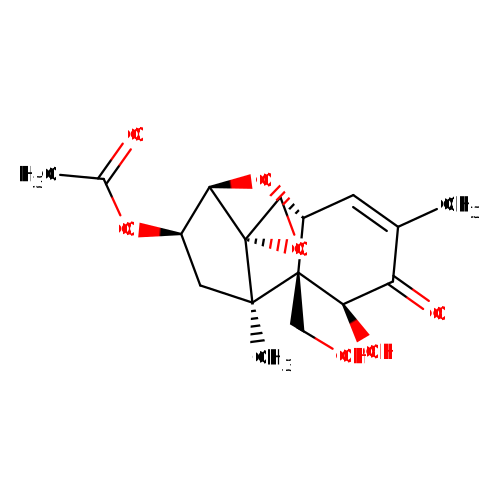
| Record Information |
|---|
| Version | 2.0 |
|---|
| Created at | 2022-06-29 19:50:33 UTC |
|---|
| Updated at | 2022-06-29 19:50:33 UTC |
|---|
| NP-MRD ID | NP0139351 |
|---|
| Secondary Accession Numbers | None |
|---|
| Natural Product Identification |
|---|
| Common Name | 3-Acetyldeoxy Nivalenol |
|---|
| Description | 3-Acetyldeoxynivalenol, also known as 15-ADON or 3-acetyl DON, belongs to the class of organic compounds known as trichothecenes. These are sesquiterpene mycotoxins structurally characterized by the presence of an epoxide ring and a benzopyran derivative with a variant number of hydroxyl, acetyl, or other substituents. The most important structural features causing the biological activities of trichothecenes are the 12,13-epoxy ring, the presence of hydroxyl or acetyl groups at appropriate positions on the trichothecene nucleus and the structure and position of the side-chain. 3-Acetyldeoxy Nivalenol is found in Fusarium culmorum and Fusarium graminearum. 3-Acetyldeoxy Nivalenol was first documented in 2001 (PMID: 11510664). Based on a literature review a significant number of articles have been published on 3-acetyldeoxynivalenol (PMID: 34199242) (PMID: 35448850) (PMID: 35051496) (PMID: 35001349) (PMID: 34666620) (PMID: 34597541). |
|---|
| Structure | [H][C@@]12O[C@]3([H])C=C(C)C(=O)[C@@H](O)[C@]3(CO)[C@@](C)(C[C@H]1OC(C)=O)[C@]21CO1 InChI=1S/C17H22O7/c1-8-4-11-16(6-18,13(21)12(8)20)15(3)5-10(23-9(2)19)14(24-11)17(15)7-22-17/h4,10-11,13-14,18,21H,5-7H2,1-3H3/t10-,11-,13-,14-,15-,16-,17+/m1/s1 |
|---|
| Synonyms | | Value | Source |
|---|
| (3alpha,7alpha)-3-(Acetyloxy)-12,13-epoxy-7,15-dihydroxytrichothec-9-en-8-one | ChEBI | | 15-ADON | ChEBI | | 3-(Acetyloxy)-12,13-epoxy-7alpha,15alpha-dihydroxytrichothec-9-en-8-one | ChEBI | | 3-Acetyl DON | ChEBI | | 3-Acetyl-deoxynivalenol | ChEBI | | 3-Acetyl-DON | ChEBI | | (3a,7a)-3-(Acetyloxy)-12,13-epoxy-7,15-dihydroxytrichothec-9-en-8-one | Generator | | (3Α,7α)-3-(acetyloxy)-12,13-epoxy-7,15-dihydroxytrichothec-9-en-8-one | Generator | | 3-(Acetyloxy)-12,13-epoxy-7a,15a-dihydroxytrichothec-9-en-8-one | Generator | | 3-(Acetyloxy)-12,13-epoxy-7α,15α-dihydroxytrichothec-9-en-8-one | Generator | | 3-ADON | MeSH | | AcetylDON | MeSH |
|
|---|
| Chemical Formula | C17H22O7 |
|---|
| Average Mass | 338.3560 Da |
|---|
| Monoisotopic Mass | 338.13655 Da |
|---|
| IUPAC Name | (1'R,2S,2'R,3'S,7'R,9'R,10'R)-3'-hydroxy-2'-(hydroxymethyl)-1',5'-dimethyl-4'-oxo-8'-oxaspiro[oxirane-2,12'-tricyclo[7.2.1.0^{2,7}]dodecan]-5'-en-10'-yl acetate |
|---|
| Traditional Name | (1'R,2S,2'R,3'S,7'R,9'R,10'R)-3'-hydroxy-2'-(hydroxymethyl)-1',5'-dimethyl-4'-oxo-8'-oxaspiro[oxirane-2,12'-tricyclo[7.2.1.0^{2,7}]dodecan]-5'-en-10'-yl acetate |
|---|
| CAS Registry Number | Not Available |
|---|
| SMILES | [H][C@@]12O[C@]3([H])C=C(C)C(=O)[C@@H](O)[C@]3(CO)[C@@](C)(C[C@H]1OC(C)=O)[C@]21CO1 |
|---|
| InChI Identifier | InChI=1S/C17H22O7/c1-8-4-11-16(6-18,13(21)12(8)20)15(3)5-10(23-9(2)19)14(24-11)17(15)7-22-17/h4,10-11,13-14,18,21H,5-7H2,1-3H3/t10-,11-,13-,14-,15-,16-,17+/m1/s1 |
|---|
| InChI Key | ADFIQZBYNGPCGY-HTJQZXIKSA-N |
|---|
| Experimental Spectra |
|---|
|
| Not Available | | Predicted Spectra |
|---|
|
| | Spectrum Type | Description | Depositor ID | Depositor Organization | Depositor | Deposition Date | View |
|---|
| 1D NMR | 13C NMR Spectrum (1D, 25 MHz, H2O, predicted) | Wishart Lab | Wishart Lab | David Wishart | 2021-06-20 | View Spectrum | | 1D NMR | 1H NMR Spectrum (1D, 100 MHz, H2O, predicted) | Wishart Lab | Wishart Lab | David Wishart | 2021-06-20 | View Spectrum | | 1D NMR | 13C NMR Spectrum (1D, 252 MHz, H2O, predicted) | Wishart Lab | Wishart Lab | David Wishart | 2021-06-20 | View Spectrum | | 1D NMR | 1H NMR Spectrum (1D, 1000 MHz, H2O, predicted) | Wishart Lab | Wishart Lab | David Wishart | 2021-06-20 | View Spectrum | | 1D NMR | 13C NMR Spectrum (1D, 50 MHz, H2O, predicted) | Wishart Lab | Wishart Lab | David Wishart | 2021-06-20 | View Spectrum | | 1D NMR | 1H NMR Spectrum (1D, 200 MHz, H2O, predicted) | Wishart Lab | Wishart Lab | David Wishart | 2021-06-20 | View Spectrum | | 1D NMR | 13C NMR Spectrum (1D, 75 MHz, H2O, predicted) | Wishart Lab | Wishart Lab | David Wishart | 2021-06-20 | View Spectrum | | 1D NMR | 1H NMR Spectrum (1D, 300 MHz, H2O, predicted) | Wishart Lab | Wishart Lab | David Wishart | 2021-06-20 | View Spectrum | | 1D NMR | 13C NMR Spectrum (1D, 101 MHz, H2O, predicted) | Wishart Lab | Wishart Lab | David Wishart | 2021-06-20 | View Spectrum | | 1D NMR | 1H NMR Spectrum (1D, 400 MHz, H2O, predicted) | Wishart Lab | Wishart Lab | David Wishart | 2021-06-20 | View Spectrum | | 1D NMR | 13C NMR Spectrum (1D, 126 MHz, H2O, predicted) | Wishart Lab | Wishart Lab | David Wishart | 2021-06-20 | View Spectrum | | 1D NMR | 1H NMR Spectrum (1D, 500 MHz, H2O, predicted) | Wishart Lab | Wishart Lab | David Wishart | 2021-06-20 | View Spectrum | | 1D NMR | 13C NMR Spectrum (1D, 151 MHz, H2O, predicted) | Wishart Lab | Wishart Lab | David Wishart | 2021-06-20 | View Spectrum | | 1D NMR | 1H NMR Spectrum (1D, 600 MHz, H2O, predicted) | Wishart Lab | Wishart Lab | David Wishart | 2021-06-20 | View Spectrum | | 1D NMR | 13C NMR Spectrum (1D, 176 MHz, H2O, predicted) | Wishart Lab | Wishart Lab | David Wishart | 2021-06-20 | View Spectrum | | 1D NMR | 1H NMR Spectrum (1D, 700 MHz, H2O, predicted) | Wishart Lab | Wishart Lab | David Wishart | 2021-06-20 | View Spectrum | | 1D NMR | 13C NMR Spectrum (1D, 201 MHz, H2O, predicted) | Wishart Lab | Wishart Lab | David Wishart | 2021-06-20 | View Spectrum | | 1D NMR | 1H NMR Spectrum (1D, 800 MHz, H2O, predicted) | Wishart Lab | Wishart Lab | David Wishart | 2021-06-20 | View Spectrum | | 1D NMR | 13C NMR Spectrum (1D, 226 MHz, H2O, predicted) | Wishart Lab | Wishart Lab | David Wishart | 2021-06-20 | View Spectrum | | 1D NMR | 1H NMR Spectrum (1D, 900 MHz, H2O, predicted) | Wishart Lab | Wishart Lab | David Wishart | 2021-06-20 | View Spectrum |
| | Chemical Shift Submissions |
|---|
|
| Not Available | | Species |
|---|
| Species of Origin | |
|---|
| Chemical Taxonomy |
|---|
| Description | Belongs to the class of organic compounds known as trichothecenes. These are sesquiterpene mycotoxins structurally characterized by the presence of an epoxide ring and a benzopyran derivative with a variant number of hydroxyl, acetyl, or other substituents. The most important structural features causing the biological activities of trichothecenes are the 12,13-epoxy ring, the presence of hydroxyl or acetyl groups at appropriate positions on the trichothecene nucleus and the structure and position of the side-chain. |
|---|
| Kingdom | Organic compounds |
|---|
| Super Class | Lipids and lipid-like molecules |
|---|
| Class | Prenol lipids |
|---|
| Sub Class | Sesquiterpenoids |
|---|
| Direct Parent | Trichothecenes |
|---|
| Alternative Parents | |
|---|
| Substituents | - Trichothecene skeleton
- Oxepane
- Cyclohexenone
- Oxane
- Carboxylic acid ester
- Ketone
- Secondary alcohol
- Cyclic ketone
- Monocarboxylic acid or derivatives
- Ether
- Oxirane
- Dialkyl ether
- Carboxylic acid derivative
- Organoheterocyclic compound
- Oxacycle
- Carbonyl group
- Primary alcohol
- Organic oxide
- Organic oxygen compound
- Organooxygen compound
- Alcohol
- Hydrocarbon derivative
- Aliphatic heteropolycyclic compound
|
|---|
| Molecular Framework | Aliphatic heteropolycyclic compounds |
|---|
| External Descriptors | Not Available |
|---|
| Physical Properties |
|---|
| State | Not Available |
|---|
| Experimental Properties | | Property | Value | Reference |
|---|
| Melting Point | Not Available | Not Available | | Boiling Point | Not Available | Not Available | | Water Solubility | Not Available | Not Available | | LogP | Not Available | Not Available |
|
|---|
| Predicted Properties | |
|---|
| General References | - Tarazona A, Gomez JV, Mateo F, Jimenez M, Mateo EM: Potential Health Risk Associated with Mycotoxins in Oat Grains Consumed in Spain. Toxins (Basel). 2021 Jun 13;13(6). pii: toxins13060421. doi: 10.3390/toxins13060421. [PubMed:34199242 ]
- Zhang D, Zhao L, Chen Y, Gao H, Hua Y, Yuan X, Yang H: Mycotoxins in Maize Silage from China in 2019. Toxins (Basel). 2022 Mar 27;14(4). pii: toxins14040241. doi: 10.3390/toxins14040241. [PubMed:35448850 ]
- Hu Y, Li H, Min J, Yu Y, Liu W, Huang JW, Zhang L, Yang Y, Dai L, Chen CC, Guo RT: Crystal structure and biochemical analysis of the specialized deoxynivalenol-detoxifying glyoxalase SPG from Gossypium hirsutum. Int J Biol Macromol. 2022 Mar 1;200:388-396. doi: 10.1016/j.ijbiomac.2022.01.055. Epub 2022 Jan 18. [PubMed:35051496 ]
- de Arruda MHM, Schwab EDP, Zchonski FL, da Cruz JF, Tessmann DJ, Da-Silva PR: Production of type-B trichothecenes by Fusarium meridionale, F. graminearum, and F. austroamericanum in wheat plants and rice medium. Mycotoxin Res. 2022 Feb;38(1):1-11. doi: 10.1007/s12550-021-00445-9. Epub 2022 Jan 10. [PubMed:35001349 ]
- Liang J, Ning M, Guan S, Fang L, Chen X, Dong Z, Fan L: Risk assessment of multiple-mycotoxin exposure for consumers of chestnuts in Shandong Province markets in China. Food Addit Contam Part A Chem Anal Control Expo Risk Assess. 2021 Dec;38(12):2137-2150. doi: 10.1080/19440049.2021.1970240. Epub 2021 Oct 19. [PubMed:34666620 ]
- Goessens T, De Baere S, Deknock A, De Troyer N, Van Leeuwenberg R, Martel A, Pasmans F, Goethals P, Lens L, Spanoghe P, Vanhaecke L, Croubels S: Agricultural contaminants in amphibian breeding ponds: Occurrence, risk and correlation with agricultural land use. Sci Total Environ. 2022 Feb 1;806(Pt 2):150661. doi: 10.1016/j.scitotenv.2021.150661. Epub 2021 Sep 29. [PubMed:34597541 ]
- Arce-Lopez B, Alvarez-Erviti L, De Santis B, Izco M, Lopez-Calvo S, Marzo-Sola ME, Debegnach F, Lizarraga E, Lopez de Cerain A, Gonzalez-Penas E, Vettorazzi A: Biomonitoring of Mycotoxins in Plasma of Patients with Alzheimer's and Parkinson's Disease. Toxins (Basel). 2021 Jul 10;13(7):477. doi: 10.3390/toxins13070477. [PubMed:34357949 ]
- Alonso-Jauregui M, Gonzalez-Penas E, Lopez de Cerain A, Vettorazzi A: Genotoxicity of 12 Mycotoxins by the SOS/umu Test: Comparison of Liver and Kidney S9 Fraction. Toxins (Basel). 2022 Jun 10;14(6):400. doi: 10.3390/toxins14060400. [PubMed:35737061 ]
- Kudupoje MB, Malathi V, Yiannikouris A: Impact of a Natural Fusarial Multi-Mycotoxin Challenge on Broiler Chickens and Mitigation Properties Provided by a Yeast Cell Wall Extract and a Postbiotic Yeast Cell Wall-Based Blend. Toxins (Basel). 2022 Apr 28;14(5):315. doi: 10.3390/toxins14050315. [PubMed:35622561 ]
- Jia H, Zhang T, Liu N, Si X, Bai J, Yang Y, Chen Z, Wu Z: 4-Phenylbutyric acid alleviates 3-acetyldeoxynivalenol-induced immune cells response by inhibiting endoplasmic reticulum stress in mouse spleen. Food Chem Toxicol. 2022 Jun;164:113002. doi: 10.1016/j.fct.2022.113002. Epub 2022 Apr 9. [PubMed:35413383 ]
- Tretiakova P, Voegele RT, Soloviev A, Link TI: Successful Silencing of the Mycotoxin Synthesis Gene TRI5 in Fusarium culmorum and Observation of Reduced Virulence in VIGS and SIGS Experiments. Genes (Basel). 2022 Feb 23;13(3):395. doi: 10.3390/genes13030395. [PubMed:35327949 ]
- Pack ED, Weiland S, Musser R, Schmale DG: Survey of zearalenone and type-B trichothecene mycotoxins in swine feed in the USA. Mycotoxin Res. 2021 Nov;37(4):297-313. doi: 10.1007/s12550-021-00442-y. Epub 2021 Sep 18. [PubMed:34537950 ]
- Wang SS, Cui H, Chen MZ, Li L, Wu Y, Wang SX: Simultaneous quantitation of 3ADON and 15ADON chemotypes of DON-producing Fusarium species in Chinese wheat based on duplex droplet digital PCR assay. J Microbiol Methods. 2021 Nov;190:106319. doi: 10.1016/j.mimet.2021.106319. Epub 2021 Sep 2. [PubMed:34480973 ]
- Jorquera-Pereira D, Pavon-Perez J, Rios-Gajardo G: Identification of type B trichothecenes and zearalenone in Chilean cereals by planar chromatography coupled to mass spectroscopy. Food Addit Contam Part A Chem Anal Control Expo Risk Assess. 2021 Oct;38(10):1778-1787. doi: 10.1080/19440049.2021.1948618. Epub 2021 Jul 13. [PubMed:34254899 ]
- Zhu T, Li L, Petridis A, Xydis G, Ren M: First Report of Fusarium asiaticum Causing Stem Rot of Ligusticum chuanxiong in China. Plant Dis. 2021 Jul 2. doi: 10.1094/PDIS-05-21-1026-PDN. [PubMed:34213965 ]
- Jia H, Liu N, Zhang Y, Wang C, Yang Y, Wu Z: 3-Acetyldeoxynivalenol induces cell death through endoplasmic reticulum stress in mouse liver. Environ Pollut. 2021 Oct 1;286:117238. doi: 10.1016/j.envpol.2021.117238. Epub 2021 Apr 27. [PubMed:33984781 ]
- Xu F, Liu W, Song Y, Zhou Y, Xu X, Yang G, Wang J, Zhang J, Liu L: The Distribution of Fusarium graminearum and Fusarium asiaticum Causing Fusarium Head Blight of Wheat in Relation to Climate and Cropping System. Plant Dis. 2021 Oct;105(10):2830-2835. doi: 10.1094/PDIS-01-21-0013-RE. Epub 2021 Nov 1. [PubMed:33881919 ]
- Dong F, Li Y, Chen X, Wu J, Wang S, Zhang X, Ma G, Lee YW, Mokoena MP, Olaniran AO, Xu JH, Shi JR: Analysis of the Fusarium graminearum Species Complex from Gramineous Weeds Near Wheat Fields in Jiangsu Province, China. Plant Dis. 2021 Oct;105(10):3269-3275. doi: 10.1094/PDIS-11-20-2376-RE. Epub 2021 Nov 9. [PubMed:33847508 ]
- Niknejad F, Escriva L, Adel Rad KB, Khoshnia M, Barba FJ, Berrada H: Biomonitoring of Multiple Mycotoxins in Urine by GC-MS/MS: A Pilot Study on Patients with Esophageal Cancer in Golestan Province, Northeastern Iran. Toxins (Basel). 2021 Mar 29;13(4):243. doi: 10.3390/toxins13040243. [PubMed:33805401 ]
- Arce-Lopez B, Lizarraga E, Lopez de Mesa R, Gonzalez-Penas E: Assessment of Exposure to Mycotoxins in Spanish Children through the Analysis of Their Levels in Plasma Samples. Toxins (Basel). 2021 Feb 15;13(2):150. doi: 10.3390/toxins13020150. [PubMed:33672088 ]
- Abramson D, Clear RM, Gaba D, Smith DM, Patrick SK, Saydak D: Trichothecene and moniliformin production by Fusarium species from western Canadian wheat. J Food Prot. 2001 Aug;64(8):1220-5. doi: 10.4315/0362-028x-64.8.1220. [PubMed:11510664 ]
- Eriksen GS, Pettersson H, Lindberg JE: Absorption, metabolism and excretion of 3-acetyl DON in pigs. Arch Tierernahr. 2003 Oct;57(5):335-45. doi: 10.1080/00039420310001607699. [PubMed:14620907 ]
- Bretz M, Beyer M, Cramer B, Humpf HU: Stable isotope dilution analysis of the Fusarium mycotoxins deoxynivalenol and 3-acetyldeoxynivalenol. Mol Nutr Food Res. 2006 Mar;50(3):251-60. doi: 10.1002/mnfr.200500230. [PubMed:16521158 ]
- Vujanovic V, Goh YK: Sphaerodes mycoparasitica biotrophic mycoparasite of 3-acetyldeoxynivalenol- and 15-acetyldeoxynivalenol-producing toxigenic Fusarium graminearum chemotypes. FEMS Microbiol Lett. 2011 Mar;316(2):136-43. doi: 10.1111/j.1574-6968.2010.02201.x. Epub 2011 Jan 19. [PubMed:21204935 ]
- Amarasinghe C, Wang JH, Liao YC, Fernando WG: Difference in TRI13 gene sequences between the 3-acetyldeoxynivalenol producing Fusarium graminearum chemotypes from Canada and China. Int J Mol Sci. 2011;12(9):6164-75. doi: 10.3390/ijms12096164. Epub 2011 Sep 20. [PubMed:22016651 ]
|
|---|