| Record Information |
|---|
| Version | 2.0 |
|---|
| Created at | 2022-06-29 19:45:40 UTC |
|---|
| Updated at | 2022-06-29 19:45:41 UTC |
|---|
| NP-MRD ID | NP0139243 |
|---|
| Secondary Accession Numbers | None |
|---|
| Natural Product Identification |
|---|
| Common Name | Undulatoside A |
|---|
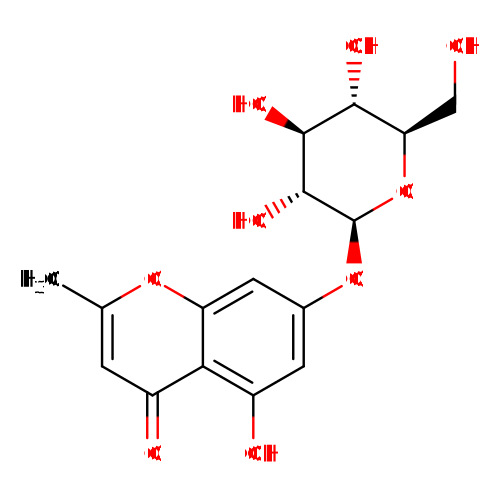
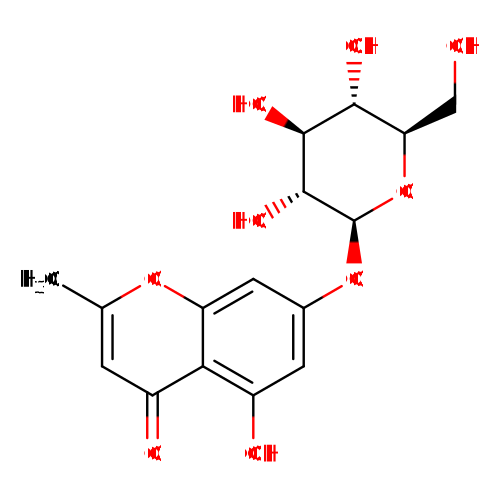
| Description | Undulatoside A belongs to the class of organic compounds known as phenolic glycosides. These are organic compounds containing a phenolic structure attached to a glycosyl moiety. Some examples of phenolic structures include lignans, and flavonoids. Among the sugar units found in natural glycosides are D-glucose, L-Fructose, and L rhamnose. Undulatoside A is found in Camellia sinensis, Helichrysum arenarium and Sinoadina racemosa. Undulatoside A was first documented in 2006 (PMID: 17135054). Based on a literature review a significant number of articles have been published on Undulatoside A (PMID: 20708173) (PMID: 22932311) (PMID: 34738433) (PMID: 35807260) (PMID: 32364737) (PMID: 28882671). |
|---|
| Structure | CC1=CC(=O)C2=C(O)C=C(O[C@@H]3O[C@H](CO)[C@@H](O)[C@H](O)[C@H]3O)C=C2O1 InChI=1S/C16H18O9/c1-6-2-8(18)12-9(19)3-7(4-10(12)23-6)24-16-15(22)14(21)13(20)11(5-17)25-16/h2-4,11,13-17,19-22H,5H2,1H3/t11-,13-,14+,15-,16-/m1/s1 |
|---|
| Synonyms | Not Available |
|---|
| Chemical Formula | C16H18O9 |
|---|
| Average Mass | 354.3110 Da |
|---|
| Monoisotopic Mass | 354.09508 Da |
|---|
| IUPAC Name | Not Available |
|---|
| Traditional Name | Not Available |
|---|
| CAS Registry Number | Not Available |
|---|
| SMILES | CC1=CC(=O)C2=C(O)C=C(O[C@@H]3O[C@H](CO)[C@@H](O)[C@H](O)[C@H]3O)C=C2O1 |
|---|
| InChI Identifier | InChI=1S/C16H18O9/c1-6-2-8(18)12-9(19)3-7(4-10(12)23-6)24-16-15(22)14(21)13(20)11(5-17)25-16/h2-4,11,13-17,19-22H,5H2,1H3/t11-,13-,14+,15-,16-/m1/s1 |
|---|
| InChI Key | BYYDEEAJCDGLER-YMILTQATSA-N |
|---|
| Experimental Spectra |
|---|
|
| Not Available | | Predicted Spectra |
|---|
|
| | Spectrum Type | Description | Depositor ID | Depositor Organization | Depositor | Deposition Date | View |
|---|
| 1D NMR | 13C NMR Spectrum (1D, 25 MHz, H2O, predicted) | Wishart Lab | Wishart Lab | David Wishart | 2021-06-20 | View Spectrum | | 1D NMR | 1H NMR Spectrum (1D, 100 MHz, H2O, predicted) | Wishart Lab | Wishart Lab | David Wishart | 2021-06-20 | View Spectrum | | 1D NMR | 13C NMR Spectrum (1D, 252 MHz, H2O, predicted) | Wishart Lab | Wishart Lab | David Wishart | 2021-06-20 | View Spectrum | | 1D NMR | 1H NMR Spectrum (1D, 1000 MHz, H2O, predicted) | Wishart Lab | Wishart Lab | David Wishart | 2021-06-20 | View Spectrum | | 1D NMR | 13C NMR Spectrum (1D, 50 MHz, H2O, predicted) | Wishart Lab | Wishart Lab | David Wishart | 2021-06-20 | View Spectrum | | 1D NMR | 1H NMR Spectrum (1D, 200 MHz, H2O, predicted) | Wishart Lab | Wishart Lab | David Wishart | 2021-06-20 | View Spectrum | | 1D NMR | 13C NMR Spectrum (1D, 75 MHz, H2O, predicted) | Wishart Lab | Wishart Lab | David Wishart | 2021-06-20 | View Spectrum | | 1D NMR | 1H NMR Spectrum (1D, 300 MHz, H2O, predicted) | Wishart Lab | Wishart Lab | David Wishart | 2021-06-20 | View Spectrum | | 1D NMR | 13C NMR Spectrum (1D, 101 MHz, H2O, predicted) | Wishart Lab | Wishart Lab | David Wishart | 2021-06-20 | View Spectrum | | 1D NMR | 1H NMR Spectrum (1D, 400 MHz, H2O, predicted) | Wishart Lab | Wishart Lab | David Wishart | 2021-06-20 | View Spectrum | | 1D NMR | 13C NMR Spectrum (1D, 126 MHz, H2O, predicted) | Wishart Lab | Wishart Lab | David Wishart | 2021-06-20 | View Spectrum | | 1D NMR | 1H NMR Spectrum (1D, 500 MHz, H2O, predicted) | Wishart Lab | Wishart Lab | David Wishart | 2021-06-20 | View Spectrum | | 1D NMR | 13C NMR Spectrum (1D, 151 MHz, H2O, predicted) | Wishart Lab | Wishart Lab | David Wishart | 2021-06-20 | View Spectrum | | 1D NMR | 1H NMR Spectrum (1D, 600 MHz, H2O, predicted) | Wishart Lab | Wishart Lab | David Wishart | 2021-06-20 | View Spectrum | | 1D NMR | 13C NMR Spectrum (1D, 176 MHz, H2O, predicted) | Wishart Lab | Wishart Lab | David Wishart | 2021-06-20 | View Spectrum | | 1D NMR | 1H NMR Spectrum (1D, 700 MHz, H2O, predicted) | Wishart Lab | Wishart Lab | David Wishart | 2021-06-20 | View Spectrum | | 1D NMR | 13C NMR Spectrum (1D, 201 MHz, H2O, predicted) | Wishart Lab | Wishart Lab | David Wishart | 2021-06-20 | View Spectrum | | 1D NMR | 1H NMR Spectrum (1D, 800 MHz, H2O, predicted) | Wishart Lab | Wishart Lab | David Wishart | 2021-06-20 | View Spectrum | | 1D NMR | 13C NMR Spectrum (1D, 226 MHz, H2O, predicted) | Wishart Lab | Wishart Lab | David Wishart | 2021-06-20 | View Spectrum | | 1D NMR | 1H NMR Spectrum (1D, 900 MHz, H2O, predicted) | Wishart Lab | Wishart Lab | David Wishart | 2021-06-20 | View Spectrum |
| | Chemical Shift Submissions |
|---|
|
| Not Available | | Species |
|---|
| Species of Origin | |
|---|
| Chemical Taxonomy |
|---|
| Description | Belongs to the class of organic compounds known as phenolic glycosides. These are organic compounds containing a phenolic structure attached to a glycosyl moiety. Some examples of phenolic structures include lignans, and flavonoids. Among the sugar units found in natural glycosides are D-glucose, L-Fructose, and L rhamnose. |
|---|
| Kingdom | Organic compounds |
|---|
| Super Class | Organic oxygen compounds |
|---|
| Class | Organooxygen compounds |
|---|
| Sub Class | Carbohydrates and carbohydrate conjugates |
|---|
| Direct Parent | Phenolic glycosides |
|---|
| Alternative Parents | |
|---|
| Substituents | - Phenolic glycoside
- Hexose monosaccharide
- Chromone
- O-glycosyl compound
- Benzopyran
- 1-benzopyran
- 1-hydroxy-4-unsubstituted benzenoid
- 1-hydroxy-2-unsubstituted benzenoid
- Pyranone
- Monosaccharide
- Oxane
- Pyran
- Benzenoid
- Heteroaromatic compound
- Vinylogous acid
- Secondary alcohol
- Organoheterocyclic compound
- Polyol
- Oxacycle
- Acetal
- Primary alcohol
- Alcohol
- Hydrocarbon derivative
- Organic oxide
- Aromatic heteropolycyclic compound
|
|---|
| Molecular Framework | Aromatic heteropolycyclic compounds |
|---|
| External Descriptors | Not Available |
|---|
| Physical Properties |
|---|
| State | Not Available |
|---|
| Experimental Properties | | Property | Value | Reference |
|---|
| Melting Point | Not Available | Not Available | | Boiling Point | Not Available | Not Available | | Water Solubility | Not Available | Not Available | | LogP | Not Available | Not Available |
|
|---|
| Predicted Properties | |
|---|
| General References | - Hakki Z, Cao B, Heskes AM, Goodger JQ, Woodrow IE, Williams SJ: Synthesis of the monoterpenoid esters cypellocarpin C and cuniloside B and evidence for their widespread occurrence in Eucalyptus. Carbohydr Res. 2010 Sep 23;345(14):2079-84. doi: 10.1016/j.carres.2010.07.029. Epub 2010 Jul 21. [PubMed:20708173 ]
- Kim SB, Ahn JH, Han SB, Hwang BY, Kim SY, Lee MK: Anti-adipogenic chromone glycosides from Cnidium monnieri fruits in 3T3-L1 cells. Bioorg Med Chem Lett. 2012 Oct 1;22(19):6267-71. doi: 10.1016/j.bmcl.2012.07.103. Epub 2012 Aug 8. [PubMed:22932311 ]
- Duan ZW, Zhang J, Chen XJ, Pang X, Ma BP: [Non-alkaloid constituents of Hymenocallis littoralis]. Zhongguo Zhong Yao Za Zhi. 2021 Oct;46(20):5304-5309. doi: 10.19540/j.cnki.cjcmm.20210610.320. [PubMed:34738433 ]
- Rahayu I, Timotius KH: Phytochemical Analysis, Antimutagenic and Antiviral Activity of Moringa oleifera L. Leaf Infusion: In Vitro and In Silico Studies. Molecules. 2022 Jun 22;27(13):4017. doi: 10.3390/molecules27134017. [PubMed:35807260 ]
- Pereira LCO, Abreu LS, Silva JPRE, Machado FSVL, Queiroga CS, do Espi Rito-Santo RF, Agnelo-Silva DF, Villarreal CF, Agra MF, Scotti MT, Costa VCO, Tavares JF, Silva MSD: Bioactive Compounds from the Aerial Parts of Evolvulus linarioides. J Nat Prod. 2020 May 22;83(5):1515-1523. doi: 10.1021/acs.jnatprod.9b01189. Epub 2020 May 4. [PubMed:32364737 ]
- Yu J, Song X, Wang D, Wang X, Wang X: Five new chromone glycosides from Scindapsus officinalis (Roxb.) Schott. Fitoterapia. 2017 Oct;122:101-106. doi: 10.1016/j.fitote.2017.09.002. Epub 2017 Sep 4. [PubMed:28882671 ]
- Peng B, Bai RF, Li P, Han XY, Wang H, Zhu CC, Zeng ZP, Chai XY: Two new glycosides from Dryopteris fragrans with anti-inflammatory activities. J Asian Nat Prod Res. 2016;18(1):59-64. doi: 10.1080/10286020.2015.1121853. Epub 2015 Dec 24. [PubMed:26700189 ]
- Wang YB, Huang R, Zhang HB, Li L: Chromone glycosides from Knoxia corymbosa. J Asian Nat Prod Res. 2006 Oct-Nov;8(7):663-70. doi: 10.1080/10286020500246303. [PubMed:17135054 ]
|
|---|