| Record Information |
|---|
| Version | 2.0 |
|---|
| Created at | 2022-06-29 17:39:41 UTC |
|---|
| Updated at | 2022-06-29 17:39:41 UTC |
|---|
| NP-MRD ID | NP0138658 |
|---|
| Secondary Accession Numbers | None |
|---|
| Natural Product Identification |
|---|
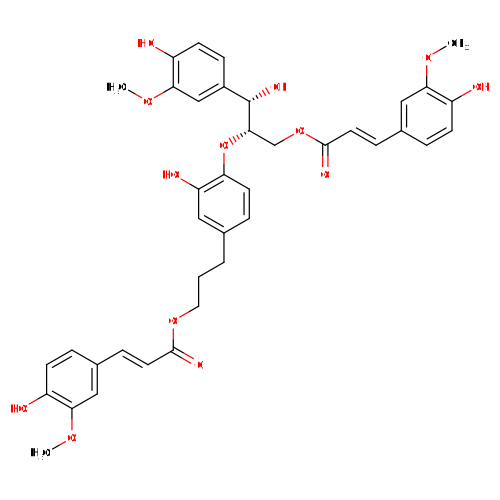
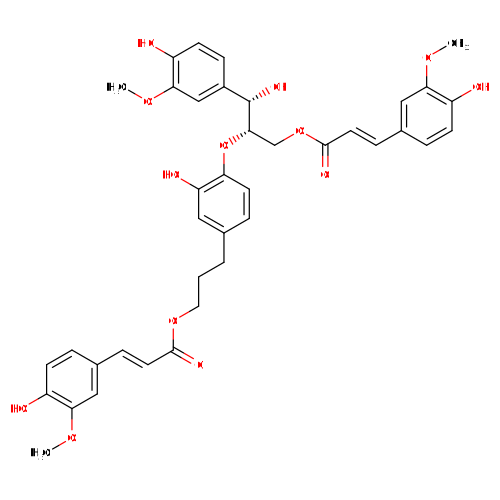
| Common Name | Demethylcarolignan E |
|---|
| Description | Demethylcarolignan E belongs to the class of organic compounds known as lignans, neolignans and related compounds. These are plant products of low molecular weight formed primarily from oxidative coupling of two p-propylphenol moieties. They can also be described as micromolecules with two phenylpropanoid units coupled together. They can be attached in various manners, like C5-C5', C8-C8'. Most known natural lignans are oxidized at C9 and C9´ and, based upon the way in which oxygen is incorporated into the skeleton and on the cyclization patterns, a wide range of lignans of very different structural types can be formed. Demethylcarolignan E is found in Abelmoschus ficulneus and Hibiscus taiwanensis. Demethylcarolignan E was first documented in 2004 (PMID: 15080919). Based on a literature review very few articles have been published on Demethylcarolignan E. |
|---|
| Structure | COC1=C(O)C=CC(\C=C\C(=O)OCCCC2=CC(O)=C(O[C@@H](COC(=O)\C=C\C3=CC(OC)=C(O)C=C3)[C@@H](O)C3=CC(OC)=C(O)C=C3)C=C2)=C1 InChI=1S/C39H40O13/c1-47-33-20-25(6-12-28(33)40)9-16-37(44)50-18-4-5-24-8-15-32(31(43)19-24)52-36(39(46)27-11-14-30(42)35(22-27)49-3)23-51-38(45)17-10-26-7-13-29(41)34(21-26)48-2/h6-17,19-22,36,39-43,46H,4-5,18,23H2,1-3H3/b16-9+,17-10+/t36-,39-/m0/s1 |
|---|
| Synonyms | Not Available |
|---|
| Chemical Formula | C39H40O13 |
|---|
| Average Mass | 716.7360 Da |
|---|
| Monoisotopic Mass | 716.24689 Da |
|---|
| IUPAC Name | Not Available |
|---|
| Traditional Name | Not Available |
|---|
| CAS Registry Number | 873694-46-3 |
|---|
| SMILES | COC1=C(O)C=CC(\C=C\C(=O)OCCCC2=CC(O)=C(O[C@@H](COC(=O)\C=C\C3=CC(OC)=C(O)C=C3)[C@@H](O)C3=CC(OC)=C(O)C=C3)C=C2)=C1 |
|---|
| InChI Identifier | InChI=1S/C39H40O13/c1-47-33-20-25(6-12-28(33)40)9-16-37(44)50-18-4-5-24-8-15-32(31(43)19-24)52-36(39(46)27-11-14-30(42)35(22-27)49-3)23-51-38(45)17-10-26-7-13-29(41)34(21-26)48-2/h6-17,19-22,36,39-43,46H,4-5,18,23H2,1-3H3/b16-9+,17-10+/t36-,39-/m0/s1 |
|---|
| InChI Key | GSGRJWMOIKUHLN-DZOJLRKVSA-N |
|---|
| Experimental Spectra |
|---|
|
| Not Available | | Predicted Spectra |
|---|
|
| | Spectrum Type | Description | Depositor ID | Depositor Organization | Depositor | Deposition Date | View |
|---|
| 1D NMR | 13C NMR Spectrum (1D, 25 MHz, H2O, predicted) | Wishart Lab | Wishart Lab | David Wishart | 2021-06-20 | View Spectrum | | 1D NMR | 1H NMR Spectrum (1D, 100 MHz, H2O, predicted) | Wishart Lab | Wishart Lab | David Wishart | 2021-06-20 | View Spectrum | | 1D NMR | 13C NMR Spectrum (1D, 252 MHz, H2O, predicted) | Wishart Lab | Wishart Lab | David Wishart | 2021-06-20 | View Spectrum | | 1D NMR | 1H NMR Spectrum (1D, 1000 MHz, H2O, predicted) | Wishart Lab | Wishart Lab | David Wishart | 2021-06-20 | View Spectrum | | 1D NMR | 13C NMR Spectrum (1D, 50 MHz, H2O, predicted) | Wishart Lab | Wishart Lab | David Wishart | 2021-06-20 | View Spectrum | | 1D NMR | 1H NMR Spectrum (1D, 200 MHz, H2O, predicted) | Wishart Lab | Wishart Lab | David Wishart | 2021-06-20 | View Spectrum | | 1D NMR | 13C NMR Spectrum (1D, 75 MHz, H2O, predicted) | Wishart Lab | Wishart Lab | David Wishart | 2021-06-20 | View Spectrum | | 1D NMR | 1H NMR Spectrum (1D, 300 MHz, H2O, predicted) | Wishart Lab | Wishart Lab | David Wishart | 2021-06-20 | View Spectrum | | 1D NMR | 13C NMR Spectrum (1D, 101 MHz, H2O, predicted) | Wishart Lab | Wishart Lab | David Wishart | 2021-06-20 | View Spectrum | | 1D NMR | 1H NMR Spectrum (1D, 400 MHz, H2O, predicted) | Wishart Lab | Wishart Lab | David Wishart | 2021-06-20 | View Spectrum | | 1D NMR | 13C NMR Spectrum (1D, 126 MHz, H2O, predicted) | Wishart Lab | Wishart Lab | David Wishart | 2021-06-20 | View Spectrum | | 1D NMR | 1H NMR Spectrum (1D, 500 MHz, H2O, predicted) | Wishart Lab | Wishart Lab | David Wishart | 2021-06-20 | View Spectrum | | 1D NMR | 13C NMR Spectrum (1D, 151 MHz, H2O, predicted) | Wishart Lab | Wishart Lab | David Wishart | 2021-06-20 | View Spectrum | | 1D NMR | 1H NMR Spectrum (1D, 600 MHz, H2O, predicted) | Wishart Lab | Wishart Lab | David Wishart | 2021-06-20 | View Spectrum | | 1D NMR | 13C NMR Spectrum (1D, 176 MHz, H2O, predicted) | Wishart Lab | Wishart Lab | David Wishart | 2021-06-20 | View Spectrum | | 1D NMR | 1H NMR Spectrum (1D, 700 MHz, H2O, predicted) | Wishart Lab | Wishart Lab | David Wishart | 2021-06-20 | View Spectrum | | 1D NMR | 13C NMR Spectrum (1D, 201 MHz, H2O, predicted) | Wishart Lab | Wishart Lab | David Wishart | 2021-06-20 | View Spectrum | | 1D NMR | 1H NMR Spectrum (1D, 800 MHz, H2O, predicted) | Wishart Lab | Wishart Lab | David Wishart | 2021-06-20 | View Spectrum | | 1D NMR | 13C NMR Spectrum (1D, 226 MHz, H2O, predicted) | Wishart Lab | Wishart Lab | David Wishart | 2021-06-20 | View Spectrum | | 1D NMR | 1H NMR Spectrum (1D, 900 MHz, H2O, predicted) | Wishart Lab | Wishart Lab | David Wishart | 2021-06-20 | View Spectrum |
| | Chemical Shift Submissions |
|---|
|
| Not Available | | Species |
|---|
| Species of Origin | |
|---|
| Chemical Taxonomy |
|---|
| Description | Belongs to the class of organic compounds known as lignans, neolignans and related compounds. These are plant products of low molecular weight formed primarily from oxidative coupling of two p-propylphenol moieties. They can also be described as micromolecules with two phenylpropanoid units coupled together. They can be attached in various manners, like C5-C5', C8-C8'. Most known natural lignans are oxidized at C9 and C9´ and, based upon the way in which oxygen is incorporated into the skeleton and on the cyclization patterns, a wide range of lignans of very different structural types can be formed. |
|---|
| Kingdom | Organic compounds |
|---|
| Super Class | Lignans, neolignans and related compounds |
|---|
| Class | Not Available |
|---|
| Sub Class | Not Available |
|---|
| Direct Parent | Lignans, neolignans and related compounds |
|---|
| Alternative Parents | |
|---|
| Substituents | - Norlignan skeleton
- Neolignan skeleton
- Hydroxycinnamic acid or derivatives
- Cinnamic acid or derivatives
- Coumaric acid or derivatives
- Cinnamic acid ester
- Methoxyphenol
- Phenoxy compound
- Anisole
- Methoxybenzene
- Phenol ether
- Styrene
- 1-hydroxy-4-unsubstituted benzenoid
- 1-hydroxy-2-unsubstituted benzenoid
- Alkyl aryl ether
- Phenol
- Fatty acid ester
- Monocyclic benzene moiety
- Fatty acyl
- Benzenoid
- Dicarboxylic acid or derivatives
- Alpha,beta-unsaturated carboxylic ester
- Enoate ester
- Carboxylic acid ester
- Secondary alcohol
- Ether
- Carboxylic acid derivative
- Aromatic alcohol
- Organic oxygen compound
- Alcohol
- Carbonyl group
- Hydrocarbon derivative
- Organic oxide
- Organooxygen compound
- Aromatic homomonocyclic compound
|
|---|
| Molecular Framework | Aromatic homomonocyclic compounds |
|---|
| External Descriptors | Not Available |
|---|
| Physical Properties |
|---|
| State | Not Available |
|---|
| Experimental Properties | | Property | Value | Reference |
|---|
| Melting Point | Not Available | Not Available | | Boiling Point | Not Available | Not Available | | Water Solubility | Not Available | Not Available | | LogP | Not Available | Not Available |
|
|---|
| Predicted Properties | |
|---|