| Record Information |
|---|
| Version | 2.0 |
|---|
| Created at | 2022-06-29 17:28:38 UTC |
|---|
| Updated at | 2022-06-29 17:28:38 UTC |
|---|
| NP-MRD ID | NP0138419 |
|---|
| Secondary Accession Numbers | None |
|---|
| Natural Product Identification |
|---|
| Common Name | Myricetin 3,4'-di-O-beta-glucopyranoside |
|---|
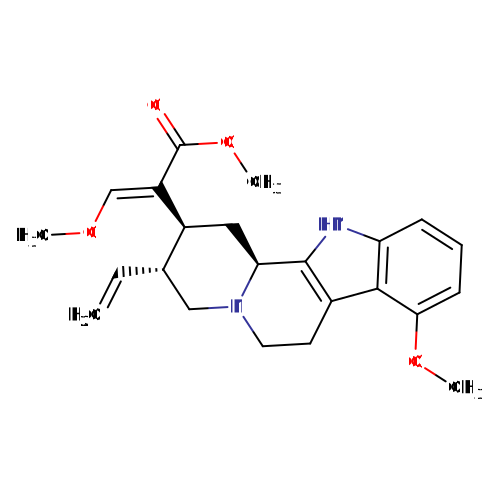
| Description | Paynantheine belongs to the class of organic compounds known as corynanthean-type alkaloids. These are alkaloids with a structure based on the corynanthean nucleus, which is a tetracycle characterized by an indole fused to a quinolizidine. Additionally, the quinolizidine ring system is substituted to a 2-methylpropyl group and one ethyl group. Myricetin 3,4'-di-O-beta-glucopyranoside is found in Picea abies. Myricetin 3,4'-di-O-beta-glucopyranoside was first documented in 2021 (PMID: 34803709). Based on a literature review a small amount of articles have been published on Paynantheine (PMID: 35472200) (PMID: 35468648) (PMID: 35335999). |
|---|
| Structure | CO\C=C(/[C@H]1C[C@@H]2N(CCC3=C2NC2=CC=CC(OC)=C32)C[C@@H]1C=C)C(=O)OC InChI=1S/C23H28N2O4/c1-5-14-12-25-10-9-15-21-18(7-6-8-20(21)28-3)24-22(15)19(25)11-16(14)17(13-27-2)23(26)29-4/h5-8,13-14,16,19,24H,1,9-12H2,2-4H3/b17-13+/t14-,16-,19-/m0/s1 |
|---|
| Synonyms | Not Available |
|---|
| Chemical Formula | C27H30O18 |
|---|
| Average Mass | 642.5190 Da |
|---|
| Monoisotopic Mass | 642.14321 Da |
|---|
| IUPAC Name | methyl (2E)-2-[(2S,4S,5R)-5-ethenyl-12-methoxy-7,17-diazatetracyclo[8.7.0.0^{2,7}.0^{11,16}]heptadeca-1(10),11,13,15-tetraen-4-yl]-3-methoxyprop-2-enoate |
|---|
| Traditional Name | methyl (2E)-2-[(2S,4S,5R)-5-ethenyl-12-methoxy-7,17-diazatetracyclo[8.7.0.0^{2,7}.0^{11,16}]heptadeca-1(10),11,13,15-tetraen-4-yl]-3-methoxyprop-2-enoate |
|---|
| CAS Registry Number | 146501-37-3 |
|---|
| SMILES | OC[C@H]1O[C@@H](OC2=C(O)C=C(C=C2O)C2=C(O[C@@H]3O[C@H](CO)[C@@H](O)[C@H](O)[C@H]3O)C(=O)C3=C(O)C=C(O)C=C3O2)[C@H](O)[C@@H](O)[C@@H]1O |
|---|
| InChI Identifier | InChI=1S/C27H30O18/c28-5-13-16(34)19(37)21(39)26(42-13)44-24-10(32)1-7(2-11(24)33)23-25(18(36)15-9(31)3-8(30)4-12(15)41-23)45-27-22(40)20(38)17(35)14(6-29)43-27/h1-4,13-14,16-17,19-22,26-35,37-40H,5-6H2/t13-,14-,16-,17-,19+,20+,21-,22-,26+,27+/m1/s1 |
|---|
| InChI Key | LLVOJEYSNCNXJN-XUAXIHHBSA-N |
|---|
| Experimental Spectra |
|---|
|
| Not Available | | Predicted Spectra |
|---|
|
| | Spectrum Type | Description | Depositor ID | Depositor Organization | Depositor | Deposition Date | View |
|---|
| 1D NMR | 13C NMR Spectrum (1D, 25 MHz, D2O, predicted) | Wishart Lab | Wishart Lab | David Wishart | 2021-06-20 | View Spectrum | | 1D NMR | 1H NMR Spectrum (1D, 100 MHz, D2O, predicted) | Wishart Lab | Wishart Lab | David Wishart | 2021-06-20 | View Spectrum | | 1D NMR | 13C NMR Spectrum (1D, 252 MHz, D2O, predicted) | Wishart Lab | Wishart Lab | David Wishart | 2021-06-20 | View Spectrum | | 1D NMR | 1H NMR Spectrum (1D, 1000 MHz, D2O, predicted) | Wishart Lab | Wishart Lab | David Wishart | 2021-06-20 | View Spectrum | | 1D NMR | 13C NMR Spectrum (1D, 50 MHz, D2O, predicted) | Wishart Lab | Wishart Lab | David Wishart | 2021-06-20 | View Spectrum | | 1D NMR | 1H NMR Spectrum (1D, 200 MHz, D2O, predicted) | Wishart Lab | Wishart Lab | David Wishart | 2021-06-20 | View Spectrum | | 1D NMR | 13C NMR Spectrum (1D, 75 MHz, D2O, predicted) | Wishart Lab | Wishart Lab | David Wishart | 2021-06-20 | View Spectrum | | 1D NMR | 1H NMR Spectrum (1D, 300 MHz, D2O, predicted) | Wishart Lab | Wishart Lab | David Wishart | 2021-06-20 | View Spectrum | | 1D NMR | 13C NMR Spectrum (1D, 101 MHz, D2O, predicted) | Wishart Lab | Wishart Lab | David Wishart | 2021-06-20 | View Spectrum | | 1D NMR | 1H NMR Spectrum (1D, 400 MHz, D2O, predicted) | Wishart Lab | Wishart Lab | David Wishart | 2021-06-20 | View Spectrum | | 1D NMR | 13C NMR Spectrum (1D, 126 MHz, D2O, predicted) | Wishart Lab | Wishart Lab | David Wishart | 2021-06-20 | View Spectrum | | 1D NMR | 1H NMR Spectrum (1D, 500 MHz, D2O, predicted) | Wishart Lab | Wishart Lab | David Wishart | 2021-06-20 | View Spectrum | | 1D NMR | 13C NMR Spectrum (1D, 151 MHz, D2O, predicted) | Wishart Lab | Wishart Lab | David Wishart | 2021-06-20 | View Spectrum | | 1D NMR | 1H NMR Spectrum (1D, 600 MHz, D2O, predicted) | Wishart Lab | Wishart Lab | David Wishart | 2021-06-20 | View Spectrum | | 1D NMR | 13C NMR Spectrum (1D, 176 MHz, D2O, predicted) | Wishart Lab | Wishart Lab | David Wishart | 2021-06-20 | View Spectrum | | 1D NMR | 1H NMR Spectrum (1D, 700 MHz, D2O, predicted) | Wishart Lab | Wishart Lab | David Wishart | 2021-06-20 | View Spectrum | | 1D NMR | 13C NMR Spectrum (1D, 201 MHz, D2O, predicted) | Wishart Lab | Wishart Lab | David Wishart | 2021-06-20 | View Spectrum | | 1D NMR | 1H NMR Spectrum (1D, 800 MHz, D2O, predicted) | Wishart Lab | Wishart Lab | David Wishart | 2021-06-20 | View Spectrum | | 1D NMR | 13C NMR Spectrum (1D, 226 MHz, D2O, predicted) | Wishart Lab | Wishart Lab | David Wishart | 2021-06-20 | View Spectrum | | 1D NMR | 1H NMR Spectrum (1D, 900 MHz, D2O, predicted) | Wishart Lab | Wishart Lab | David Wishart | 2021-06-20 | View Spectrum |
| | Chemical Shift Submissions |
|---|
|
| Not Available | | Species |
|---|
| Species of Origin | |
|---|
| Chemical Taxonomy |
|---|
| Description | Belongs to the class of organic compounds known as corynanthean-type alkaloids. These are alkaloids with a structure based on the corynanthean nucleus, which is a tetracycle characterized by an indole fused to a quinolizidine. Additionally, the quinolizidine ring system is substituted to a 2-methylpropyl group and one ethyl group. |
|---|
| Kingdom | Organic compounds |
|---|
| Super Class | Alkaloids and derivatives |
|---|
| Class | Corynanthean-type alkaloids |
|---|
| Sub Class | Not Available |
|---|
| Direct Parent | Corynanthean-type alkaloids |
|---|
| Alternative Parents | |
|---|
| Substituents | - Corynanthean skeleton
- Beta-carboline
- Pyridoindole
- Quinolizine
- 3-alkylindole
- Indole
- Indole or derivatives
- Anisole
- Phenol ether
- Alkyl aryl ether
- Aralkylamine
- Benzenoid
- Piperidine
- Heteroaromatic compound
- Vinylogous ester
- Alpha,beta-unsaturated carboxylic ester
- Pyrrole
- Enoate ester
- Methyl ester
- Amino acid or derivatives
- Tertiary aliphatic amine
- Tertiary amine
- Carboxylic acid ester
- Carboxylic acid derivative
- Monocarboxylic acid or derivatives
- Organoheterocyclic compound
- Azacycle
- Ether
- Organic oxygen compound
- Organic nitrogen compound
- Organonitrogen compound
- Carbonyl group
- Amine
- Hydrocarbon derivative
- Organooxygen compound
- Organic oxide
- Aromatic heteropolycyclic compound
|
|---|
| Molecular Framework | Aromatic heteropolycyclic compounds |
|---|
| External Descriptors | Not Available |
|---|
| Physical Properties |
|---|
| State | Not Available |
|---|
| Experimental Properties | | Property | Value | Reference |
|---|
| Melting Point | Not Available | Not Available | | Boiling Point | Not Available | Not Available | | Water Solubility | Not Available | Not Available | | LogP | Not Available | Not Available |
|
|---|
| Predicted Properties | |
|---|
| General References | - Zhang M, Sharma A, Leon F, Avery B, Kjelgren R, McCurdy CR, Pearson BJ: Plant growth and phytoactive alkaloid synthesis in kratom [Mitragyna speciosa (Korth.)] in response to varying radiance. PLoS One. 2022 Apr 26;17(4):e0259326. doi: 10.1371/journal.pone.0259326. eCollection 2022. [PubMed:35472200 ]
- Manwill PK, Flores-Bocanegra L, Khin M, Raja HA, Cech NB, Oberlies NH, Todd DA: Kratom (Mitragyna speciosa) Validation: Quantitative Analysis of Indole and Oxindole Alkaloids Reveals Chemotypes of Plants and Products. Planta Med. 2022 Apr 25. doi: 10.1055/a-1795-5876. [PubMed:35468648 ]
- Tanna RS, Nguyen JT, Hadi DL, Manwill PK, Flores-Bocanegra L, Layton ME, White JR, Cech NB, Oberlies NH, Rettie AE, Thummel KE, Paine MF: Clinical Pharmacokinetic Assessment of Kratom (Mitragyna speciosa), a Botanical Product with Opioid-like Effects, in Healthy Adult Participants. Pharmaceutics. 2022 Mar 11;14(3). pii: pharmaceutics14030620. doi: 10.3390/pharmaceutics14030620. [PubMed:35335999 ]
- Gutridge AM, Chakraborty S, Varga BR, Rhoda ES, French AR, Blaine AT, Royer QH, Cui H, Yuan J, Cassell RJ, Szabo M, Majumdar S, van Rijn RM: Evaluation of Kratom Opioid Derivatives as Potential Treatment Option for Alcohol Use Disorder. Front Pharmacol. 2021 Nov 3;12:764885. doi: 10.3389/fphar.2021.764885. eCollection 2021. [PubMed:34803709 ]
|
|---|