| Record Information |
|---|
| Version | 2.0 |
|---|
| Created at | 2022-05-31 16:04:11 UTC |
|---|
| Updated at | 2022-05-31 16:04:11 UTC |
|---|
| NP-MRD ID | NP0137705 |
|---|
| Secondary Accession Numbers | None |
|---|
| Natural Product Identification |
|---|
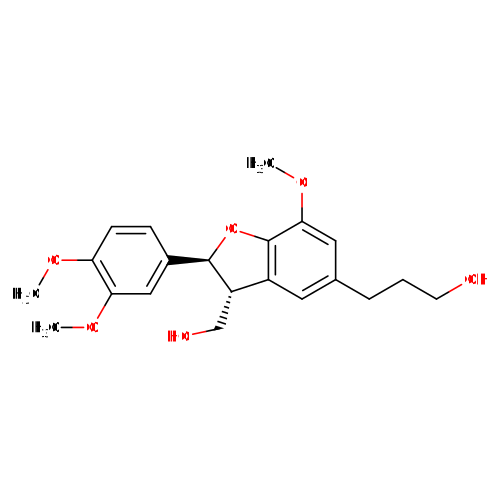
| Common Name | 3,4-O-dimethylcedrusin |
|---|
| Description | 3',4-O-Dimethylcedrusin belongs to the class of organic compounds known as 2-arylbenzofuran flavonoids. These are phenylpropanoids containing the 2-phenylbenzofuran moiety. 3,4-O-dimethylcedrusin is found in Croton lechleri and Faramea multiflora. 3,4-O-dimethylcedrusin was first documented in 2020 (PMID: 32962016). Based on a literature review a small amount of articles have been published on 3',4-O-Dimethylcedrusin (PMID: 35630789) (PMID: 32478640). |
|---|
| Structure | [H][C@]1(CO)C2=C(O[C@]1([H])C1=CC(OC)=C(OC)C=C1)C(OC)=CC(CCCO)=C2 InChI=1S/C21H26O6/c1-24-17-7-6-14(11-18(17)25-2)20-16(12-23)15-9-13(5-4-8-22)10-19(26-3)21(15)27-20/h6-7,9-11,16,20,22-23H,4-5,8,12H2,1-3H3/t16-,20+/m0/s1 |
|---|
| Synonyms | | Value | Source |
|---|
| 4-O-Methyldihydrodehydrodiconiferyl alcohol | MeSH | | 2-(3',4'-Dimethoxyphenyl)-2,3-dihydro-3-hydroxymethyl-7-methoxybenzofuran-5-propan-1-ol | MeSH |
|
|---|
| Chemical Formula | C21H26O6 |
|---|
| Average Mass | 374.4330 Da |
|---|
| Monoisotopic Mass | 374.17294 Da |
|---|
| IUPAC Name | Not Available |
|---|
| Traditional Name | Not Available |
|---|
| CAS Registry Number | 166021-14-3 |
|---|
| SMILES | [H][C@]1(CO)C2=C(O[C@]1([H])C1=CC(OC)=C(OC)C=C1)C(OC)=CC(CCCO)=C2 |
|---|
| InChI Identifier | InChI=1S/C21H26O6/c1-24-17-7-6-14(11-18(17)25-2)20-16(12-23)15-9-13(5-4-8-22)10-19(26-3)21(15)27-20/h6-7,9-11,16,20,22-23H,4-5,8,12H2,1-3H3/t16-,20+/m0/s1 |
|---|
| InChI Key | UVPCDEDIFJYIPT-OXJNMPFZSA-N |
|---|
| Experimental Spectra |
|---|
|
| Not Available | | Predicted Spectra |
|---|
|
| | Spectrum Type | Description | Depositor ID | Depositor Organization | Depositor | Deposition Date | View |
|---|
| 1D NMR | 13C NMR Spectrum (1D, 25 MHz, H2O, predicted) | Wishart Lab | Wishart Lab | David Wishart | 2021-06-20 | View Spectrum | | 1D NMR | 1H NMR Spectrum (1D, 100 MHz, H2O, predicted) | Wishart Lab | Wishart Lab | David Wishart | 2021-06-20 | View Spectrum | | 1D NMR | 13C NMR Spectrum (1D, 252 MHz, H2O, predicted) | Wishart Lab | Wishart Lab | David Wishart | 2021-06-20 | View Spectrum | | 1D NMR | 1H NMR Spectrum (1D, 1000 MHz, H2O, predicted) | Wishart Lab | Wishart Lab | David Wishart | 2021-06-20 | View Spectrum | | 1D NMR | 13C NMR Spectrum (1D, 50 MHz, H2O, predicted) | Wishart Lab | Wishart Lab | David Wishart | 2021-06-20 | View Spectrum | | 1D NMR | 1H NMR Spectrum (1D, 200 MHz, H2O, predicted) | Wishart Lab | Wishart Lab | David Wishart | 2021-06-20 | View Spectrum | | 1D NMR | 13C NMR Spectrum (1D, 75 MHz, H2O, predicted) | Wishart Lab | Wishart Lab | David Wishart | 2021-06-20 | View Spectrum | | 1D NMR | 1H NMR Spectrum (1D, 300 MHz, H2O, predicted) | Wishart Lab | Wishart Lab | David Wishart | 2021-06-20 | View Spectrum | | 1D NMR | 13C NMR Spectrum (1D, 101 MHz, H2O, predicted) | Wishart Lab | Wishart Lab | David Wishart | 2021-06-20 | View Spectrum | | 1D NMR | 1H NMR Spectrum (1D, 400 MHz, H2O, predicted) | Wishart Lab | Wishart Lab | David Wishart | 2021-06-20 | View Spectrum | | 1D NMR | 13C NMR Spectrum (1D, 126 MHz, H2O, predicted) | Wishart Lab | Wishart Lab | David Wishart | 2021-06-20 | View Spectrum | | 1D NMR | 1H NMR Spectrum (1D, 500 MHz, H2O, predicted) | Wishart Lab | Wishart Lab | David Wishart | 2021-06-20 | View Spectrum | | 1D NMR | 13C NMR Spectrum (1D, 151 MHz, H2O, predicted) | Wishart Lab | Wishart Lab | David Wishart | 2021-06-20 | View Spectrum | | 1D NMR | 1H NMR Spectrum (1D, 600 MHz, H2O, predicted) | Wishart Lab | Wishart Lab | David Wishart | 2021-06-20 | View Spectrum | | 1D NMR | 13C NMR Spectrum (1D, 176 MHz, H2O, predicted) | Wishart Lab | Wishart Lab | David Wishart | 2021-06-20 | View Spectrum | | 1D NMR | 1H NMR Spectrum (1D, 700 MHz, H2O, predicted) | Wishart Lab | Wishart Lab | David Wishart | 2021-06-20 | View Spectrum | | 1D NMR | 13C NMR Spectrum (1D, 201 MHz, H2O, predicted) | Wishart Lab | Wishart Lab | David Wishart | 2021-06-20 | View Spectrum | | 1D NMR | 1H NMR Spectrum (1D, 800 MHz, H2O, predicted) | Wishart Lab | Wishart Lab | David Wishart | 2021-06-20 | View Spectrum | | 1D NMR | 13C NMR Spectrum (1D, 226 MHz, H2O, predicted) | Wishart Lab | Wishart Lab | David Wishart | 2021-06-20 | View Spectrum | | 1D NMR | 1H NMR Spectrum (1D, 900 MHz, H2O, predicted) | Wishart Lab | Wishart Lab | David Wishart | 2021-06-20 | View Spectrum |
| | Chemical Shift Submissions |
|---|
|
| Not Available | | Species |
|---|
| Species of Origin | |
|---|
| Chemical Taxonomy |
|---|
| Description | Belongs to the class of organic compounds known as 2-arylbenzofuran flavonoids. These are phenylpropanoids containing the 2-phenylbenzofuran moiety. |
|---|
| Kingdom | Organic compounds |
|---|
| Super Class | Phenylpropanoids and polyketides |
|---|
| Class | 2-arylbenzofuran flavonoids |
|---|
| Sub Class | Not Available |
|---|
| Direct Parent | 2-arylbenzofuran flavonoids |
|---|
| Alternative Parents | |
|---|
| Substituents | - 2-arylbenzofuran flavonoid
- Norlignan skeleton
- Neolignan skeleton
- Dimethoxybenzene
- O-dimethoxybenzene
- Benzofuran
- Coumaran
- Phenol ether
- Phenoxy compound
- Anisole
- Methoxybenzene
- Alkyl aryl ether
- Benzenoid
- Monocyclic benzene moiety
- Organoheterocyclic compound
- Ether
- Oxacycle
- Hydrocarbon derivative
- Primary alcohol
- Organooxygen compound
- Organic oxygen compound
- Alcohol
- Aromatic heteropolycyclic compound
|
|---|
| Molecular Framework | Aromatic heteropolycyclic compounds |
|---|
| External Descriptors | Not Available |
|---|
| Physical Properties |
|---|
| State | Not Available |
|---|
| Experimental Properties | | Property | Value | Reference |
|---|
| Melting Point | Not Available | Not Available | | Boiling Point | Not Available | Not Available | | Water Solubility | Not Available | Not Available | | LogP | Not Available | Not Available |
|
|---|
| Predicted Properties | |
|---|
| General References | - Mangmool S, Limpichai C, Han KK, Reutrakul V, Anantachoke N: Anti-Inflammatory Effects of Mitrephora sirikitiae Leaf Extract and Isolated Lignans in RAW 264.7 Cells. Molecules. 2022 May 21;27(10). pii: molecules27103313. doi: 10.3390/molecules27103313. [PubMed:35630789 ]
- Qi Y, Choi SI, Son SR, Han HS, Ahn HS, Shin YK, Lee SH, Lee KT, Kwon HC, Jang DS: Chemical Constituents of the Leaves of Campanula takesimana (Korean Bellflower) and Their Inhibitory Effects on LPS-induced PGE2 Production. Plants (Basel). 2020 Sep 18;9(9). pii: plants9091232. doi: 10.3390/plants9091232. [PubMed:32962016 ]
- Anantachoke N, Lovacharaporn D, Reutrakul V, Michel S, Gaslonde T, Piyachaturawat P, Suksen K, Prabpai S, Nuntasaen N: Cytotoxic compounds from the leaves and stems of the endemic Thai plant Mitrephora sirikitiae. Pharm Biol. 2020 Dec;58(1):490-497. doi: 10.1080/13880209.2020.1765813. [PubMed:32478640 ]
|
|---|