| Record Information |
|---|
| Version | 2.0 |
|---|
| Created at | 2022-05-30 16:51:39 UTC |
|---|
| Updated at | 2022-05-30 16:51:39 UTC |
|---|
| NP-MRD ID | NP0137409 |
|---|
| Secondary Accession Numbers | None |
|---|
| Natural Product Identification |
|---|
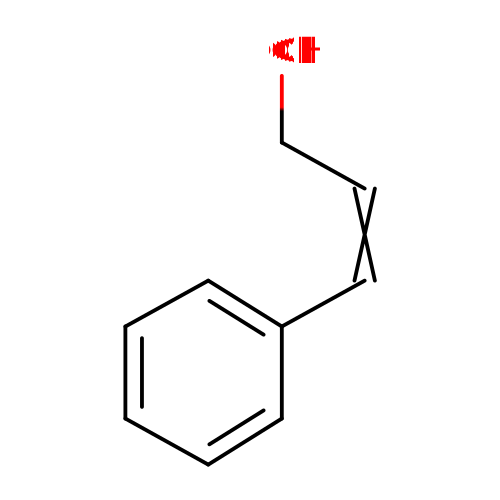
| Common Name | 3-Phenyl-2-propen-1-ol |
|---|
| Description | Cinnamyl alcohol, also known as styrylcarbinol or zimtalcohol, belongs to the class of organic compounds known as cinnamyl alcohols. These are aromatic alcohols containing a 3-phenylprop-2-en-1-ol moiety. Cinnamyl alcohol is an extremely weak basic (essentially neutral) compound (based on its pKa). Cinnamyl alcohol is a sweet, balsam, and bitter tasting compound. Outside of the human body, Cinnamyl alcohol is found, on average, in the highest concentration within ceylon cinnamons and star anises. Cinnamyl alcohol has also been detected, but not quantified in, several different foods, such as papaya, new zealand spinachs, wax apples, wild celeries, and eggplants. This could make cinnamyl alcohol a potential biomarker for the consumption of these foods. 3-Phenyl-2-propen-1-ol is found in Bidens graveolens, Cinnamomum aromaticum, Cinnamomum burmannii, Cinnamomum sieboldii, Cinnamomum verum, Cinnamomum yabunikkei, Citrullus lanatus, Coreopsis woytkowskii, Cryptocarya amygdalina, Ficus carica, Illicium verum, Lavandula angustifolia, Rhodiola rosea, Rhodiola sachalinensis, Syzygium jambos and Tetrapanax papyrifer. 3-Phenyl-2-propen-1-ol was first documented in 2013 (PMID: 23421457). A primary alcohol comprising an allyl core with a hydroxy substituent at the 1-position and a phenyl substituent at the 3-position (geometry of the C=C bond unspecified) (PMID: 24190481). |
|---|
| Structure | InChI=1S/C9H10O/c10-8-4-7-9-5-2-1-3-6-9/h1-7,10H,8H2 |
|---|
| Synonyms | | Value | Source |
|---|
| 3-Phenyl-2-propen-1-ol | ChEBI | | Styrylcarbinol | ChEBI | | Zimtalcohol | ChEBI | | 1-Phenyl-1-propen-3-ol | HMDB | | 3-Phenyl-2-propene-1-ol | HMDB | | 3-Phenyl-2-propenol | HMDB | | 3-Phenylallyl alcohol | HMDB | | 3-Phenylprop-2-en-1-ol | HMDB | | Cinnamic alcohol | HMDB | | Cinnamyl alcohol, 8ci | HMDB | | FEMA 2294 | HMDB | | gamma-Phenylallyl alcohol | HMDB | | Phenyl-2-propen-1-ol | HMDB | | Phenyl-2-propenol | HMDB | | Phenylallyl alcohol | HMDB | | Styrone | HMDB | | Styryl alcohol | HMDB | | Cinnamyl alcohol, (e)-isomer | HMDB | | Cinnamyl alcohol, titanium (4+) salt | HMDB |
|
|---|
| Chemical Formula | C9H10O |
|---|
| Average Mass | 134.1751 Da |
|---|
| Monoisotopic Mass | 134.07316 Da |
|---|
| IUPAC Name | 3-phenylprop-2-en-1-ol |
|---|
| Traditional Name | 3-phenyl-2-propen-1-ol |
|---|
| CAS Registry Number | Not Available |
|---|
| SMILES | OCC=CC1=CC=CC=C1 |
|---|
| InChI Identifier | InChI=1S/C9H10O/c10-8-4-7-9-5-2-1-3-6-9/h1-7,10H,8H2 |
|---|
| InChI Key | OOCCDEMITAIZTP-UHFFFAOYSA-N |
|---|
| Experimental Spectra |
|---|
|
| Not Available | | Predicted Spectra |
|---|
|
| | Spectrum Type | Description | Depositor ID | Depositor Organization | Depositor | Deposition Date | View |
|---|
| 1D NMR | 13C NMR Spectrum (1D, 25 MHz, H2O, predicted) | Wishart Lab | Wishart Lab | David Wishart | 2021-06-20 | View Spectrum | | 1D NMR | 1H NMR Spectrum (1D, 100 MHz, H2O, predicted) | Wishart Lab | Wishart Lab | David Wishart | 2021-06-20 | View Spectrum | | 1D NMR | 13C NMR Spectrum (1D, 252 MHz, H2O, predicted) | Wishart Lab | Wishart Lab | David Wishart | 2021-06-20 | View Spectrum | | 1D NMR | 1H NMR Spectrum (1D, 1000 MHz, H2O, predicted) | Wishart Lab | Wishart Lab | David Wishart | 2021-06-20 | View Spectrum | | 1D NMR | 13C NMR Spectrum (1D, 50 MHz, H2O, predicted) | Wishart Lab | Wishart Lab | David Wishart | 2021-06-20 | View Spectrum | | 1D NMR | 1H NMR Spectrum (1D, 200 MHz, H2O, predicted) | Wishart Lab | Wishart Lab | David Wishart | 2021-06-20 | View Spectrum | | 1D NMR | 13C NMR Spectrum (1D, 75 MHz, H2O, predicted) | Wishart Lab | Wishart Lab | David Wishart | 2021-06-20 | View Spectrum | | 1D NMR | 1H NMR Spectrum (1D, 300 MHz, H2O, predicted) | Wishart Lab | Wishart Lab | David Wishart | 2021-06-20 | View Spectrum | | 1D NMR | 13C NMR Spectrum (1D, 101 MHz, H2O, predicted) | Wishart Lab | Wishart Lab | David Wishart | 2021-06-20 | View Spectrum | | 1D NMR | 1H NMR Spectrum (1D, 400 MHz, H2O, predicted) | Wishart Lab | Wishart Lab | David Wishart | 2021-06-20 | View Spectrum | | 1D NMR | 13C NMR Spectrum (1D, 126 MHz, H2O, predicted) | Wishart Lab | Wishart Lab | David Wishart | 2021-06-20 | View Spectrum | | 1D NMR | 1H NMR Spectrum (1D, 500 MHz, H2O, predicted) | Wishart Lab | Wishart Lab | David Wishart | 2021-06-20 | View Spectrum | | 1D NMR | 13C NMR Spectrum (1D, 151 MHz, H2O, predicted) | Wishart Lab | Wishart Lab | David Wishart | 2021-06-20 | View Spectrum | | 1D NMR | 1H NMR Spectrum (1D, 600 MHz, H2O, predicted) | Wishart Lab | Wishart Lab | David Wishart | 2021-06-20 | View Spectrum | | 1D NMR | 13C NMR Spectrum (1D, 176 MHz, H2O, predicted) | Wishart Lab | Wishart Lab | David Wishart | 2021-06-20 | View Spectrum | | 1D NMR | 1H NMR Spectrum (1D, 700 MHz, H2O, predicted) | Wishart Lab | Wishart Lab | David Wishart | 2021-06-20 | View Spectrum | | 1D NMR | 13C NMR Spectrum (1D, 201 MHz, H2O, predicted) | Wishart Lab | Wishart Lab | David Wishart | 2021-06-20 | View Spectrum | | 1D NMR | 1H NMR Spectrum (1D, 800 MHz, H2O, predicted) | Wishart Lab | Wishart Lab | David Wishart | 2021-06-20 | View Spectrum | | 1D NMR | 13C NMR Spectrum (1D, 226 MHz, H2O, predicted) | Wishart Lab | Wishart Lab | David Wishart | 2021-06-20 | View Spectrum | | 1D NMR | 1H NMR Spectrum (1D, 900 MHz, H2O, predicted) | Wishart Lab | Wishart Lab | David Wishart | 2021-06-20 | View Spectrum |
| | Chemical Shift Submissions |
|---|
|
| Not Available | | Species |
|---|
| Species of Origin | |
|---|
| Chemical Taxonomy |
|---|
| Description | Belongs to the class of organic compounds known as cinnamyl alcohols. These are aromatic alcohols containing a 3-phenylprop-2-en-1-ol moiety. |
|---|
| Kingdom | Organic compounds |
|---|
| Super Class | Phenylpropanoids and polyketides |
|---|
| Class | Cinnamyl alcohols |
|---|
| Sub Class | Not Available |
|---|
| Direct Parent | Cinnamyl alcohols |
|---|
| Alternative Parents | |
|---|
| Substituents | - Cinnamyl alcohol
- Styrene
- Benzenoid
- Monocyclic benzene moiety
- Organic oxygen compound
- Hydrocarbon derivative
- Primary alcohol
- Organooxygen compound
- Alcohol
- Aromatic homomonocyclic compound
|
|---|
| Molecular Framework | Aromatic homomonocyclic compounds |
|---|
| External Descriptors | |
|---|
| Physical Properties |
|---|
| State | Not Available |
|---|
| Experimental Properties | | Property | Value | Reference |
|---|
| Melting Point | Not Available | Not Available | | Boiling Point | Not Available | Not Available | | Water Solubility | Not Available | Not Available | | LogP | Not Available | Not Available |
|
|---|
| Predicted Properties | |
|---|