| Record Information |
|---|
| Version | 2.0 |
|---|
| Created at | 2022-05-30 16:44:44 UTC |
|---|
| Updated at | 2022-05-30 16:44:44 UTC |
|---|
| NP-MRD ID | NP0137196 |
|---|
| Secondary Accession Numbers | None |
|---|
| Natural Product Identification |
|---|
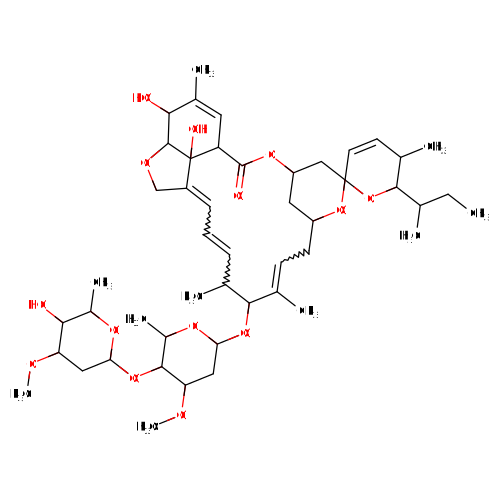
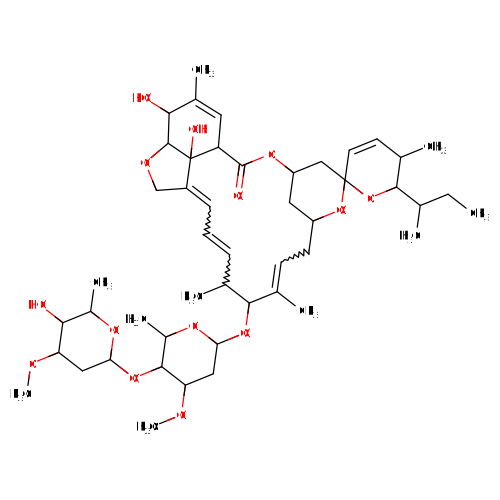
| Common Name | Avermectin B1a |
|---|
| Description | Avermectin B1a belongs to the class of organic compounds known as macrolides and analogues. These are organic compounds containing a lactone ring of at least twelve members. They show activity against a broad range of nematodes and arthropod parasites of domestic animals at dose rates of 300 microgram/kg or less. The avermectins are a series of macrocyclic lactone derivatives with potent anthelmintic properties. Avermectin B1a is an extremely weak basic (essentially neutral) compound (based on its pKa). Avermectin B1a is a potentially toxic compound. It has low solubility in water and extensive non-specific binding. It opens GABA-insensitive chloride channels, reducing membrane resistance and increasing conductance inward. A commonly used therapy in recent times has been based on oral or parenteral administration of avermectins, which are macrocyclic lactones produced by fermentation of various, carefully prepared laboratory broths using the soil micro-organism Streptomyces avermitilis. Unlike the macrolide or polyene antibiotics, they lack significant antibacterial or antifungal activity. Avermectin B1a is found in Streptomyces avermitilis. Avermectins cause irritation of skin and eyes, central nervous system depression (incoordination, tremors, lethargy, excitation, pupil dilation, coma), vomiting, convulsions and/or tremors, and respiratory failure at high doses. |
|---|
| Structure | CCC(C)C1OC2(CC3CC(CC=C(C)C(OC4CC(OC)C(OC5CC(OC)C(O)C(C)O5)C(C)O4)C(C)C=CC=C4COC5C(O)C(C)=CC(C(=O)O3)C45O)O2)C=CC1C InChI=1S/C48H72O14/c1-11-25(2)43-28(5)17-18-47(62-43)23-34-20-33(61-47)16-15-27(4)42(26(3)13-12-14-32-24-55-45-40(49)29(6)19-35(46(51)58-34)48(32,45)52)59-39-22-37(54-10)44(31(8)57-39)60-38-21-36(53-9)41(50)30(7)56-38/h12-15,17-19,25-26,28,30-31,33-45,49-50,52H,11,16,20-24H2,1-10H3 |
|---|
| Synonyms | Not Available |
|---|
| Chemical Formula | C48H72O14 |
|---|
| Average Mass | 873.0769 Da |
|---|
| Monoisotopic Mass | 872.49221 Da |
|---|
| IUPAC Name | 6-(butan-2-yl)-21',24'-dihydroxy-12'-({5-[(5-hydroxy-4-methoxy-6-methyloxan-2-yl)oxy]-4-methoxy-6-methyloxan-2-yl}oxy)-5,11',13',22'-tetramethyl-5,6-dihydro-3',7',19'-trioxaspiro[pyran-2,6'-tetracyclo[15.6.1.1⁴,⁸.0²⁰,²⁴]pentacosane]-10',14',16',22'-tetraen-2'-one |
|---|
| Traditional Name | 21',24'-dihydroxy-12'-({5-[(5-hydroxy-4-methoxy-6-methyloxan-2-yl)oxy]-4-methoxy-6-methyloxan-2-yl}oxy)-5,11',13',22'-tetramethyl-6-(sec-butyl)-5,6-dihydro-3',7',19'-trioxaspiro[pyran-2,6'-tetracyclo[15.6.1.1⁴,⁸.0²⁰,²⁴]pentacosane]-10',14',16',22'-tetraen-2'-one |
|---|
| CAS Registry Number | Not Available |
|---|
| SMILES | CCC(C)C1OC2(CC3CC(CC=C(C)C(OC4CC(OC)C(OC5CC(OC)C(O)C(C)O5)C(C)O4)C(C)C=CC=C4COC5C(O)C(C)=CC(C(=O)O3)C45O)O2)C=CC1C |
|---|
| InChI Identifier | InChI=1S/C48H72O14/c1-11-25(2)43-28(5)17-18-47(62-43)23-34-20-33(61-47)16-15-27(4)42(26(3)13-12-14-32-24-55-45-40(49)29(6)19-35(46(51)58-34)48(32,45)52)59-39-22-37(54-10)44(31(8)57-39)60-38-21-36(53-9)41(50)30(7)56-38/h12-15,17-19,25-26,28,30-31,33-45,49-50,52H,11,16,20-24H2,1-10H3 |
|---|
| InChI Key | RRZXIRBKKLTSOM-UHFFFAOYSA-N |
|---|
| Experimental Spectra |
|---|
|
| Not Available | | Predicted Spectra |
|---|
|
| | Spectrum Type | Description | Depositor ID | Depositor Organization | Depositor | Deposition Date | View |
|---|
| 1D NMR | 13C NMR Spectrum (1D, 25 MHz, H2O, predicted) | Wishart Lab | Wishart Lab | David Wishart | 2021-06-20 | View Spectrum | | 1D NMR | 1H NMR Spectrum (1D, 100 MHz, H2O, predicted) | Wishart Lab | Wishart Lab | David Wishart | 2021-06-20 | View Spectrum | | 1D NMR | 13C NMR Spectrum (1D, 252 MHz, H2O, predicted) | Wishart Lab | Wishart Lab | David Wishart | 2021-06-20 | View Spectrum | | 1D NMR | 1H NMR Spectrum (1D, 1000 MHz, H2O, predicted) | Wishart Lab | Wishart Lab | David Wishart | 2021-06-20 | View Spectrum | | 1D NMR | 13C NMR Spectrum (1D, 50 MHz, H2O, predicted) | Wishart Lab | Wishart Lab | David Wishart | 2021-06-20 | View Spectrum | | 1D NMR | 1H NMR Spectrum (1D, 200 MHz, H2O, predicted) | Wishart Lab | Wishart Lab | David Wishart | 2021-06-20 | View Spectrum | | 1D NMR | 13C NMR Spectrum (1D, 75 MHz, H2O, predicted) | Wishart Lab | Wishart Lab | David Wishart | 2021-06-20 | View Spectrum | | 1D NMR | 1H NMR Spectrum (1D, 300 MHz, H2O, predicted) | Wishart Lab | Wishart Lab | David Wishart | 2021-06-20 | View Spectrum | | 1D NMR | 13C NMR Spectrum (1D, 101 MHz, H2O, predicted) | Wishart Lab | Wishart Lab | David Wishart | 2021-06-20 | View Spectrum | | 1D NMR | 1H NMR Spectrum (1D, 400 MHz, H2O, predicted) | Wishart Lab | Wishart Lab | David Wishart | 2021-06-20 | View Spectrum | | 1D NMR | 13C NMR Spectrum (1D, 126 MHz, H2O, predicted) | Wishart Lab | Wishart Lab | David Wishart | 2021-06-20 | View Spectrum | | 1D NMR | 1H NMR Spectrum (1D, 500 MHz, H2O, predicted) | Wishart Lab | Wishart Lab | David Wishart | 2021-06-20 | View Spectrum | | 1D NMR | 13C NMR Spectrum (1D, 151 MHz, H2O, predicted) | Wishart Lab | Wishart Lab | David Wishart | 2021-06-20 | View Spectrum | | 1D NMR | 1H NMR Spectrum (1D, 600 MHz, H2O, predicted) | Wishart Lab | Wishart Lab | David Wishart | 2021-06-20 | View Spectrum | | 1D NMR | 13C NMR Spectrum (1D, 176 MHz, H2O, predicted) | Wishart Lab | Wishart Lab | David Wishart | 2021-06-20 | View Spectrum | | 1D NMR | 1H NMR Spectrum (1D, 700 MHz, H2O, predicted) | Wishart Lab | Wishart Lab | David Wishart | 2021-06-20 | View Spectrum | | 1D NMR | 13C NMR Spectrum (1D, 201 MHz, H2O, predicted) | Wishart Lab | Wishart Lab | David Wishart | 2021-06-20 | View Spectrum | | 1D NMR | 1H NMR Spectrum (1D, 800 MHz, H2O, predicted) | Wishart Lab | Wishart Lab | David Wishart | 2021-06-20 | View Spectrum | | 1D NMR | 13C NMR Spectrum (1D, 226 MHz, H2O, predicted) | Wishart Lab | Wishart Lab | David Wishart | 2021-06-20 | View Spectrum | | 1D NMR | 1H NMR Spectrum (1D, 900 MHz, H2O, predicted) | Wishart Lab | Wishart Lab | David Wishart | 2021-06-20 | View Spectrum |
| | Chemical Shift Submissions |
|---|
|
| Not Available | | Species |
|---|
| Species of Origin | |
|---|
| Chemical Taxonomy |
|---|
| Description | Belongs to the class of organic compounds known as macrolides and analogues. These are organic compounds containing a lactone ring of at least twelve members. |
|---|
| Kingdom | Organic compounds |
|---|
| Super Class | Phenylpropanoids and polyketides |
|---|
| Class | Macrolides and analogues |
|---|
| Sub Class | Not Available |
|---|
| Direct Parent | Macrolides and analogues |
|---|
| Alternative Parents | |
|---|
| Substituents | - Macrolide
- Disaccharide
- Glycosyl compound
- O-glycosyl compound
- Ketal
- Oxane
- Pyran
- Tetrahydrofuran
- Tertiary alcohol
- Secondary alcohol
- Carboxylic acid ester
- Lactone
- Acetal
- Carboxylic acid derivative
- Organoheterocyclic compound
- Dialkyl ether
- Ether
- Monocarboxylic acid or derivatives
- Oxacycle
- Organic oxygen compound
- Alcohol
- Organic oxide
- Organooxygen compound
- Hydrocarbon derivative
- Carbonyl group
- Aliphatic heteropolycyclic compound
|
|---|
| Molecular Framework | Aliphatic heteropolycyclic compounds |
|---|
| External Descriptors | |
|---|
| Physical Properties |
|---|
| State | Not Available |
|---|
| Experimental Properties | | Property | Value | Reference |
|---|
| Melting Point | Not Available | Not Available | | Boiling Point | Not Available | Not Available | | Water Solubility | Not Available | Not Available | | LogP | Not Available | Not Available |
|
|---|
| Predicted Properties | |
|---|