| Record Information |
|---|
| Version | 2.0 |
|---|
| Created at | 2022-05-30 16:44:01 UTC |
|---|
| Updated at | 2022-05-30 16:44:01 UTC |
|---|
| NP-MRD ID | NP0137175 |
|---|
| Secondary Accession Numbers | None |
|---|
| Natural Product Identification |
|---|
| Common Name | 7,8-Dihydroxyflavone |
|---|
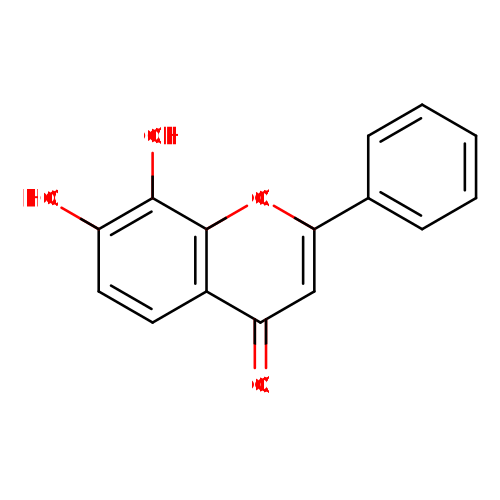
| Description | 7,8-Dihydroxyflavone, also known as 7,8-DHF, belongs to the class of organic compounds known as flavones. These are flavonoids with a structure based on the backbone of 2-phenylchromen-4-one (2-phenyl-1-benzopyran-4-one). 7,8-Dihydroxyflavone is found in Chrysanthemum morifolium. 7,8-Dihydroxyflavone was first documented in 2015 (PMID: 26220903). 7,8-Dihydroxyflavone is an extremely weak basic (essentially neutral) compound (based on its pKa) (PMID: 26943953) (PMID: 27019033). |
|---|
| Structure | OC1=CC=C2C(=O)C=C(OC2=C1O)C1=CC=CC=C1 InChI=1S/C15H10O4/c16-11-7-6-10-12(17)8-13(19-15(10)14(11)18)9-4-2-1-3-5-9/h1-8,16,18H |
|---|
| Synonyms | | Value | Source |
|---|
| 7,8-DHF | ChEBI | | 7,8-Dihydroxy-2-phenyl-4-benzopyrone | ChEBI | | 7,8-Dihydroxy-2-phenylchromone | ChEBI | | 6,7-Dihydroxyflavone | MeSH | | 78-Dihydroxyflavone | ChEMBL | | 78-Dihydroxy-flavone | ChEMBL |
|
|---|
| Chemical Formula | C15H10O4 |
|---|
| Average Mass | 254.2410 Da |
|---|
| Monoisotopic Mass | 254.05791 Da |
|---|
| IUPAC Name | 7,8-dihydroxy-2-phenyl-4H-chromen-4-one |
|---|
| Traditional Name | 7,8-dihydroxy-2-phenylchromen-4-one |
|---|
| CAS Registry Number | Not Available |
|---|
| SMILES | OC1=CC=C2C(=O)C=C(OC2=C1O)C1=CC=CC=C1 |
|---|
| InChI Identifier | InChI=1S/C15H10O4/c16-11-7-6-10-12(17)8-13(19-15(10)14(11)18)9-4-2-1-3-5-9/h1-8,16,18H |
|---|
| InChI Key | COCYGNDCWFKTMF-UHFFFAOYSA-N |
|---|
| Experimental Spectra |
|---|
|
| Not Available | | Predicted Spectra |
|---|
|
| | Spectrum Type | Description | Depositor ID | Depositor Organization | Depositor | Deposition Date | View |
|---|
| 1D NMR | 13C NMR Spectrum (1D, 25 MHz, H2O, predicted) | Wishart Lab | Wishart Lab | David Wishart | 2021-06-20 | View Spectrum | | 1D NMR | 1H NMR Spectrum (1D, 100 MHz, H2O, predicted) | Wishart Lab | Wishart Lab | David Wishart | 2021-06-20 | View Spectrum | | 1D NMR | 13C NMR Spectrum (1D, 252 MHz, H2O, predicted) | Wishart Lab | Wishart Lab | David Wishart | 2021-06-20 | View Spectrum | | 1D NMR | 1H NMR Spectrum (1D, 1000 MHz, H2O, predicted) | Wishart Lab | Wishart Lab | David Wishart | 2021-06-20 | View Spectrum | | 1D NMR | 13C NMR Spectrum (1D, 50 MHz, H2O, predicted) | Wishart Lab | Wishart Lab | David Wishart | 2021-06-20 | View Spectrum | | 1D NMR | 1H NMR Spectrum (1D, 200 MHz, H2O, predicted) | Wishart Lab | Wishart Lab | David Wishart | 2021-06-20 | View Spectrum | | 1D NMR | 13C NMR Spectrum (1D, 75 MHz, H2O, predicted) | Wishart Lab | Wishart Lab | David Wishart | 2021-06-20 | View Spectrum | | 1D NMR | 1H NMR Spectrum (1D, 300 MHz, H2O, predicted) | Wishart Lab | Wishart Lab | David Wishart | 2021-06-20 | View Spectrum | | 1D NMR | 13C NMR Spectrum (1D, 101 MHz, H2O, predicted) | Wishart Lab | Wishart Lab | David Wishart | 2021-06-20 | View Spectrum | | 1D NMR | 1H NMR Spectrum (1D, 400 MHz, H2O, predicted) | Wishart Lab | Wishart Lab | David Wishart | 2021-06-20 | View Spectrum | | 1D NMR | 13C NMR Spectrum (1D, 126 MHz, H2O, predicted) | Wishart Lab | Wishart Lab | David Wishart | 2021-06-20 | View Spectrum | | 1D NMR | 1H NMR Spectrum (1D, 500 MHz, H2O, predicted) | Wishart Lab | Wishart Lab | David Wishart | 2021-06-20 | View Spectrum | | 1D NMR | 13C NMR Spectrum (1D, 151 MHz, H2O, predicted) | Wishart Lab | Wishart Lab | David Wishart | 2021-06-20 | View Spectrum | | 1D NMR | 1H NMR Spectrum (1D, 600 MHz, H2O, predicted) | Wishart Lab | Wishart Lab | David Wishart | 2021-06-20 | View Spectrum | | 1D NMR | 13C NMR Spectrum (1D, 176 MHz, H2O, predicted) | Wishart Lab | Wishart Lab | David Wishart | 2021-06-20 | View Spectrum | | 1D NMR | 1H NMR Spectrum (1D, 700 MHz, H2O, predicted) | Wishart Lab | Wishart Lab | David Wishart | 2021-06-20 | View Spectrum | | 1D NMR | 13C NMR Spectrum (1D, 201 MHz, H2O, predicted) | Wishart Lab | Wishart Lab | David Wishart | 2021-06-20 | View Spectrum | | 1D NMR | 1H NMR Spectrum (1D, 800 MHz, H2O, predicted) | Wishart Lab | Wishart Lab | David Wishart | 2021-06-20 | View Spectrum | | 1D NMR | 13C NMR Spectrum (1D, 226 MHz, H2O, predicted) | Wishart Lab | Wishart Lab | David Wishart | 2021-06-20 | View Spectrum | | 1D NMR | 1H NMR Spectrum (1D, 900 MHz, H2O, predicted) | Wishart Lab | Wishart Lab | David Wishart | 2021-06-20 | View Spectrum |
| | Chemical Shift Submissions |
|---|
|
| Not Available | | Species |
|---|
| Species of Origin | |
|---|
| Chemical Taxonomy |
|---|
| Description | Belongs to the class of organic compounds known as flavones. These are flavonoids with a structure based on the backbone of 2-phenylchromen-4-one (2-phenyl-1-benzopyran-4-one). |
|---|
| Kingdom | Organic compounds |
|---|
| Super Class | Phenylpropanoids and polyketides |
|---|
| Class | Flavonoids |
|---|
| Sub Class | Flavones |
|---|
| Direct Parent | Flavones |
|---|
| Alternative Parents | |
|---|
| Substituents | - 7-hydroxyflavonoid
- 8-hydroxyflavonoid
- Flavone
- Hydroxyflavonoid
- Chromone
- Benzopyran
- 1-benzopyran
- 1-hydroxy-4-unsubstituted benzenoid
- 1-hydroxy-2-unsubstituted benzenoid
- Pyranone
- Monocyclic benzene moiety
- Benzenoid
- Pyran
- Heteroaromatic compound
- Organoheterocyclic compound
- Oxacycle
- Hydrocarbon derivative
- Organic oxygen compound
- Organooxygen compound
- Organic oxide
- Aromatic heteropolycyclic compound
|
|---|
| Molecular Framework | Aromatic heteropolycyclic compounds |
|---|
| External Descriptors | Not Available |
|---|
| Physical Properties |
|---|
| State | Not Available |
|---|
| Experimental Properties | | Property | Value | Reference |
|---|
| Melting Point | Not Available | Not Available | | Boiling Point | Not Available | Not Available | | Water Solubility | Not Available | Not Available | | LogP | Not Available | Not Available |
|
|---|
| Predicted Properties | |
|---|
| General References | - Du X, Hill RA: 7,8-Dihydroxyflavone as a pro-neurotrophic treatment for neurodevelopmental disorders. Neurochem Int. 2015 Oct;89:170-80. doi: 10.1016/j.neuint.2015.07.021. Epub 2015 Jul 26. [PubMed:26220903 ]
- Makar TK, Nimmagadda VK, Singh IS, Lam K, Mubariz F, Judge SI, Trisler D, Bever CT Jr: TrkB agonist, 7,8-dihydroxyflavone, reduces the clinical and pathological severity of a murine model of multiple sclerosis. J Neuroimmunol. 2016 Mar 15;292:9-20. doi: 10.1016/j.jneuroim.2016.01.002. Epub 2016 Jan 6. [PubMed:26943953 ]
- Luo D, Shi Y, Wang J, Lin Q, Sun Y, Ye K, Yan Q, Zhang H: 7,8-dihydroxyflavone protects 6-OHDA and MPTP induced dopaminergic neurons degeneration through activation of TrkB in rodents. Neurosci Lett. 2016 May 4;620:43-9. doi: 10.1016/j.neulet.2016.03.042. Epub 2016 Mar 24. [PubMed:27019033 ]
|
|---|