| Record Information |
|---|
| Version | 2.0 |
|---|
| Created at | 2022-05-30 16:38:56 UTC |
|---|
| Updated at | 2022-05-30 16:38:56 UTC |
|---|
| NP-MRD ID | NP0137011 |
|---|
| Secondary Accession Numbers | None |
|---|
| Natural Product Identification |
|---|
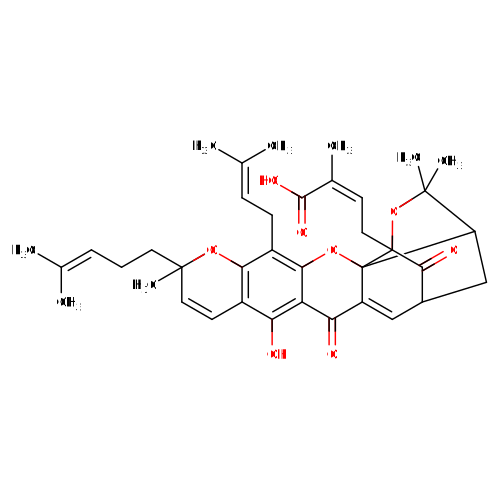
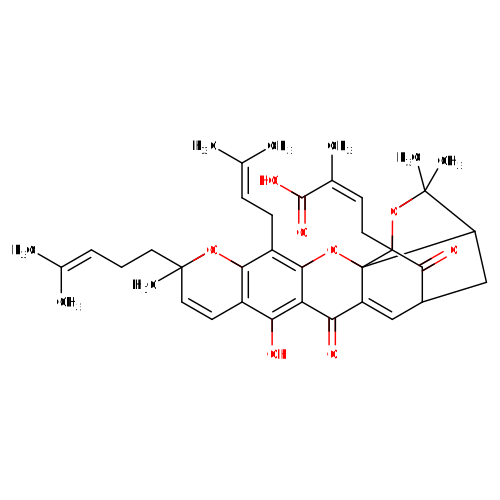
| Common Name | Gambogic acid |
|---|
| Description | Gambogic acid, also known as gambogate or b-guttiferin, belongs to the class of organic compounds known as pyranoxanthones. These are organic aromatic compounds containing a pyran or a hydrogenated derivative fused to a xanthone ring system. Gambogic acid is an extremely weak basic (essentially neutral) compound (based on its pKa). Gambogic acid is a xanthonoid that is derived from the brownish or orange resin from Garcinia hanburyi. Outside of the human body, gambogic acid has been detected, but not quantified in, fruits and herbs and spices. This could make gambogic acid a potential biomarker for the consumption of these foods. At the highest level of 120 mg/kg the primary toxic target organs were the liver and kidneys. For the same length of exposure, the higher the concentration of gambogic acid that was administered, the greater the effect on inhibiting cell growth. Gambogic acid is found in Garcinia hanburyi. The ratio of relative tumor volume (RTV) for the treated group of mice to the control group indicates the gambogic acid was having an impact on tumor size while having no adverse effects on body weight or mortality. |
|---|
| Structure | CC(C)=CCCC1(C)OC2=C(C=C1)C(O)=C1C(=O)C3=CC4CC5C(C)(C)OC(C\C=C(\C)C(O)=O)(C4=O)C35OC1=C2CC=C(C)C InChI=1S/C38H44O8/c1-20(2)10-9-15-36(8)16-14-24-29(39)28-30(40)26-18-23-19-27-35(6,7)46-37(33(23)41,17-13-22(5)34(42)43)38(26,27)45-32(28)25(31(24)44-36)12-11-21(3)4/h10-11,13-14,16,18,23,27,39H,9,12,15,17,19H2,1-8H3,(H,42,43)/b22-13- |
|---|
| Synonyms | | Value | Source |
|---|
| Gambogate | Generator | | a-Gambogic acid | HMDB | | b-Guttiferin | HMDB | | b-Guttilactone | HMDB | | Guttatic acid | HMDB | | Guttic acid | HMDB | | Gamboge acid | HMDB | | Gambogoic acid | HMDB | | (2Z)-4-[12-Hydroxy-8,21,21-trimethyl-5-(3-methylbut-2-en-1-yl)-8-(4-methylpent-3-en-1-yl)-14,18-dioxo-3,7,20-trioxahexacyclo[15.4.1.0²,¹⁵.0²,¹⁹.0⁴,¹³.0⁶,¹¹]docosa-4(13),5,9,11,15-pentaen-19-yl]-2-methylbut-2-enoate | Generator | | Gambogic acid | MeSH |
|
|---|
| Chemical Formula | C38H44O8 |
|---|
| Average Mass | 628.7512 Da |
|---|
| Monoisotopic Mass | 628.30362 Da |
|---|
| IUPAC Name | (2Z)-4-[12-hydroxy-8,21,21-trimethyl-5-(3-methylbut-2-en-1-yl)-8-(4-methylpent-3-en-1-yl)-14,18-dioxo-3,7,20-trioxahexacyclo[15.4.1.0²,¹⁵.0²,¹⁹.0⁴,¹³.0⁶,¹¹]docosa-4,6(11),9,12,15-pentaen-19-yl]-2-methylbut-2-enoic acid |
|---|
| Traditional Name | (2Z)-4-[12-hydroxy-8,21,21-trimethyl-5-(3-methylbut-2-en-1-yl)-8-(4-methylpent-3-en-1-yl)-14,18-dioxo-3,7,20-trioxahexacyclo[15.4.1.0²,¹⁵.0²,¹⁹.0⁴,¹³.0⁶,¹¹]docosa-4,6(11),9,12,15-pentaen-19-yl]-2-methylbut-2-enoic acid |
|---|
| CAS Registry Number | Not Available |
|---|
| SMILES | CC(C)=CCCC1(C)OC2=C(C=C1)C(O)=C1C(=O)C3=CC4CC5C(C)(C)OC(C\C=C(\C)C(O)=O)(C4=O)C35OC1=C2CC=C(C)C |
|---|
| InChI Identifier | InChI=1S/C38H44O8/c1-20(2)10-9-15-36(8)16-14-24-29(39)28-30(40)26-18-23-19-27-35(6,7)46-37(33(23)41,17-13-22(5)34(42)43)38(26,27)45-32(28)25(31(24)44-36)12-11-21(3)4/h10-11,13-14,16,18,23,27,39H,9,12,15,17,19H2,1-8H3,(H,42,43)/b22-13- |
|---|
| InChI Key | GEZHEQNLKAOMCA-XKZIYDEJSA-N |
|---|
| Experimental Spectra |
|---|
|
| Not Available | | Predicted Spectra |
|---|
|
| | Spectrum Type | Description | Depositor ID | Depositor Organization | Depositor | Deposition Date | View |
|---|
| 1D NMR | 13C NMR Spectrum (1D, 25 MHz, H2O, predicted) | Wishart Lab | Wishart Lab | David Wishart | 2021-06-20 | View Spectrum | | 1D NMR | 1H NMR Spectrum (1D, 100 MHz, H2O, predicted) | Wishart Lab | Wishart Lab | David Wishart | 2021-06-20 | View Spectrum | | 1D NMR | 13C NMR Spectrum (1D, 252 MHz, H2O, predicted) | Wishart Lab | Wishart Lab | David Wishart | 2021-06-20 | View Spectrum | | 1D NMR | 1H NMR Spectrum (1D, 1000 MHz, H2O, predicted) | Wishart Lab | Wishart Lab | David Wishart | 2021-06-20 | View Spectrum | | 1D NMR | 13C NMR Spectrum (1D, 50 MHz, H2O, predicted) | Wishart Lab | Wishart Lab | David Wishart | 2021-06-20 | View Spectrum | | 1D NMR | 1H NMR Spectrum (1D, 200 MHz, H2O, predicted) | Wishart Lab | Wishart Lab | David Wishart | 2021-06-20 | View Spectrum | | 1D NMR | 13C NMR Spectrum (1D, 75 MHz, H2O, predicted) | Wishart Lab | Wishart Lab | David Wishart | 2021-06-20 | View Spectrum | | 1D NMR | 1H NMR Spectrum (1D, 300 MHz, H2O, predicted) | Wishart Lab | Wishart Lab | David Wishart | 2021-06-20 | View Spectrum | | 1D NMR | 13C NMR Spectrum (1D, 101 MHz, H2O, predicted) | Wishart Lab | Wishart Lab | David Wishart | 2021-06-20 | View Spectrum | | 1D NMR | 1H NMR Spectrum (1D, 400 MHz, H2O, predicted) | Wishart Lab | Wishart Lab | David Wishart | 2021-06-20 | View Spectrum | | 1D NMR | 13C NMR Spectrum (1D, 126 MHz, H2O, predicted) | Wishart Lab | Wishart Lab | David Wishart | 2021-06-20 | View Spectrum | | 1D NMR | 1H NMR Spectrum (1D, 500 MHz, H2O, predicted) | Wishart Lab | Wishart Lab | David Wishart | 2021-06-20 | View Spectrum | | 1D NMR | 13C NMR Spectrum (1D, 151 MHz, H2O, predicted) | Wishart Lab | Wishart Lab | David Wishart | 2021-06-20 | View Spectrum | | 1D NMR | 1H NMR Spectrum (1D, 600 MHz, H2O, predicted) | Wishart Lab | Wishart Lab | David Wishart | 2021-06-20 | View Spectrum | | 1D NMR | 13C NMR Spectrum (1D, 176 MHz, H2O, predicted) | Wishart Lab | Wishart Lab | David Wishart | 2021-06-20 | View Spectrum | | 1D NMR | 1H NMR Spectrum (1D, 700 MHz, H2O, predicted) | Wishart Lab | Wishart Lab | David Wishart | 2021-06-20 | View Spectrum | | 1D NMR | 13C NMR Spectrum (1D, 201 MHz, H2O, predicted) | Wishart Lab | Wishart Lab | David Wishart | 2021-06-20 | View Spectrum | | 1D NMR | 1H NMR Spectrum (1D, 800 MHz, H2O, predicted) | Wishart Lab | Wishart Lab | David Wishart | 2021-06-20 | View Spectrum | | 1D NMR | 13C NMR Spectrum (1D, 226 MHz, H2O, predicted) | Wishart Lab | Wishart Lab | David Wishart | 2021-06-20 | View Spectrum | | 1D NMR | 1H NMR Spectrum (1D, 900 MHz, H2O, predicted) | Wishart Lab | Wishart Lab | David Wishart | 2021-06-20 | View Spectrum |
| | Chemical Shift Submissions |
|---|
|
| Not Available | | Species |
|---|
| Species of Origin | |
|---|
| Chemical Taxonomy |
|---|
| Description | Belongs to the class of organic compounds known as pyranoxanthones. These are organic aromatic compounds containing a pyran or a hydrogenated derivative fused to a xanthone ring system. |
|---|
| Kingdom | Organic compounds |
|---|
| Super Class | Organoheterocyclic compounds |
|---|
| Class | Benzopyrans |
|---|
| Sub Class | 1-benzopyrans |
|---|
| Direct Parent | Pyranoxanthones |
|---|
| Alternative Parents | |
|---|
| Substituents | - Pyranoxanthone
- Pyranochromene
- Chromone
- Aromatic monoterpenoid
- Monoterpenoid
- Aryl ketone
- Alkyl aryl ether
- Cyclohexenone
- Oxepane
- Benzenoid
- Vinylogous acid
- Tetrahydrofuran
- Ketone
- Monocarboxylic acid or derivatives
- Oxacycle
- Ether
- Dialkyl ether
- Carboxylic acid
- Carboxylic acid derivative
- Hydrocarbon derivative
- Organic oxide
- Carbonyl group
- Organic oxygen compound
- Organooxygen compound
- Aromatic heteropolycyclic compound
|
|---|
| Molecular Framework | Aromatic heteropolycyclic compounds |
|---|
| External Descriptors | Not Available |
|---|
| Physical Properties |
|---|
| State | Not Available |
|---|
| Experimental Properties | | Property | Value | Reference |
|---|
| Melting Point | Not Available | Not Available | | Boiling Point | Not Available | Not Available | | Water Solubility | Not Available | Not Available | | LogP | Not Available | Not Available |
|
|---|
| Predicted Properties | |
|---|