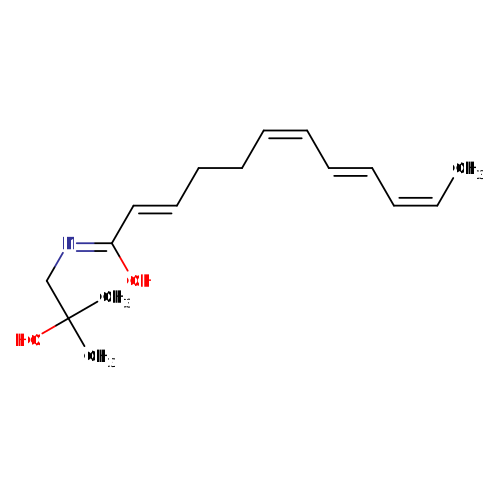
| Record Information |
|---|
| Version | 2.0 |
|---|
| Created at | 2022-05-30 16:37:13 UTC |
|---|
| Updated at | 2022-05-30 16:37:13 UTC |
|---|
| NP-MRD ID | NP0136955 |
|---|
| Secondary Accession Numbers | None |
|---|
| Natural Product Identification |
|---|
| Common Name | Hydroxy-α-sanshool |
|---|
| Description | Hydroxy-alpha-sanshool belongs to the class of organic compounds known as n-acyl amines. N-acyl amines are compounds containing a fatty acid moiety linked to an amine group through an ester linkage. Thus, hydroxy-alpha-sanshool is considered to be a fatty amide lipid molecule. Hydroxy-alpha-sanshool is a very hydrophobic molecule, practically insoluble (in water), and relatively neutral. Hydroxy-alpha sanshool is a molecule found in plants from the genus Zanthoxylum. The term sanshool in the compound's name is derived from the Japanese term for the Sichuan pepper, sanshō (山椒) (literally, mountain pepper), to which was appended the suffix -ol, indicating an alcohol. Outside of the human body, Hydroxy-alpha-sanshool has been detected, but not quantified in, herbs and spices. This could make hydroxy-alpha-sanshool a potential biomarker for the consumption of these foods. Hydroxy-alpha sanshool excites D-hair afferent nerve fibers, a distinct subset of the sensitive light touch receptors in the skin, and targets novel populations of Aβ and C-fiber nerve fibers. The chemical structure of hydroxy-alpha sanshool is similar to that of capsaicin, but the mechanism of action by which it induces nerve sensations have been a matter of debate. It is believed to be responsible for the numbing and tingling sensation caused by eating food cooked with Sichuan peppercorns. Hydroxy-Œ±-sanshool is found in Zanthoxylum bungeanum. Although the compound is an agonist at the pain-integration channels TRPV1 and TRPA1 as capsaicin, newer evidence suggests that the tandem pore domain potassium channels KCNK3, KCNK9, and KCNK18 are primarily responsible for sanshool's effects. |
|---|
| Structure | C\C=C/C=C/C=C\CC\C=C\C(\O)=N\CC(C)(C)O InChI=1S/C16H25NO2/c1-4-5-6-7-8-9-10-11-12-13-15(18)17-14-16(2,3)19/h4-9,12-13,19H,10-11,14H2,1-3H3,(H,17,18)/b5-4-,7-6+,9-8-,13-12+ |
|---|
| Synonyms | | Value | Source |
|---|
| Hydroxy-a-sanshool | Generator | | Hydroxy-α-sanshool | Generator |
|
|---|
| Chemical Formula | C16H25NO2 |
|---|
| Average Mass | 263.3752 Da |
|---|
| Monoisotopic Mass | 263.18853 Da |
|---|
| IUPAC Name | (Z,2E,6Z,8E,10Z)-N-(2-hydroxy-2-methylpropyl)dodeca-2,6,8,10-tetraenimidic acid |
|---|
| Traditional Name | (Z,2E,6Z,8E,10Z)-N-(2-hydroxy-2-methylpropyl)dodeca-2,6,8,10-tetraenimidic acid |
|---|
| CAS Registry Number | Not Available |
|---|
| SMILES | C\C=C/C=C/C=C\CC\C=C\C(\O)=N\CC(C)(C)O |
|---|
| InChI Identifier | InChI=1S/C16H25NO2/c1-4-5-6-7-8-9-10-11-12-13-15(18)17-14-16(2,3)19/h4-9,12-13,19H,10-11,14H2,1-3H3,(H,17,18)/b5-4-,7-6+,9-8-,13-12+ |
|---|
| InChI Key | LHFKHAVGGJJQFF-JRNWQWJGSA-N |
|---|
| Experimental Spectra |
|---|
|
| Not Available | | Predicted Spectra |
|---|
|
| | Spectrum Type | Description | Depositor ID | Depositor Organization | Depositor | Deposition Date | View |
|---|
| 1D NMR | 13C NMR Spectrum (1D, 25 MHz, H2O, predicted) | Wishart Lab | Wishart Lab | David Wishart | 2021-06-20 | View Spectrum | | 1D NMR | 1H NMR Spectrum (1D, 100 MHz, H2O, predicted) | Wishart Lab | Wishart Lab | David Wishart | 2021-06-20 | View Spectrum | | 1D NMR | 13C NMR Spectrum (1D, 252 MHz, H2O, predicted) | Wishart Lab | Wishart Lab | David Wishart | 2021-06-20 | View Spectrum | | 1D NMR | 1H NMR Spectrum (1D, 1000 MHz, H2O, predicted) | Wishart Lab | Wishart Lab | David Wishart | 2021-06-20 | View Spectrum | | 1D NMR | 13C NMR Spectrum (1D, 50 MHz, H2O, predicted) | Wishart Lab | Wishart Lab | David Wishart | 2021-06-20 | View Spectrum | | 1D NMR | 1H NMR Spectrum (1D, 200 MHz, H2O, predicted) | Wishart Lab | Wishart Lab | David Wishart | 2021-06-20 | View Spectrum | | 1D NMR | 13C NMR Spectrum (1D, 75 MHz, H2O, predicted) | Wishart Lab | Wishart Lab | David Wishart | 2021-06-20 | View Spectrum | | 1D NMR | 1H NMR Spectrum (1D, 300 MHz, H2O, predicted) | Wishart Lab | Wishart Lab | David Wishart | 2021-06-20 | View Spectrum | | 1D NMR | 13C NMR Spectrum (1D, 101 MHz, H2O, predicted) | Wishart Lab | Wishart Lab | David Wishart | 2021-06-20 | View Spectrum | | 1D NMR | 1H NMR Spectrum (1D, 400 MHz, H2O, predicted) | Wishart Lab | Wishart Lab | David Wishart | 2021-06-20 | View Spectrum | | 1D NMR | 13C NMR Spectrum (1D, 126 MHz, H2O, predicted) | Wishart Lab | Wishart Lab | David Wishart | 2021-06-20 | View Spectrum | | 1D NMR | 1H NMR Spectrum (1D, 500 MHz, H2O, predicted) | Wishart Lab | Wishart Lab | David Wishart | 2021-06-20 | View Spectrum | | 1D NMR | 13C NMR Spectrum (1D, 151 MHz, H2O, predicted) | Wishart Lab | Wishart Lab | David Wishart | 2021-06-20 | View Spectrum | | 1D NMR | 1H NMR Spectrum (1D, 600 MHz, H2O, predicted) | Wishart Lab | Wishart Lab | David Wishart | 2021-06-20 | View Spectrum | | 1D NMR | 13C NMR Spectrum (1D, 176 MHz, H2O, predicted) | Wishart Lab | Wishart Lab | David Wishart | 2021-06-20 | View Spectrum | | 1D NMR | 1H NMR Spectrum (1D, 700 MHz, H2O, predicted) | Wishart Lab | Wishart Lab | David Wishart | 2021-06-20 | View Spectrum | | 1D NMR | 13C NMR Spectrum (1D, 201 MHz, H2O, predicted) | Wishart Lab | Wishart Lab | David Wishart | 2021-06-20 | View Spectrum | | 1D NMR | 1H NMR Spectrum (1D, 800 MHz, H2O, predicted) | Wishart Lab | Wishart Lab | David Wishart | 2021-06-20 | View Spectrum | | 1D NMR | 13C NMR Spectrum (1D, 226 MHz, H2O, predicted) | Wishart Lab | Wishart Lab | David Wishart | 2021-06-20 | View Spectrum | | 1D NMR | 1H NMR Spectrum (1D, 900 MHz, H2O, predicted) | Wishart Lab | Wishart Lab | David Wishart | 2021-06-20 | View Spectrum |
| | Chemical Shift Submissions |
|---|
|
| Not Available | | Species |
|---|
| Species of Origin | |
|---|
| Chemical Taxonomy |
|---|
| Description | Belongs to the class of organic compounds known as n-acyl amines. N-acyl amines are compounds containing a fatty acid moiety linked to an amine group through an ester linkage. |
|---|
| Kingdom | Organic compounds |
|---|
| Super Class | Lipids and lipid-like molecules |
|---|
| Class | Fatty Acyls |
|---|
| Sub Class | Fatty amides |
|---|
| Direct Parent | N-acyl amines |
|---|
| Alternative Parents | |
|---|
| Substituents | - N-acyl-amine
- Tertiary alcohol
- Secondary carboxylic acid amide
- Carboxamide group
- Carboxylic acid derivative
- Organic nitrogen compound
- Organic oxygen compound
- Organopnictogen compound
- Organic oxide
- Hydrocarbon derivative
- Organooxygen compound
- Organonitrogen compound
- Carbonyl group
- Alcohol
- Aliphatic acyclic compound
|
|---|
| Molecular Framework | Aliphatic acyclic compounds |
|---|
| External Descriptors | Not Available |
|---|
| Physical Properties |
|---|
| State | Not Available |
|---|
| Experimental Properties | | Property | Value | Reference |
|---|
| Melting Point | Not Available | Not Available | | Boiling Point | Not Available | Not Available | | Water Solubility | Not Available | Not Available | | LogP | Not Available | Not Available |
|
|---|
| Predicted Properties | |
|---|