| Record Information |
|---|
| Version | 2.0 |
|---|
| Created at | 2022-05-30 16:28:54 UTC |
|---|
| Updated at | 2022-05-30 16:28:54 UTC |
|---|
| NP-MRD ID | NP0136935 |
|---|
| Secondary Accession Numbers | None |
|---|
| Natural Product Identification |
|---|
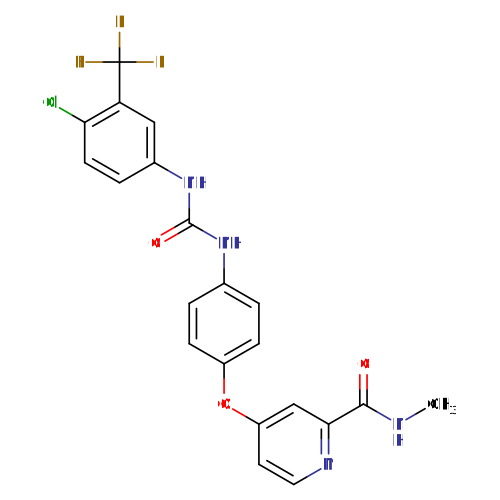
| Common Name | Sorafenib |
|---|
| Description | Sorafenib, also known as nexavar or sorafenib N-oxide, belongs to the class of organic compounds known as diarylethers. These are organic compounds containing the dialkyl ether functional group, with the formula ROR', where R and R' are aryl groups. Sorafenib is a moderately basic compound (based on its pKa). Within humans, sorafenib participates in a number of enzymatic reactions. In particular, sorafenib and uridine diphosphate glucuronic acid can be converted into sorafenib β-D-glucuronide and uridine 5'-diphosphate; which is mediated by the enzyme UDP-glucuronosyltransferase 1-9. In addition, sorafenib can be converted into sorafenib N-oxide through its interaction with the enzyme cytochrome P450 3A4. In humans, sorafenib is involved in sorafenib metabolism pathway. Sorafenib is a potentially toxic compound. Desmoid tumor (aggressive fibromatosis) A study performed in 2011 showed that Sorafenib is active against aggressive fibromatosis. In a randomized, double-blind, phase II trial combining sorafenib with doxorubicin, the median time to progression was not significantly delayed compared with doxorubicin alone in patients with advanced hepatocellular carcinoma. At the current time sorafenib is indicated as a treatment for advanced renal cell carcinoma (RCC), unresectable hepatocellular carcinomas (HCC) and thyroid cancer. In Scotland the drug had already been refused authorization by the Scottish Medicines Consortium for use within NHS Scotland, for the same reason. |
|---|
| Structure | CNC(=O)C1=NC=CC(OC2=CC=C(NC(=O)NC3=CC(=C(Cl)C=C3)C(F)(F)F)C=C2)=C1 InChI=1S/C21H16ClF3N4O3/c1-26-19(30)18-11-15(8-9-27-18)32-14-5-2-12(3-6-14)28-20(31)29-13-4-7-17(22)16(10-13)21(23,24)25/h2-11H,1H3,(H,26,30)(H2,28,29,31) |
|---|
| Synonyms | | Value | Source |
|---|
| 4-(4-((((4-Chloro-3-(trifluoromethyl)phenyl)amino)carbonyl)amino)phenoxy)-N-methyl-2-pyridinecarboxamide | ChEBI | | N-(4-Chloro-3-(trifluoromethyl)phenyl)-n'-(4-(2-(N-methylcarbamoyl)-4-pyridyloxy)phenyl)urea | ChEBI | | Sorafenibum | ChEBI | | Sorafenib tosylate | HMDB | | 4-(4-(3-(4-Chloro-3-trifluoromethylphenyl)ureido)phenoxy)pyridine-2-carboxyllic acid methyamide-4-methylbenzenesulfonate | HMDB | | Nexavar | HMDB | | Sorafenib N-oxide | HMDB | | Sorafenib N oxide | HMDB | | 4-(4-(3-(4-Chloro-3-trifluoromethylphenyl)ureido)phenoxy)pyridine-2-carboxylic acid methyamide-4-methylbenzenesulfonate | HMDB |
|
|---|
| Chemical Formula | C21H16ClF3N4O3 |
|---|
| Average Mass | 464.8250 Da |
|---|
| Monoisotopic Mass | 464.08630 Da |
|---|
| IUPAC Name | 4-[4-({[4-chloro-3-(trifluoromethyl)phenyl]carbamoyl}amino)phenoxy]-N-methylpyridine-2-carboxamide |
|---|
| Traditional Name | sorafenib |
|---|
| CAS Registry Number | Not Available |
|---|
| SMILES | CNC(=O)C1=NC=CC(OC2=CC=C(NC(=O)NC3=CC(=C(Cl)C=C3)C(F)(F)F)C=C2)=C1 |
|---|
| InChI Identifier | InChI=1S/C21H16ClF3N4O3/c1-26-19(30)18-11-15(8-9-27-18)32-14-5-2-12(3-6-14)28-20(31)29-13-4-7-17(22)16(10-13)21(23,24)25/h2-11H,1H3,(H,26,30)(H2,28,29,31) |
|---|
| InChI Key | MLDQJTXFUGDVEO-UHFFFAOYSA-N |
|---|
| Experimental Spectra |
|---|
|
| Not Available | | Predicted Spectra |
|---|
|
| | Spectrum Type | Description | Depositor ID | Depositor Organization | Depositor | Deposition Date | View |
|---|
| 1D NMR | 13C NMR Spectrum (1D, 25 MHz, H2O, predicted) | Wishart Lab | Wishart Lab | David Wishart | 2021-06-20 | View Spectrum | | 1D NMR | 1H NMR Spectrum (1D, 100 MHz, H2O, predicted) | Wishart Lab | Wishart Lab | David Wishart | 2021-06-20 | View Spectrum | | 1D NMR | 13C NMR Spectrum (1D, 252 MHz, H2O, predicted) | Wishart Lab | Wishart Lab | David Wishart | 2021-06-20 | View Spectrum | | 1D NMR | 1H NMR Spectrum (1D, 1000 MHz, H2O, predicted) | Wishart Lab | Wishart Lab | David Wishart | 2021-06-20 | View Spectrum | | 1D NMR | 13C NMR Spectrum (1D, 50 MHz, H2O, predicted) | Wishart Lab | Wishart Lab | David Wishart | 2021-06-20 | View Spectrum | | 1D NMR | 1H NMR Spectrum (1D, 200 MHz, H2O, predicted) | Wishart Lab | Wishart Lab | David Wishart | 2021-06-20 | View Spectrum | | 1D NMR | 13C NMR Spectrum (1D, 75 MHz, H2O, predicted) | Wishart Lab | Wishart Lab | David Wishart | 2021-06-20 | View Spectrum | | 1D NMR | 1H NMR Spectrum (1D, 300 MHz, H2O, predicted) | Wishart Lab | Wishart Lab | David Wishart | 2021-06-20 | View Spectrum | | 1D NMR | 13C NMR Spectrum (1D, 101 MHz, H2O, predicted) | Wishart Lab | Wishart Lab | David Wishart | 2021-06-20 | View Spectrum | | 1D NMR | 1H NMR Spectrum (1D, 400 MHz, H2O, predicted) | Wishart Lab | Wishart Lab | David Wishart | 2021-06-20 | View Spectrum | | 1D NMR | 13C NMR Spectrum (1D, 126 MHz, H2O, predicted) | Wishart Lab | Wishart Lab | David Wishart | 2021-06-20 | View Spectrum | | 1D NMR | 1H NMR Spectrum (1D, 500 MHz, H2O, predicted) | Wishart Lab | Wishart Lab | David Wishart | 2021-06-20 | View Spectrum | | 1D NMR | 13C NMR Spectrum (1D, 151 MHz, H2O, predicted) | Wishart Lab | Wishart Lab | David Wishart | 2021-06-20 | View Spectrum | | 1D NMR | 1H NMR Spectrum (1D, 600 MHz, H2O, predicted) | Wishart Lab | Wishart Lab | David Wishart | 2021-06-20 | View Spectrum | | 1D NMR | 13C NMR Spectrum (1D, 176 MHz, H2O, predicted) | Wishart Lab | Wishart Lab | David Wishart | 2021-06-20 | View Spectrum | | 1D NMR | 1H NMR Spectrum (1D, 700 MHz, H2O, predicted) | Wishart Lab | Wishart Lab | David Wishart | 2021-06-20 | View Spectrum | | 1D NMR | 13C NMR Spectrum (1D, 201 MHz, H2O, predicted) | Wishart Lab | Wishart Lab | David Wishart | 2021-06-20 | View Spectrum | | 1D NMR | 1H NMR Spectrum (1D, 800 MHz, H2O, predicted) | Wishart Lab | Wishart Lab | David Wishart | 2021-06-20 | View Spectrum | | 1D NMR | 13C NMR Spectrum (1D, 226 MHz, H2O, predicted) | Wishart Lab | Wishart Lab | David Wishart | 2021-06-20 | View Spectrum | | 1D NMR | 1H NMR Spectrum (1D, 900 MHz, H2O, predicted) | Wishart Lab | Wishart Lab | David Wishart | 2021-06-20 | View Spectrum |
| | Chemical Shift Submissions |
|---|
|
| Not Available | | Species |
|---|
| Species of Origin | Not Available |
|---|
| Chemical Taxonomy |
|---|
| Description | Belongs to the class of organic compounds known as diarylethers. These are organic compounds containing the dialkyl ether functional group, with the formula ROR', where R and R' are aryl groups. |
|---|
| Kingdom | Organic compounds |
|---|
| Super Class | Organic oxygen compounds |
|---|
| Class | Organooxygen compounds |
|---|
| Sub Class | Ethers |
|---|
| Direct Parent | Diarylethers |
|---|
| Alternative Parents | |
|---|
| Substituents | - Diaryl ether
- Trifluoromethylbenzene
- N-phenylurea
- Pyridine carboxylic acid or derivatives
- Pyridinecarboxamide
- 2-heteroaryl carboxamide
- Phenoxy compound
- Phenol ether
- Halobenzene
- Chlorobenzene
- Benzenoid
- Pyridine
- Monocyclic benzene moiety
- Aryl halide
- Aryl chloride
- Heteroaromatic compound
- Urea
- Secondary carboxylic acid amide
- Carbonic acid derivative
- Carboxamide group
- Azacycle
- Organoheterocyclic compound
- Carboxylic acid derivative
- Organic nitrogen compound
- Organopnictogen compound
- Organic oxide
- Hydrocarbon derivative
- Organonitrogen compound
- Organofluoride
- Organochloride
- Organohalogen compound
- Carbonyl group
- Alkyl halide
- Alkyl fluoride
- Aromatic heteromonocyclic compound
|
|---|
| Molecular Framework | Aromatic heteromonocyclic compounds |
|---|
| External Descriptors | |
|---|
| Physical Properties |
|---|
| State | Not Available |
|---|
| Experimental Properties | | Property | Value | Reference |
|---|
| Melting Point | Not Available | Not Available | | Boiling Point | Not Available | Not Available | | Water Solubility | Not Available | Not Available | | LogP | Not Available | Not Available |
|
|---|
| Predicted Properties | |
|---|