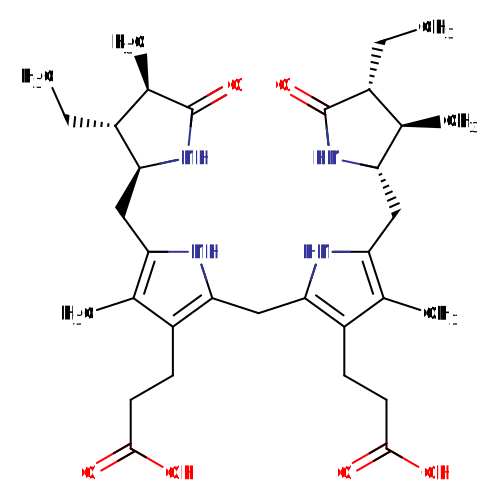
| Record Information |
|---|
| Version | 2.0 |
|---|
| Created at | 2022-05-12 15:26:43 UTC |
|---|
| Updated at | 2022-05-12 15:26:43 UTC |
|---|
| NP-MRD ID | NP0136905 |
|---|
| Secondary Accession Numbers | None |
|---|
| Natural Product Identification |
|---|
| Common Name | Stercobilinogen |
|---|
| Description | Stercobilinogen belongs to the class of organic compounds known as bilirubins. These are organic compounds containing a dicarboxylic acyclic tetrapyrrole derivative. Stercobilinogen is an extremely weak basic (essentially neutral) compound (based on its pKa). It is further processed to become the chemical that gives feces its brown color. It is made of broken-down hemoglobin. Stercobilinogen (fecal urobilinogen) is a chemical created by bacteria in the gut. Bilirubin is a pigment that results from the breakdown of the heme portion of hemoglobin. Stercobilinogen is oxidized to stercobilin, which is responsible for the pigmentation of feces. In the intestine, bilirubin is converted by bacteria to stercobilinogen. Stercobilinogen is absorbed and excreted by either the liver or the kidney. The liver conjugates bilirubin, making it water-soluble; and the conjugated form is then excreted in urine as urobilinogen, giving urine its color. This happens because "Stercobilinogen" is simply the name given to Urobilinogen in the GI tract; and in fact its use as a separate term has fallen out of favor due to the confusion. Stercobilinogen was first documented in 2006 (PMID: 16504607). In early liver disease, impaired biliary excretion causes sterocobilinogen to be absorbed mostly by the kidney, and, therefore, stercobilinogen will appear in the urine in excess as urobilinogen. |
|---|
| Structure | [H][C@@]1(CC2=C(C)C(CCC(O)=O)=C(CC3=C(CCC(O)=O)C(C)=C(C[C@]4([H])NC(=O)[C@H](C)[C@H]4CC)N3)N2)NC(=O)[C@H](CC)[C@H]1C InChI=1S/C33H48N4O6/c1-7-20-19(6)32(42)37-27(20)14-25-18(5)23(10-12-31(40)41)29(35-25)15-28-22(9-11-30(38)39)17(4)24(34-28)13-26-16(3)21(8-2)33(43)36-26/h16,19-21,26-27,34-35H,7-15H2,1-6H3,(H,36,43)(H,37,42)(H,38,39)(H,40,41)/t16-,19-,20-,21-,26+,27+/m1/s1 |
|---|
| Synonyms | | Value | Source |
|---|
| (2R,3R,4S,16S,17R,18R)-2,17-Diethyl-1,2,3,4,5,10,15,16,17,18,19,22,23,24-tetradecahydro-3,7,13,18-tetramethyl-1,19-dioxo-21H-biline-8,12-dipropanoic acid | ChEBI | | L-Stercobilinogen | ChEBI | | (2R,3R,4S,16S,17R,18R)-2,17-Diethyl-1,2,3,4,5,10,15,16,17,18,19,22,23,24-tetradecahydro-3,7,13,18-tetramethyl-1,19-dioxo-21H-biline-8,12-dipropanoate | Generator | | Stercobilinogen ixα | HMDB | | (-)-2,17-Diethyl-1,2,3,4,5,10,15,16,17,18,19,22,23,24-tetradecahydro-3,7,13,18-tetramethyl-1,19-dioxo-biline-8,12-dipropionic acid | HMDB | | (-)-Stercobilinogen | HMDB | | L-Urobilinogen | HMDB | | Stercobilinogen ixalpha | HMDB | | Stercobilinogen | ChEBI |
|
|---|
| Chemical Formula | C33H48N4O6 |
|---|
| Average Mass | 596.7690 Da |
|---|
| Monoisotopic Mass | 596.35739 Da |
|---|
| IUPAC Name | 3-(2-{[3-(2-carboxyethyl)-5-{[(2S,3R,4R)-4-ethyl-3-methyl-5-oxopyrrolidin-2-yl]methyl}-4-methyl-1H-pyrrol-2-yl]methyl}-5-{[(2S,3R,4R)-3-ethyl-4-methyl-5-oxopyrrolidin-2-yl]methyl}-4-methyl-1H-pyrrol-3-yl)propanoic acid |
|---|
| Traditional Name | (-)-stercobilinogen |
|---|
| CAS Registry Number | Not Available |
|---|
| SMILES | [H][C@@]1(CC2=C(C)C(CCC(O)=O)=C(CC3=C(CCC(O)=O)C(C)=C(C[C@]4([H])NC(=O)[C@H](C)[C@H]4CC)N3)N2)NC(=O)[C@H](CC)[C@H]1C |
|---|
| InChI Identifier | InChI=1S/C33H48N4O6/c1-7-20-19(6)32(42)37-27(20)14-25-18(5)23(10-12-31(40)41)29(35-25)15-28-22(9-11-30(38)39)17(4)24(34-28)13-26-16(3)21(8-2)33(43)36-26/h16,19-21,26-27,34-35H,7-15H2,1-6H3,(H,36,43)(H,37,42)(H,38,39)(H,40,41)/t16-,19-,20-,21-,26+,27+/m1/s1 |
|---|
| InChI Key | VKGRRZVYCXLHII-OLFWPHQKSA-N |
|---|
| Experimental Spectra |
|---|
|
| Not Available | | Predicted Spectra |
|---|
|
| | Spectrum Type | Description | Depositor ID | Depositor Organization | Depositor | Deposition Date | View |
|---|
| 1D NMR | 13C NMR Spectrum (1D, 25 MHz, D2O, predicted) | Wishart Lab | Wishart Lab | David Wishart | 2021-06-20 | View Spectrum | | 1D NMR | 1H NMR Spectrum (1D, 100 MHz, D2O, predicted) | Wishart Lab | Wishart Lab | David Wishart | 2021-06-20 | View Spectrum | | 1D NMR | 13C NMR Spectrum (1D, 252 MHz, D2O, predicted) | Wishart Lab | Wishart Lab | David Wishart | 2021-06-20 | View Spectrum | | 1D NMR | 1H NMR Spectrum (1D, 1000 MHz, D2O, predicted) | Wishart Lab | Wishart Lab | David Wishart | 2021-06-20 | View Spectrum | | 1D NMR | 13C NMR Spectrum (1D, 50 MHz, D2O, predicted) | Wishart Lab | Wishart Lab | David Wishart | 2021-06-20 | View Spectrum | | 1D NMR | 1H NMR Spectrum (1D, 200 MHz, D2O, predicted) | Wishart Lab | Wishart Lab | David Wishart | 2021-06-20 | View Spectrum | | 1D NMR | 13C NMR Spectrum (1D, 75 MHz, D2O, predicted) | Wishart Lab | Wishart Lab | David Wishart | 2021-06-20 | View Spectrum | | 1D NMR | 1H NMR Spectrum (1D, 300 MHz, D2O, predicted) | Wishart Lab | Wishart Lab | David Wishart | 2021-06-20 | View Spectrum | | 1D NMR | 13C NMR Spectrum (1D, 101 MHz, D2O, predicted) | Wishart Lab | Wishart Lab | David Wishart | 2021-06-20 | View Spectrum | | 1D NMR | 1H NMR Spectrum (1D, 400 MHz, D2O, predicted) | Wishart Lab | Wishart Lab | David Wishart | 2021-06-20 | View Spectrum | | 1D NMR | 13C NMR Spectrum (1D, 126 MHz, D2O, predicted) | Wishart Lab | Wishart Lab | David Wishart | 2021-06-20 | View Spectrum | | 1D NMR | 1H NMR Spectrum (1D, 500 MHz, D2O, predicted) | Wishart Lab | Wishart Lab | David Wishart | 2021-06-20 | View Spectrum | | 1D NMR | 13C NMR Spectrum (1D, 151 MHz, D2O, predicted) | Wishart Lab | Wishart Lab | David Wishart | 2021-06-20 | View Spectrum | | 1D NMR | 1H NMR Spectrum (1D, 600 MHz, D2O, predicted) | Wishart Lab | Wishart Lab | David Wishart | 2021-06-20 | View Spectrum | | 1D NMR | 13C NMR Spectrum (1D, 176 MHz, D2O, predicted) | Wishart Lab | Wishart Lab | David Wishart | 2021-06-20 | View Spectrum | | 1D NMR | 1H NMR Spectrum (1D, 700 MHz, D2O, predicted) | Wishart Lab | Wishart Lab | David Wishart | 2021-06-20 | View Spectrum | | 1D NMR | 13C NMR Spectrum (1D, 201 MHz, D2O, predicted) | Wishart Lab | Wishart Lab | David Wishart | 2021-06-20 | View Spectrum | | 1D NMR | 1H NMR Spectrum (1D, 800 MHz, D2O, predicted) | Wishart Lab | Wishart Lab | David Wishart | 2021-06-20 | View Spectrum | | 1D NMR | 13C NMR Spectrum (1D, 226 MHz, D2O, predicted) | Wishart Lab | Wishart Lab | David Wishart | 2021-06-20 | View Spectrum | | 1D NMR | 1H NMR Spectrum (1D, 900 MHz, D2O, predicted) | Wishart Lab | Wishart Lab | David Wishart | 2021-06-20 | View Spectrum |
| | Chemical Shift Submissions |
|---|
|
| Not Available | | Species |
|---|
| Species of Origin | Not Available |
|---|
| Chemical Taxonomy |
|---|
| Description | Belongs to the class of organic compounds known as bilirubins. These are organic compounds containing a dicarboxylic acyclic tetrapyrrole derivative. |
|---|
| Kingdom | Organic compounds |
|---|
| Super Class | Organoheterocyclic compounds |
|---|
| Class | Tetrapyrroles and derivatives |
|---|
| Sub Class | Bilirubins |
|---|
| Direct Parent | Bilirubins |
|---|
| Alternative Parents | |
|---|
| Substituents | - Bilirubin skeleton
- Dicarboxylic acid or derivatives
- Substituted pyrrole
- 2-pyrrolidone
- Pyrrolidone
- Pyrrole
- Heteroaromatic compound
- Pyrrolidine
- Carboxamide group
- Lactam
- Secondary carboxylic acid amide
- Carboxylic acid derivative
- Carboxylic acid
- Azacycle
- Organonitrogen compound
- Organic oxide
- Organopnictogen compound
- Organic nitrogen compound
- Organic oxygen compound
- Organooxygen compound
- Hydrocarbon derivative
- Carbonyl group
- Aromatic heteromonocyclic compound
|
|---|
| Molecular Framework | Aromatic heteromonocyclic compounds |
|---|
| External Descriptors | |
|---|
| Physical Properties |
|---|
| State | Not Available |
|---|
| Experimental Properties | | Property | Value | Reference |
|---|
| Melting Point | Not Available | Not Available | | Boiling Point | Not Available | Not Available | | Water Solubility | Not Available | Not Available | | LogP | Not Available | Not Available |
|
|---|
| Predicted Properties | |
|---|