| Record Information |
|---|
| Version | 2.0 |
|---|
| Created at | 2022-05-12 15:20:35 UTC |
|---|
| Updated at | 2022-05-12 15:20:35 UTC |
|---|
| NP-MRD ID | NP0136673 |
|---|
| Secondary Accession Numbers | None |
|---|
| Natural Product Identification |
|---|
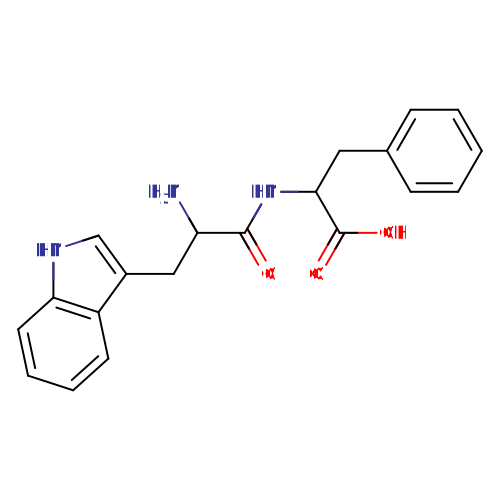
| Common Name | Tryptophyl-Phenylalanine |
|---|
| Description | Tryptophyl-Phenylalanine, also known as W-F dipeptide or TRP-phe, belongs to the class of organic compounds known as dipeptides. These are organic compounds containing a sequence of exactly two alpha-amino acids joined by a peptide bond. Tryptophyl-Phenylalanine is a very strong basic compound (based on its pKa). It is an incomplete breakdown product of protein digestion or protein catabolism. Some dipeptides are known to have physiological or cell-signaling effects although most are simply short-lived intermediates on their way to specific amino acid degradation pathways following further proteolysis. Tryptophyl-Phenylalanine is a dipeptide composed of tryptophan and phenylalanine. Tryptophyl-Phenylalanine was first documented in 1992 (PMID: 1375965). This dipeptide has not yet been identified in human tissues or biofluids and so it is classified as an 'Expected' metabolite (PMID: 17436599). |
|---|
| Structure | NC(CC1=CNC2=C1C=CC=C2)C(=O)NC(CC1=CC=CC=C1)C(O)=O InChI=1S/C20H21N3O3/c21-16(11-14-12-22-17-9-5-4-8-15(14)17)19(24)23-18(20(25)26)10-13-6-2-1-3-7-13/h1-9,12,16,18,22H,10-11,21H2,(H,23,24)(H,25,26) |
|---|
| Synonyms | | Value | Source |
|---|
| L-Tryptophyl-L-phenylalanine | HMDB | | TRP-Phe | HMDB | | Tryptophan phenylalanine dipeptide | HMDB | | Tryptophan-phenylalanine dipeptide | HMDB | | Tryptophylphenylalanine | HMDB | | W-F Dipeptide | HMDB | | WF Dipeptide | HMDB | | 2-{[2-amino-1-hydroxy-3-(1H-indol-3-yl)propylidene]amino}-3-phenylpropanoate | Generator |
|
|---|
| Chemical Formula | C20H21N3O3 |
|---|
| Average Mass | 351.3990 Da |
|---|
| Monoisotopic Mass | 351.15829 Da |
|---|
| IUPAC Name | 2-[2-amino-3-(1H-indol-3-yl)propanamido]-3-phenylpropanoic acid |
|---|
| Traditional Name | trp-phe |
|---|
| CAS Registry Number | Not Available |
|---|
| SMILES | NC(CC1=CNC2=C1C=CC=C2)C(=O)NC(CC1=CC=CC=C1)C(O)=O |
|---|
| InChI Identifier | InChI=1S/C20H21N3O3/c21-16(11-14-12-22-17-9-5-4-8-15(14)17)19(24)23-18(20(25)26)10-13-6-2-1-3-7-13/h1-9,12,16,18,22H,10-11,21H2,(H,23,24)(H,25,26) |
|---|
| InChI Key | IMMPMHKLUUZKAZ-UHFFFAOYSA-N |
|---|
| Experimental Spectra |
|---|
|
| Not Available | | Predicted Spectra |
|---|
|
| | Spectrum Type | Description | Depositor ID | Depositor Organization | Depositor | Deposition Date | View |
|---|
| 1D NMR | 13C NMR Spectrum (1D, 25 MHz, D2O, predicted) | Wishart Lab | Wishart Lab | David Wishart | 2021-06-20 | View Spectrum | | 1D NMR | 1H NMR Spectrum (1D, 100 MHz, D2O, predicted) | Wishart Lab | Wishart Lab | David Wishart | 2021-06-20 | View Spectrum | | 1D NMR | 13C NMR Spectrum (1D, 252 MHz, D2O, predicted) | Wishart Lab | Wishart Lab | David Wishart | 2021-06-20 | View Spectrum | | 1D NMR | 1H NMR Spectrum (1D, 1000 MHz, D2O, predicted) | Wishart Lab | Wishart Lab | David Wishart | 2021-06-20 | View Spectrum | | 1D NMR | 13C NMR Spectrum (1D, 50 MHz, D2O, predicted) | Wishart Lab | Wishart Lab | David Wishart | 2021-06-20 | View Spectrum | | 1D NMR | 1H NMR Spectrum (1D, 200 MHz, D2O, predicted) | Wishart Lab | Wishart Lab | David Wishart | 2021-06-20 | View Spectrum | | 1D NMR | 13C NMR Spectrum (1D, 75 MHz, D2O, predicted) | Wishart Lab | Wishart Lab | David Wishart | 2021-06-20 | View Spectrum | | 1D NMR | 1H NMR Spectrum (1D, 300 MHz, D2O, predicted) | Wishart Lab | Wishart Lab | David Wishart | 2021-06-20 | View Spectrum | | 1D NMR | 13C NMR Spectrum (1D, 101 MHz, D2O, predicted) | Wishart Lab | Wishart Lab | David Wishart | 2021-06-20 | View Spectrum | | 1D NMR | 1H NMR Spectrum (1D, 400 MHz, D2O, predicted) | Wishart Lab | Wishart Lab | David Wishart | 2021-06-20 | View Spectrum | | 1D NMR | 13C NMR Spectrum (1D, 126 MHz, D2O, predicted) | Wishart Lab | Wishart Lab | David Wishart | 2021-06-20 | View Spectrum | | 1D NMR | 1H NMR Spectrum (1D, 500 MHz, D2O, predicted) | Wishart Lab | Wishart Lab | David Wishart | 2021-06-20 | View Spectrum | | 1D NMR | 13C NMR Spectrum (1D, 151 MHz, D2O, predicted) | Wishart Lab | Wishart Lab | David Wishart | 2021-06-20 | View Spectrum | | 1D NMR | 1H NMR Spectrum (1D, 600 MHz, D2O, predicted) | Wishart Lab | Wishart Lab | David Wishart | 2021-06-20 | View Spectrum | | 1D NMR | 13C NMR Spectrum (1D, 176 MHz, D2O, predicted) | Wishart Lab | Wishart Lab | David Wishart | 2021-06-20 | View Spectrum | | 1D NMR | 1H NMR Spectrum (1D, 700 MHz, D2O, predicted) | Wishart Lab | Wishart Lab | David Wishart | 2021-06-20 | View Spectrum | | 1D NMR | 13C NMR Spectrum (1D, 201 MHz, D2O, predicted) | Wishart Lab | Wishart Lab | David Wishart | 2021-06-20 | View Spectrum | | 1D NMR | 1H NMR Spectrum (1D, 800 MHz, D2O, predicted) | Wishart Lab | Wishart Lab | David Wishart | 2021-06-20 | View Spectrum | | 1D NMR | 13C NMR Spectrum (1D, 226 MHz, D2O, predicted) | Wishart Lab | Wishart Lab | David Wishart | 2021-06-20 | View Spectrum | | 1D NMR | 1H NMR Spectrum (1D, 900 MHz, D2O, predicted) | Wishart Lab | Wishart Lab | David Wishart | 2021-06-20 | View Spectrum |
| | Chemical Shift Submissions |
|---|
|
| Not Available | | Species |
|---|
| Species of Origin | Not Available |
|---|
| Chemical Taxonomy |
|---|
| Description | Belongs to the class of organic compounds known as dipeptides. These are organic compounds containing a sequence of exactly two alpha-amino acids joined by a peptide bond. |
|---|
| Kingdom | Organic compounds |
|---|
| Super Class | Organic acids and derivatives |
|---|
| Class | Carboxylic acids and derivatives |
|---|
| Sub Class | Amino acids, peptides, and analogues |
|---|
| Direct Parent | Dipeptides |
|---|
| Alternative Parents | |
|---|
| Substituents | - Alpha-dipeptide
- Phenylalanine or derivatives
- N-acyl-alpha amino acid or derivatives
- N-acyl-alpha-amino acid
- Alpha-amino acid amide
- Triptan
- 3-phenylpropanoic-acid
- Alpha-amino acid or derivatives
- Amphetamine or derivatives
- 3-alkylindole
- Indole or derivatives
- Indole
- Aralkylamine
- Benzenoid
- Fatty acyl
- Substituted pyrrole
- Monocyclic benzene moiety
- Fatty amide
- Pyrrole
- Heteroaromatic compound
- Amino acid or derivatives
- Secondary carboxylic acid amide
- Carboxamide group
- Amino acid
- Azacycle
- Carboxylic acid
- Organoheterocyclic compound
- Monocarboxylic acid or derivatives
- Primary amine
- Amine
- Organic oxygen compound
- Organic nitrogen compound
- Carbonyl group
- Hydrocarbon derivative
- Organic oxide
- Organooxygen compound
- Primary aliphatic amine
- Organopnictogen compound
- Organonitrogen compound
- Aromatic heteropolycyclic compound
|
|---|
| Molecular Framework | Aromatic heteropolycyclic compounds |
|---|
| External Descriptors | Not Available |
|---|
| Physical Properties |
|---|
| State | Not Available |
|---|
| Experimental Properties | | Property | Value | Reference |
|---|
| Melting Point | Not Available | Not Available | | Boiling Point | Not Available | Not Available | | Water Solubility | Not Available | Not Available | | LogP | Not Available | Not Available |
|
|---|
| Predicted Properties | |
|---|