| Record Information |
|---|
| Version | 2.0 |
|---|
| Created at | 2022-05-12 15:14:55 UTC |
|---|
| Updated at | 2022-05-12 15:14:55 UTC |
|---|
| NP-MRD ID | NP0136453 |
|---|
| Secondary Accession Numbers | None |
|---|
| Natural Product Identification |
|---|
| Common Name | Glutamyltryptophan |
|---|
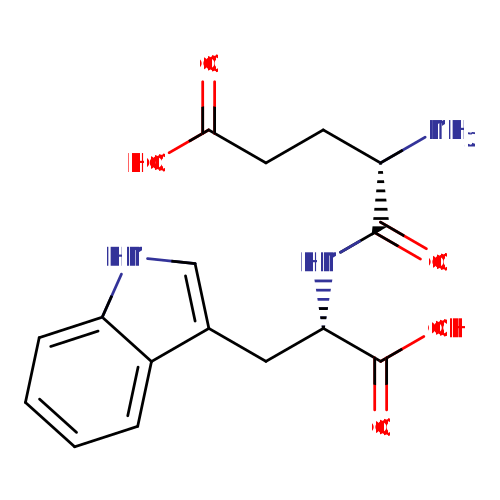
| Description | Glutamyltryptophan, also known as alpha-glu-TRP or oglufanide, belongs to the class of organic compounds known as peptides. Peptides are compounds containing an amide derived from two or more amino carboxylic acid molecules (the same or different) by formation of a covalent bond from the carbonyl carbon of one to the nitrogen atom of another. It may control or reverse the suppression of the immune system which the hepatitis virus uses to defeat our normally healthy defenses. Glutamyltryptophan is a very strong basic compound (based on its pKa). Glutamyltryptophan is a dipeptide composed of glutamate and tryptophan, and is a proteolytic breakdown product of larger proteins. The synthetic version of this dipeptide is named Oglufanide. Glutamyltryptophan is a synthetic dipeptide immunomodulator in development for the treatment of chronic hepatitis C viral infection. Some dipeptides are known to have physiological or cell-signaling effects although most are simply short-lived intermediates on their way to specific amino acid degradation pathways following further proteolysis. These are compounds containing an alpha amino acid which bears an acyl group at its terminal nitrogen atom. Glutamyltryptophan is an incomplete breakdown product of protein digestion or protein catabolism. Glutamyltryptophan was first documented in 2000 (PMID: 11707921). Glutamyltryptophan regulates the body's innate immune response to defeat invading germs and cancer cells (PMID: 17276896). |
|---|
| Structure | N[C@@H](CCC(O)=O)C(=O)N[C@@H](CC1=CNC2=CC=CC=C12)C(O)=O InChI=1S/C16H19N3O5/c17-11(5-6-14(20)21)15(22)19-13(16(23)24)7-9-8-18-12-4-2-1-3-10(9)12/h1-4,8,11,13,18H,5-7,17H2,(H,19,22)(H,20,21)(H,23,24)/t11-,13-/m0/s1 |
|---|
| Synonyms | | Value | Source |
|---|
| alpha-Glu-TRP | ChEBI | | alpha-Glutamyltryptophan | ChEBI | | L-alpha-Glu-L-TRP | ChEBI | | L-Glu-L-TRP | ChEBI | | Oglufanide | ChEBI | | a-Glu-TRP | Generator | | Α-glu-TRP | Generator | | a-Glutamyltryptophan | Generator | | Α-glutamyltryptophan | Generator | | L-a-Glu-L-TRP | Generator | | L-Α-glu-L-TRP | Generator | | Glu-TRP | HMDB | | L-alpha-Glutamyl-L-tryptophan | HMDB | | Α-L-glu-L-TRP | HMDB | | Α-L-glutamyl-L-tryptophan | HMDB | | L-Α-glutamyl-L-tryptophan | HMDB | | N-Α-glutamyltryptophan | HMDB | | N-Α-L-glutamyl-L-tryptophan | HMDB | | N-L-Α-glutamyltryptophan | HMDB | | N-L-Α-glutamyl-L-tryptophan | HMDB | | alpha-L-Glu-L-TRP | HMDB | | alpha-L-Glutamyl-L-tryptophan | HMDB | | N-alpha-Glutamyltryptophan | HMDB | | N-alpha-L-Glutamyl-L-tryptophan | HMDB | | N-L-alpha-Glutamyltryptophan | HMDB | | N-L-alpha-Glutamyl-L-tryptophan | HMDB | | IM 862 | HMDB | | NSC 334073 | HMDB | | Thymogen | HMDB | | Timogen | HMDB | | L-Glutamyl-L-tryptophan | HMDB | | N-Glutamyltryptophan | HMDB | | N-L-Glutamyl-L-tryptophan | HMDB | | Glutamyl-tryptophan | HMDB | | Glutamic acid tryptophan dipeptide | HMDB | | Glutamate tryptophan dipeptide | HMDB | | Glutamic acid-tryptophan dipeptide | HMDB | | Glutamate-tryptophan dipeptide | HMDB | | e-W Dipeptide | HMDB | | EW dipeptide | HMDB | | Glutamyltryptophan | HMDB, ChEBI |
|
|---|
| Chemical Formula | C16H19N3O5 |
|---|
| Average Mass | 333.3440 Da |
|---|
| Monoisotopic Mass | 333.13247 Da |
|---|
| IUPAC Name | (4S)-4-amino-4-{[(1S)-1-carboxy-2-(1H-indol-3-yl)ethyl]carbamoyl}butanoic acid |
|---|
| Traditional Name | (4S)-4-amino-4-{[(1S)-1-carboxy-2-(1H-indol-3-yl)ethyl]carbamoyl}butanoic acid |
|---|
| CAS Registry Number | Not Available |
|---|
| SMILES | N[C@@H](CCC(O)=O)C(=O)N[C@@H](CC1=CNC2=CC=CC=C12)C(O)=O |
|---|
| InChI Identifier | InChI=1S/C16H19N3O5/c17-11(5-6-14(20)21)15(22)19-13(16(23)24)7-9-8-18-12-4-2-1-3-10(9)12/h1-4,8,11,13,18H,5-7,17H2,(H,19,22)(H,20,21)(H,23,24)/t11-,13-/m0/s1 |
|---|
| InChI Key | LLEUXCDZPQOJMY-AAEUAGOBSA-N |
|---|
| Experimental Spectra |
|---|
|
| Not Available | | Predicted Spectra |
|---|
|
| | Spectrum Type | Description | Depositor ID | Depositor Organization | Depositor | Deposition Date | View |
|---|
| 1D NMR | 13C NMR Spectrum (1D, 25 MHz, D2O, predicted) | Wishart Lab | Wishart Lab | David Wishart | 2021-06-20 | View Spectrum | | 1D NMR | 1H NMR Spectrum (1D, 100 MHz, D2O, predicted) | Wishart Lab | Wishart Lab | David Wishart | 2021-06-20 | View Spectrum | | 1D NMR | 13C NMR Spectrum (1D, 252 MHz, D2O, predicted) | Wishart Lab | Wishart Lab | David Wishart | 2021-06-20 | View Spectrum | | 1D NMR | 1H NMR Spectrum (1D, 1000 MHz, D2O, predicted) | Wishart Lab | Wishart Lab | David Wishart | 2021-06-20 | View Spectrum | | 1D NMR | 13C NMR Spectrum (1D, 50 MHz, D2O, predicted) | Wishart Lab | Wishart Lab | David Wishart | 2021-06-20 | View Spectrum | | 1D NMR | 1H NMR Spectrum (1D, 200 MHz, D2O, predicted) | Wishart Lab | Wishart Lab | David Wishart | 2021-06-20 | View Spectrum | | 1D NMR | 13C NMR Spectrum (1D, 75 MHz, D2O, predicted) | Wishart Lab | Wishart Lab | David Wishart | 2021-06-20 | View Spectrum | | 1D NMR | 1H NMR Spectrum (1D, 300 MHz, D2O, predicted) | Wishart Lab | Wishart Lab | David Wishart | 2021-06-20 | View Spectrum | | 1D NMR | 13C NMR Spectrum (1D, 101 MHz, D2O, predicted) | Wishart Lab | Wishart Lab | David Wishart | 2021-06-20 | View Spectrum | | 1D NMR | 1H NMR Spectrum (1D, 400 MHz, D2O, predicted) | Wishart Lab | Wishart Lab | David Wishart | 2021-06-20 | View Spectrum | | 1D NMR | 13C NMR Spectrum (1D, 126 MHz, D2O, predicted) | Wishart Lab | Wishart Lab | David Wishart | 2021-06-20 | View Spectrum | | 1D NMR | 1H NMR Spectrum (1D, 500 MHz, D2O, predicted) | Wishart Lab | Wishart Lab | David Wishart | 2021-06-20 | View Spectrum | | 1D NMR | 13C NMR Spectrum (1D, 151 MHz, D2O, predicted) | Wishart Lab | Wishart Lab | David Wishart | 2021-06-20 | View Spectrum | | 1D NMR | 1H NMR Spectrum (1D, 600 MHz, D2O, predicted) | Wishart Lab | Wishart Lab | David Wishart | 2021-06-20 | View Spectrum | | 1D NMR | 13C NMR Spectrum (1D, 176 MHz, D2O, predicted) | Wishart Lab | Wishart Lab | David Wishart | 2021-06-20 | View Spectrum | | 1D NMR | 1H NMR Spectrum (1D, 700 MHz, D2O, predicted) | Wishart Lab | Wishart Lab | David Wishart | 2021-06-20 | View Spectrum | | 1D NMR | 13C NMR Spectrum (1D, 201 MHz, D2O, predicted) | Wishart Lab | Wishart Lab | David Wishart | 2021-06-20 | View Spectrum | | 1D NMR | 1H NMR Spectrum (1D, 800 MHz, D2O, predicted) | Wishart Lab | Wishart Lab | David Wishart | 2021-06-20 | View Spectrum | | 1D NMR | 13C NMR Spectrum (1D, 226 MHz, D2O, predicted) | Wishart Lab | Wishart Lab | David Wishart | 2021-06-20 | View Spectrum | | 1D NMR | 1H NMR Spectrum (1D, 900 MHz, D2O, predicted) | Wishart Lab | Wishart Lab | David Wishart | 2021-06-20 | View Spectrum |
| | Chemical Shift Submissions |
|---|
|
| Not Available | | Species |
|---|
| Species of Origin | Not Available |
|---|
| Chemical Taxonomy |
|---|
| Description | Belongs to the class of organic compounds known as peptides. Peptides are compounds containing an amide derived from two or more amino carboxylic acid molecules (the same or different) by formation of a covalent bond from the carbonyl carbon of one to the nitrogen atom of another. |
|---|
| Kingdom | Organic compounds |
|---|
| Super Class | Organic acids and derivatives |
|---|
| Class | Carboxylic acids and derivatives |
|---|
| Sub Class | Amino acids, peptides, and analogues |
|---|
| Direct Parent | Peptides |
|---|
| Alternative Parents | |
|---|
| Substituents | - Alpha peptide
- N-acyl-alpha-amino acid
- N-acyl-alpha amino acid or derivatives
- Gamma amino acid or derivatives
- Alpha-amino acid or derivatives
- 3-alkylindole
- Indole
- Indole or derivatives
- Amino fatty acid
- Dicarboxylic acid or derivatives
- Substituted pyrrole
- Fatty acyl
- Benzenoid
- Pyrrole
- Heteroaromatic compound
- Amino acid or derivatives
- Amino acid
- Organoheterocyclic compound
- Organic 1,3-dipolar compound
- Azacycle
- Propargyl-type 1,3-dipolar organic compound
- Carboximidic acid
- Carboximidic acid derivative
- Carboxylic acid
- Amine
- Organic oxide
- Organopnictogen compound
- Organic nitrogen compound
- Primary aliphatic amine
- Hydrocarbon derivative
- Organonitrogen compound
- Carbonyl group
- Organic oxygen compound
- Organooxygen compound
- Primary amine
- Aromatic heteropolycyclic compound
|
|---|
| Molecular Framework | Aromatic heteropolycyclic compounds |
|---|
| External Descriptors | |
|---|
| Physical Properties |
|---|
| State | Not Available |
|---|
| Experimental Properties | | Property | Value | Reference |
|---|
| Melting Point | Not Available | Not Available | | Boiling Point | Not Available | Not Available | | Water Solubility | Not Available | Not Available | | LogP | Not Available | Not Available |
|
|---|
| Predicted Properties | |
|---|