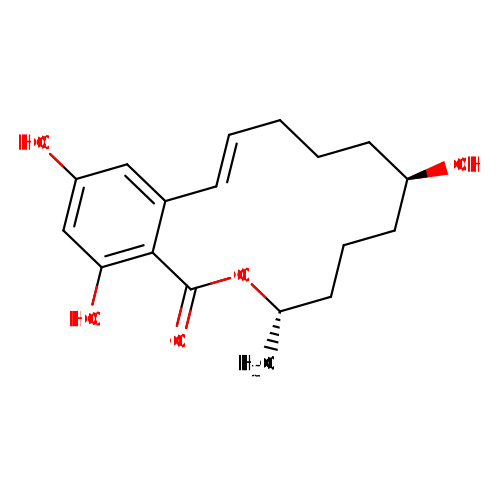
| Record Information |
|---|
| Version | 2.0 |
|---|
| Created at | 2022-05-12 15:09:50 UTC |
|---|
| Updated at | 2022-05-12 15:09:51 UTC |
|---|
| NP-MRD ID | NP0136257 |
|---|
| Secondary Accession Numbers | None |
|---|
| Natural Product Identification |
|---|
| Common Name | alpha-Zearalenol |
|---|
| Description | Alpha-Zearalenol, also known as trans-zearalenol, belongs to the class of organic compounds known as macrolides and analogues. These are organic compounds containing a lactone ring of at least twelve members. Alpha-Zearalenol is an extremely weak basic (essentially neutral) compound (based on its pKa). Alpha-Zearalenol is a potentially toxic compound. These are organic compounds containing a lactone ring of at least twelve members. The enzymatic activity of 3beta-HSD and the abundance of p450scc protein were also reduced by these mycotoxins. The zearalenone metabolites induced loss of mitochondrial membrane potential (MMP), mitochondrial changes in Bcl-2 and Bax proteins, and cytoplasmic release of cytochrome c and apoptosis-inducing factor (AIF). Testing the zearalenone derivatives, _- and _-ZOL, which is metabolised in the liver, as an examination of excretory products indicated a predominance of the _ epimer in pig and man (A15419) Generally, alpha-zearalenol possess estrogenic potencies that are approximately 50% compared to that of E2, and their order of estrogenic potency (in both in vitro receptor competitive binding and in vivo induction of Vtg and Zr-proteins levels) is: Alpha-zearalenol > beta-zearalenol. Use of an inhibitor specific to c-Jun N-terminal kinase (JNK), p38 kinase or p53, but not pan-caspase or caspase-8, decreased the toxin-induced generation of reactive oxygen species (ROS) and also attenuated the _-ZOL- or _-ZOL-induced decrease of cell viability. The activation of p53, JNK or p38 kinase by zearalenone metabolites is the main upstream signal required for the mitochondrial alteration of Bcl-2/Bax signaling pathways and intracellular ROS generation, while MMP loss and nuclear translocation of AIF are the critical downstream events for zearalenone metabolite-mediated apoptosis in macrophages. The effects of mycotoxins on FSH receptor-dependent and receptor-independent pathways indicate that adenylate cyclase activity and/or regulatory pathways further downstream are targets of mycotoxin actions. The mechanisms by which _-ZOL or _-ZOL mediates their cytotoxic effects appear to differ according to cell type and the exposed toxins. It has also been observed that mycotoxin alpha and beta zearalenol influence the apoptosis and proliferation of cultured granulosa cells from equine ovaries. In evaluating the toxicity of _-ZOL and _-ZOL on RAW264.7 Macrophages, _-ZOL not only more strongly reduced the viability of cells than did _-ZOL, but it also induced cell death mainly by apoptosis rather than necrosis. |
|---|
| Structure | C[C@H]1CCC[C@H](O)CCC\C=C\C2=CC(O)=CC(O)=C2C(=O)O1 InChI=1S/C18H24O5/c1-12-6-5-9-14(19)8-4-2-3-7-13-10-15(20)11-16(21)17(13)18(22)23-12/h3,7,10-12,14,19-21H,2,4-6,8-9H2,1H3/b7-3+/t12-,14+/m0/s1 |
|---|
| Synonyms | | Value | Source |
|---|
| trans-Zearalenol | Kegg | | a-Zearalenol | Generator | | Α-zearalenol | Generator | | alpha-Zearalenol, (cis)-isomer | HMDB | | Zearalenol | HMDB | | beta-Zearalenol | HMDB | | (-)-beta-Zearalenol | MeSH | | 3,4,5,6,7,8,9,10-Octahydro-7,14,16-trihydroxy-3-methyl-1H-2-benzoxacyclotetradecin-1-one | MeSH | | (3R,7R,11E)-7,14,16-Trihydroxy-3-methyl-3,4,5,6,7,8,9,10-octahydro-1H-2-benzoxacyclotetradecin-1-one | MeSH | | beta-trans-Zearalenol | MeSH |
|
|---|
| Chemical Formula | C18H24O5 |
|---|
| Average Mass | 320.3802 Da |
|---|
| Monoisotopic Mass | 320.16237 Da |
|---|
| IUPAC Name | (3S,7R)-7,14,16-trihydroxy-3-methyl-3,4,5,6,7,8,9,10-octahydro-1H-2-benzoxacyclotetradecin-1-one |
|---|
| Traditional Name | zeranol |
|---|
| CAS Registry Number | Not Available |
|---|
| SMILES | C[C@H]1CCC[C@H](O)CCC\C=C\C2=CC(O)=CC(O)=C2C(=O)O1 |
|---|
| InChI Identifier | InChI=1S/C18H24O5/c1-12-6-5-9-14(19)8-4-2-3-7-13-10-15(20)11-16(21)17(13)18(22)23-12/h3,7,10-12,14,19-21H,2,4-6,8-9H2,1H3/b7-3+/t12-,14+/m0/s1 |
|---|
| InChI Key | FPQFYIAXQDXNOR-QDKLYSGJSA-N |
|---|
| Experimental Spectra |
|---|
|
| Not Available | | Predicted Spectra |
|---|
|
| | Spectrum Type | Description | Depositor ID | Depositor Organization | Depositor | Deposition Date | View |
|---|
| 1D NMR | 13C NMR Spectrum (1D, 25 MHz, D2O, predicted) | Wishart Lab | Wishart Lab | David Wishart | 2021-06-20 | View Spectrum | | 1D NMR | 1H NMR Spectrum (1D, 100 MHz, D2O, predicted) | Wishart Lab | Wishart Lab | David Wishart | 2021-06-20 | View Spectrum | | 1D NMR | 13C NMR Spectrum (1D, 252 MHz, D2O, predicted) | Wishart Lab | Wishart Lab | David Wishart | 2021-06-20 | View Spectrum | | 1D NMR | 1H NMR Spectrum (1D, 1000 MHz, D2O, predicted) | Wishart Lab | Wishart Lab | David Wishart | 2021-06-20 | View Spectrum | | 1D NMR | 13C NMR Spectrum (1D, 50 MHz, D2O, predicted) | Wishart Lab | Wishart Lab | David Wishart | 2021-06-20 | View Spectrum | | 1D NMR | 1H NMR Spectrum (1D, 200 MHz, D2O, predicted) | Wishart Lab | Wishart Lab | David Wishart | 2021-06-20 | View Spectrum | | 1D NMR | 13C NMR Spectrum (1D, 75 MHz, D2O, predicted) | Wishart Lab | Wishart Lab | David Wishart | 2021-06-20 | View Spectrum | | 1D NMR | 1H NMR Spectrum (1D, 300 MHz, D2O, predicted) | Wishart Lab | Wishart Lab | David Wishart | 2021-06-20 | View Spectrum | | 1D NMR | 13C NMR Spectrum (1D, 101 MHz, D2O, predicted) | Wishart Lab | Wishart Lab | David Wishart | 2021-06-20 | View Spectrum | | 1D NMR | 1H NMR Spectrum (1D, 400 MHz, D2O, predicted) | Wishart Lab | Wishart Lab | David Wishart | 2021-06-20 | View Spectrum | | 1D NMR | 13C NMR Spectrum (1D, 126 MHz, D2O, predicted) | Wishart Lab | Wishart Lab | David Wishart | 2021-06-20 | View Spectrum | | 1D NMR | 1H NMR Spectrum (1D, 500 MHz, D2O, predicted) | Wishart Lab | Wishart Lab | David Wishart | 2021-06-20 | View Spectrum | | 1D NMR | 13C NMR Spectrum (1D, 151 MHz, D2O, predicted) | Wishart Lab | Wishart Lab | David Wishart | 2021-06-20 | View Spectrum | | 1D NMR | 1H NMR Spectrum (1D, 600 MHz, D2O, predicted) | Wishart Lab | Wishart Lab | David Wishart | 2021-06-20 | View Spectrum | | 1D NMR | 13C NMR Spectrum (1D, 176 MHz, D2O, predicted) | Wishart Lab | Wishart Lab | David Wishart | 2021-06-20 | View Spectrum | | 1D NMR | 1H NMR Spectrum (1D, 700 MHz, D2O, predicted) | Wishart Lab | Wishart Lab | David Wishart | 2021-06-20 | View Spectrum | | 1D NMR | 13C NMR Spectrum (1D, 201 MHz, D2O, predicted) | Wishart Lab | Wishart Lab | David Wishart | 2021-06-20 | View Spectrum | | 1D NMR | 1H NMR Spectrum (1D, 800 MHz, D2O, predicted) | Wishart Lab | Wishart Lab | David Wishart | 2021-06-20 | View Spectrum | | 1D NMR | 13C NMR Spectrum (1D, 226 MHz, D2O, predicted) | Wishart Lab | Wishart Lab | David Wishart | 2021-06-20 | View Spectrum | | 1D NMR | 1H NMR Spectrum (1D, 900 MHz, D2O, predicted) | Wishart Lab | Wishart Lab | David Wishart | 2021-06-20 | View Spectrum |
| | Chemical Shift Submissions |
|---|
|
| Not Available | | Species |
|---|
| Species of Origin | Not Available |
|---|
| Chemical Taxonomy |
|---|
| Description | Belongs to the class of organic compounds known as macrolides and analogues. These are organic compounds containing a lactone ring of at least twelve members. |
|---|
| Kingdom | Organic compounds |
|---|
| Super Class | Phenylpropanoids and polyketides |
|---|
| Class | Macrolides and analogues |
|---|
| Sub Class | Not Available |
|---|
| Direct Parent | Macrolides and analogues |
|---|
| Alternative Parents | |
|---|
| Substituents | - Macrolide
- Dihydroxybenzoic acid
- 1-hydroxy-4-unsubstituted benzenoid
- 1-hydroxy-2-unsubstituted benzenoid
- Benzenoid
- Vinylogous acid
- Carboxylic acid ester
- Lactone
- Secondary alcohol
- Carboxylic acid derivative
- Polyol
- Monocarboxylic acid or derivatives
- Oxacycle
- Organoheterocyclic compound
- Organooxygen compound
- Organic oxide
- Organic oxygen compound
- Alcohol
- Hydrocarbon derivative
- Aromatic heteropolycyclic compound
|
|---|
| Molecular Framework | Aromatic heteropolycyclic compounds |
|---|
| External Descriptors | |
|---|
| Physical Properties |
|---|
| State | Not Available |
|---|
| Experimental Properties | | Property | Value | Reference |
|---|
| Melting Point | Not Available | Not Available | | Boiling Point | Not Available | Not Available | | Water Solubility | Not Available | Not Available | | LogP | Not Available | Not Available |
|
|---|
| Predicted Properties | |
|---|