| Record Information |
|---|
| Version | 2.0 |
|---|
| Created at | 2022-05-11 19:04:19 UTC |
|---|
| Updated at | 2022-05-11 19:04:20 UTC |
|---|
| NP-MRD ID | NP0092352 |
|---|
| Secondary Accession Numbers | None |
|---|
| Natural Product Identification |
|---|
| Common Name | Hydroxidodioxidosulfidosulfate |
|---|
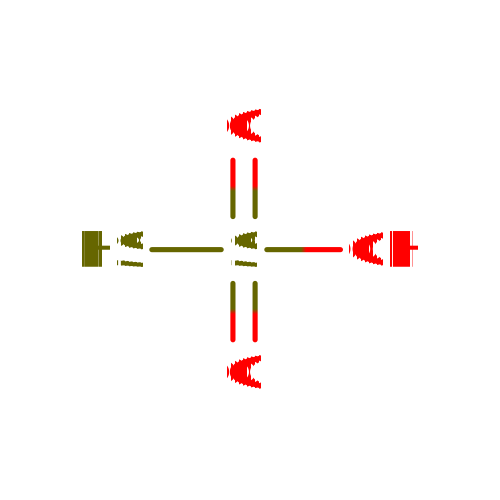
| Description | Thiosulfate, also known as thiosulfuric acid or [so2(OH)(SH)], belongs to the class of inorganic compounds known as non-metal thiosulfates. These are inorganic non-metallic compounds containing a thiosulfate as its largest oxoanion. Thiosulfate is an extremely strong acidic compound (based on its pKa). Sodium thiosulfate has been considered as an empirical treatment for cyanide poisoning, along with hydroxocobalamin. Thiosulfate exists in all living species, ranging from bacteria to humans. Sodium thiosulfate, commonly called hypo (from "hyposulfite"), was widely used in photography to fix black and white negatives and prints after the developing stage; modern 'rapid' fixers use ammonium thiosulfate as a fixing salt because it acts three to four times faster. Thiosulfates react with halogens differently, which can be attributed to the decrease of oxidizing power down the halogen group:2 S2O2−3 (aq) + I2 (aq) → S4O2−6 (aq) + 2 I− (aq)S2O2−3 (aq) + 4 Br2 (aq) + 5 H2O(l) → 2 SO2−4 (aq) + 8 Br− (aq) + 10 H+ (aq)S2O2−3 (aq) + 4 Cl2 (aq) + 5 H2O (l) → 2 SO2−4 (aq) + 8 Cl− (aq) + 10 H+ (aq)In acidic conditions, thiosulfate causes rapid corrosion of metals; steel and stainless steel are particularly sensitive to pitting corrosion induced by thiosulfate. Addition of molybdenum to stainless steel is needed to improve its resistance to pitting (AISI 316L hMo). Thiosulfate extensively forms complexes with transition metals hence a common use is dissolving silver halides in film photography developing. The prefix thio- indicates that the thiosulfate ion is a sulfate ion with one oxygen replaced by sulfur. Hydroxidodioxidosulfidosulfate was first documented in 1977 (PMID: 856920). Thiosulfate occurs naturally and is produced by certain biochemical processes (PMID: 12011515) (PMID: 1681358) (PMID: 6600205) (PMID: 1943059). |
|---|
| Structure | InChI=1S/H2O3S2/c1-5(2,3)4/h(H2,1,2,3,4) |
|---|
| Synonyms | | Value | Source |
|---|
| [SO2(OH)(SH)] | ChEBI | | H2S2O3 | ChEBI | | Thiosulfuric acid | ChEBI | | Thiosulphate | Generator | | Thiosulphuric acid | Generator | | Hydroxidodioxidosulfidosulfuric acid | HMDB | | Hydroxidodioxidosulphidosulphate | HMDB | | Hydroxidodioxidosulphidosulphuric acid | HMDB | | Thiosulfate | Generator |
|
|---|
| Chemical Formula | H2O3S2 |
|---|
| Average Mass | 114.1440 Da |
|---|
| Monoisotopic Mass | 113.94454 Da |
|---|
| IUPAC Name | sulfanesulfonic acid |
|---|
| Traditional Name | sulfurothioic S-acid |
|---|
| CAS Registry Number | Not Available |
|---|
| SMILES | OS(S)(=O)=O |
|---|
| InChI Identifier | InChI=1S/H2O3S2/c1-5(2,3)4/h(H2,1,2,3,4) |
|---|
| InChI Key | DHCDFWKWKRSZHF-UHFFFAOYSA-N |
|---|
| Experimental Spectra |
|---|
|
| Not Available | | Predicted Spectra |
|---|
|
| | Spectrum Type | Description | Depositor ID | Depositor Organization | Depositor | Deposition Date | View |
|---|
| 1D NMR | 1H NMR Spectrum (1D, 100 MHz, D2O, predicted) | Wishart Lab | Wishart Lab | David Wishart | 2021-06-20 | View Spectrum | | 1D NMR | 1H NMR Spectrum (1D, 1000 MHz, D2O, predicted) | Wishart Lab | Wishart Lab | David Wishart | 2021-06-20 | View Spectrum | | 1D NMR | 1H NMR Spectrum (1D, 200 MHz, D2O, predicted) | Wishart Lab | Wishart Lab | David Wishart | 2021-06-20 | View Spectrum | | 1D NMR | 1H NMR Spectrum (1D, 300 MHz, D2O, predicted) | Wishart Lab | Wishart Lab | David Wishart | 2021-06-20 | View Spectrum | | 1D NMR | 1H NMR Spectrum (1D, 400 MHz, D2O, predicted) | Wishart Lab | Wishart Lab | David Wishart | 2021-06-20 | View Spectrum | | 1D NMR | 1H NMR Spectrum (1D, 500 MHz, D2O, predicted) | Wishart Lab | Wishart Lab | David Wishart | 2021-06-20 | View Spectrum | | 1D NMR | 1H NMR Spectrum (1D, 600 MHz, D2O, predicted) | Wishart Lab | Wishart Lab | David Wishart | 2021-06-20 | View Spectrum | | 1D NMR | 1H NMR Spectrum (1D, 700 MHz, D2O, predicted) | Wishart Lab | Wishart Lab | David Wishart | 2021-06-20 | View Spectrum | | 1D NMR | 1H NMR Spectrum (1D, 800 MHz, D2O, predicted) | Wishart Lab | Wishart Lab | David Wishart | 2021-06-20 | View Spectrum | | 1D NMR | 1H NMR Spectrum (1D, 900 MHz, D2O, predicted) | Wishart Lab | Wishart Lab | David Wishart | 2021-06-20 | View Spectrum |
| | Chemical Shift Submissions |
|---|
|
| Not Available | | Species |
|---|
| Species of Origin | |
|---|
| Chemical Taxonomy |
|---|
| Description | Belongs to the class of inorganic compounds known as non-metal thiosulfates. These are inorganic non-metallic compounds containing a thiosulfate as its largest oxoanion. |
|---|
| Kingdom | Inorganic compounds |
|---|
| Super Class | Homogeneous non-metal compounds |
|---|
| Class | Non-metal oxoanionic compounds |
|---|
| Sub Class | Non-metal thiosulfates |
|---|
| Direct Parent | Non-metal thiosulfates |
|---|
| Alternative Parents | |
|---|
| Substituents | - Non-metal thiosulfate
- Inorganic oxide
- Inorganic sulfide
|
|---|
| Molecular Framework | Not Available |
|---|
| External Descriptors | |
|---|
| Physical Properties |
|---|
| State | Not Available |
|---|
| Experimental Properties | | Property | Value | Reference |
|---|
| Melting Point | Not Available | Not Available | | Boiling Point | Not Available | Not Available | | Water Solubility | Not Available | Not Available | | LogP | Not Available | Not Available |
|
|---|
| Predicted Properties | |
|---|
| General References | - Chatterjee BD, De PK, Sen T: Sucrose teepol tellurite agar: a new selective indicator medium for isolation of Vibrio species. J Infect Dis. 1977 Apr;135(4):654-8. doi: 10.1093/infdis/135.4.654. [PubMed:856920 ]
- Rikimaru T, Kondo M, Kajimura K, Hashimoto K, Oyamada K, Sagawa K, Tanoue S, Oizumi K: Bactericidal activities of commonly used antiseptics against multidrug-resistant mycobacterium tuberculosis. Dermatology. 2002;204 Suppl 1:15-20. doi: 10.1159/000057719. [PubMed:12011515 ]
- Maddocks JL, MacLachlan J: Application of new fluorescent thiol reagent to diagnosis of homocystinuria. Lancet. 1991 Oct 26;338(8774):1043-4. doi: 10.1016/0140-6736(91)91903-8. [PubMed:1681358 ]
- Ivankovich AD, Braverman B, Stephens TS, Shulman M, Heyman HJ: Sodium thiosulfate disposition in humans: relation to sodium nitroprusside toxicity. Anesthesiology. 1983 Jan;58(1):11-7. doi: 10.1097/00000542-198301000-00003. [PubMed:6600205 ]
- Kage S, Nagata T, Kudo K: Determination of thiosulfate in body fluids by GC and GC/MS. J Anal Toxicol. 1991 May-Jun;15(3):148-50. doi: 10.1093/jat/15.3.148. [PubMed:1943059 ]
|
|---|