| Record Information |
|---|
| Version | 2.0 |
|---|
| Created at | 2022-05-11 19:02:17 UTC |
|---|
| Updated at | 2022-05-11 19:02:18 UTC |
|---|
| NP-MRD ID | NP0092280 |
|---|
| Secondary Accession Numbers | None |
|---|
| Natural Product Identification |
|---|
| Common Name | leukotriene-C4 |
|---|
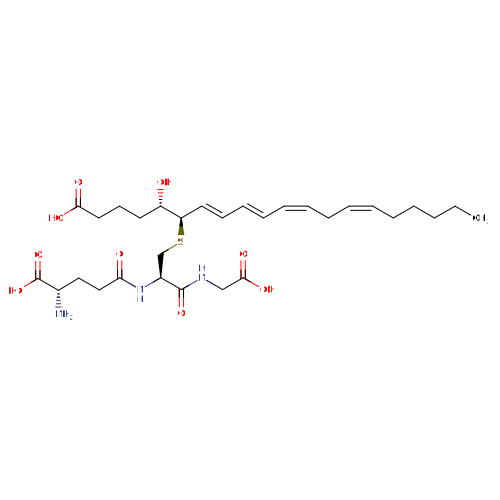
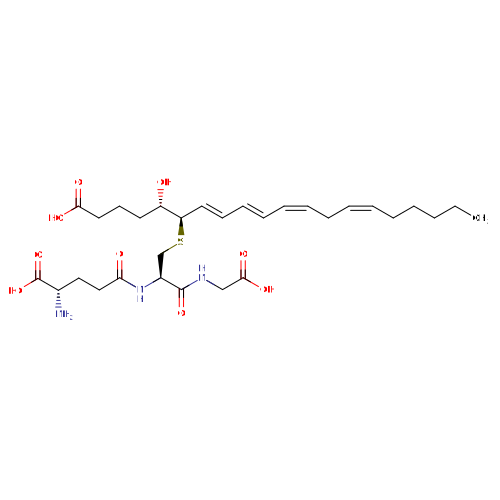
| Description | Leukotriene C4, also known as 5S,6R-LTC(sub 4) or LTC4, belongs to the class of organic compounds known as oligopeptides. These are organic compounds containing a sequence of between three and ten alpha-amino acids joined by peptide bonds. Thus, leukotriene C4 is considered to be an eicosanoid lipid molecule. Leukotriene C4 is a very hydrophobic molecule, practically insoluble (in water), and relatively neutral. Within humans, leukotriene C4 participates in a number of enzymatic reactions. In particular, leukotriene C4 can be biosynthesized from leukotriene A4 and glutathione; which is catalyzed by the enzyme leukotriene C4 synthase. In addition, leukotriene C4 can be converted into leukotriene D4 and L-glutamic acid through its interaction with the enzyme Gamma-glutamyltranspeptidase 1. In humans, leukotriene C4 is involved in mefenamic acid action pathway. Outside of the human body, Leukotriene C4 has been detected, but not quantified in, several different foods, such as romaine lettuces, mung beans, annual wild rices, dandelions, and java plums. This could make leukotriene C4 a potential biomarker for the consumption of these foods. Leukotriene C4, with regard to humans, has been found to be associated with several diseases such as leukotriene c4-synthesis deficiency, aseptic meningitis, hydrocephalus, and aids; leukotriene C4 has also been linked to the inborn metabolic disorder glutathione synthetase deficiency. leukotriene-C4 is found in Mus musculus. leukotriene-C4 was first documented in 1984 (PMID: 6440558). A leukotriene that is (5S,7E,9E,11Z,14Z)-5-hydroxyicosa-7,9,11,14-tetraenoic acid in which a glutathionyl group is attached at position 6 via a sulfide linkage (PMID: 2558123) (PMID: 8608646) (PMID: 8939179) (PMID: 3421265) (PMID: 3418380) (PMID: 2007712). |
|---|
| Structure | CCCCC\C=C/C\C=C/C=C/C=C/[C@@H](SC[C@H](NC(=O)CC[C@H](N)C(O)=O)C(=O)NCC(O)=O)[C@@H](O)CCCC(O)=O InChI=1S/C30H47N3O9S/c1-2-3-4-5-6-7-8-9-10-11-12-13-16-25(24(34)15-14-17-27(36)37)43-21-23(29(40)32-20-28(38)39)33-26(35)19-18-22(31)30(41)42/h6-7,9-13,16,22-25,34H,2-5,8,14-15,17-21,31H2,1H3,(H,32,40)(H,33,35)(H,36,37)(H,38,39)(H,41,42)/b7-6-,10-9-,12-11+,16-13+/t22-,23-,24-,25+/m0/s1 |
|---|
| Synonyms | | Value | Source |
|---|
| (R-(R*,s*-(e,e,Z,Z)))-N-(S-(1-(4-carboxy-1-hydroxybutyl)-2,4,6,9-pentadecatetraenyl)-N-L-gamma-glutamyl-L-cysteinyl)glycine | ChEBI | | 5S,6R-LTC(Sub 4) | ChEBI | | 5S-Hydroxy,6R-(S-glutathionyl),7E,9E,11Z,14Z-eicosatetraenoic acid | ChEBI | | LTC (Sub 4) | ChEBI | | LTC4 | ChEBI | | (R-(R*,s*-(e,e,Z,Z)))-N-(S-(1-(4-carboxy-1-hydroxybutyl)-2,4,6,9-pentadecatetraenyl)-N-L-g-glutamyl-L-cysteinyl)glycine | Generator | | (R-(R*,s*-(e,e,Z,Z)))-N-(S-(1-(4-carboxy-1-hydroxybutyl)-2,4,6,9-pentadecatetraenyl)-N-L-γ-glutamyl-L-cysteinyl)glycine | Generator | | 5S-Hydroxy,6R-(S-glutathionyl),7E,9E,11Z,14Z-eicosatetraenoate | Generator | | Leukotriene C-1 | HMDB | | Leukotriene C-4 | HMDB | | Leukotrienes C | HMDB | | Leukotriene C | HMDB | | Leukotriene C 1 | HMDB | | Leukotriene C 4 | HMDB | | Leukotriene C1 | HMDB | | (R-(R*,s*-(e,e,Z,Z)))-N-(S-(1-(4-carboxy-1-hydroxybutyl)-2,4,6,9-pentadecatetraenyl)-N-L-gamma-glutamyl-L-cysteinyl)-glycine | HMDB | | 5S,6R-LTC | HMDB | | L-gamma-Glutamyl-S-[(1R,2E,4E,6Z,9Z)-1-[(1S)-4-carboxy-1-hydroxybutyl]-2,4,6,9-pentadecatetraenyl]-L-cysteinyl-glycine | HMDB | | Leucotriene C4 | HMDB | | LTC | HMDB | | [R-[R*,s*-(e,e,Z,Z)]]-N-[S-[1-(4-carboxy-1-hydroxybutyl)-2,4,6,9-pentadecatetraenyl]-N-L-gamma-glutamyl-L-cysteinyl]-glycine 5S,6R-LTC4 | HMDB | | 5S,6R-LTC4 | HMDB | | Leukotriene C4 | HMDB |
|
|---|
| Chemical Formula | C30H47N3O9S |
|---|
| Average Mass | 625.7740 Da |
|---|
| Monoisotopic Mass | 625.30330 Da |
|---|
| IUPAC Name | (5S,6R,7E,9E,11Z,14Z)-6-{[(2R)-2-[(4S)-4-amino-4-carboxybutanamido]-2-[(carboxymethyl)carbamoyl]ethyl]sulfanyl}-5-hydroxyicosa-7,9,11,14-tetraenoic acid |
|---|
| Traditional Name | leukotriene C4 |
|---|
| CAS Registry Number | Not Available |
|---|
| SMILES | CCCCC\C=C/C\C=C/C=C/C=C/[C@@H](SC[C@H](NC(=O)CC[C@H](N)C(O)=O)C(=O)NCC(O)=O)[C@@H](O)CCCC(O)=O |
|---|
| InChI Identifier | InChI=1S/C30H47N3O9S/c1-2-3-4-5-6-7-8-9-10-11-12-13-16-25(24(34)15-14-17-27(36)37)43-21-23(29(40)32-20-28(38)39)33-26(35)19-18-22(31)30(41)42/h6-7,9-13,16,22-25,34H,2-5,8,14-15,17-21,31H2,1H3,(H,32,40)(H,33,35)(H,36,37)(H,38,39)(H,41,42)/b7-6-,10-9-,12-11+,16-13+/t22-,23-,24-,25+/m0/s1 |
|---|
| InChI Key | GWNVDXQDILPJIG-NXOLIXFESA-N |
|---|
| Experimental Spectra |
|---|
|
| Not Available | | Predicted Spectra |
|---|
|
| | Spectrum Type | Description | Depositor ID | Depositor Organization | Depositor | Deposition Date | View |
|---|
| 1D NMR | 13C NMR Spectrum (1D, 25 MHz, D2O, predicted) | Wishart Lab | Wishart Lab | David Wishart | 2021-06-20 | View Spectrum | | 1D NMR | 1H NMR Spectrum (1D, 100 MHz, D2O, predicted) | Wishart Lab | Wishart Lab | David Wishart | 2021-06-20 | View Spectrum | | 1D NMR | 13C NMR Spectrum (1D, 252 MHz, D2O, predicted) | Wishart Lab | Wishart Lab | David Wishart | 2021-06-20 | View Spectrum | | 1D NMR | 1H NMR Spectrum (1D, 1000 MHz, D2O, predicted) | Wishart Lab | Wishart Lab | David Wishart | 2021-06-20 | View Spectrum | | 1D NMR | 13C NMR Spectrum (1D, 50 MHz, D2O, predicted) | Wishart Lab | Wishart Lab | David Wishart | 2021-06-20 | View Spectrum | | 1D NMR | 1H NMR Spectrum (1D, 200 MHz, D2O, predicted) | Wishart Lab | Wishart Lab | David Wishart | 2021-06-20 | View Spectrum | | 1D NMR | 13C NMR Spectrum (1D, 75 MHz, D2O, predicted) | Wishart Lab | Wishart Lab | David Wishart | 2021-06-20 | View Spectrum | | 1D NMR | 1H NMR Spectrum (1D, 300 MHz, D2O, predicted) | Wishart Lab | Wishart Lab | David Wishart | 2021-06-20 | View Spectrum | | 1D NMR | 13C NMR Spectrum (1D, 101 MHz, D2O, predicted) | Wishart Lab | Wishart Lab | David Wishart | 2021-06-20 | View Spectrum | | 1D NMR | 1H NMR Spectrum (1D, 400 MHz, D2O, predicted) | Wishart Lab | Wishart Lab | David Wishart | 2021-06-20 | View Spectrum | | 1D NMR | 13C NMR Spectrum (1D, 126 MHz, D2O, predicted) | Wishart Lab | Wishart Lab | David Wishart | 2021-06-20 | View Spectrum | | 1D NMR | 1H NMR Spectrum (1D, 500 MHz, D2O, predicted) | Wishart Lab | Wishart Lab | David Wishart | 2021-06-20 | View Spectrum | | 1D NMR | 13C NMR Spectrum (1D, 151 MHz, D2O, predicted) | Wishart Lab | Wishart Lab | David Wishart | 2021-06-20 | View Spectrum | | 1D NMR | 1H NMR Spectrum (1D, 600 MHz, D2O, predicted) | Wishart Lab | Wishart Lab | David Wishart | 2021-06-20 | View Spectrum | | 1D NMR | 13C NMR Spectrum (1D, 176 MHz, D2O, predicted) | Wishart Lab | Wishart Lab | David Wishart | 2021-06-20 | View Spectrum | | 1D NMR | 1H NMR Spectrum (1D, 700 MHz, D2O, predicted) | Wishart Lab | Wishart Lab | David Wishart | 2021-06-20 | View Spectrum | | 1D NMR | 13C NMR Spectrum (1D, 201 MHz, D2O, predicted) | Wishart Lab | Wishart Lab | David Wishart | 2021-06-20 | View Spectrum | | 1D NMR | 1H NMR Spectrum (1D, 800 MHz, D2O, predicted) | Wishart Lab | Wishart Lab | David Wishart | 2021-06-20 | View Spectrum | | 1D NMR | 13C NMR Spectrum (1D, 226 MHz, D2O, predicted) | Wishart Lab | Wishart Lab | David Wishart | 2021-06-20 | View Spectrum | | 1D NMR | 1H NMR Spectrum (1D, 900 MHz, D2O, predicted) | Wishart Lab | Wishart Lab | David Wishart | 2021-06-20 | View Spectrum |
| | Chemical Shift Submissions |
|---|
|
| Not Available | | Species |
|---|
| Species of Origin | |
|---|
| Chemical Taxonomy |
|---|
| Description | Belongs to the class of organic compounds known as oligopeptides. These are organic compounds containing a sequence of between three and ten alpha-amino acids joined by peptide bonds. |
|---|
| Kingdom | Organic compounds |
|---|
| Super Class | Organic acids and derivatives |
|---|
| Class | Carboxylic acids and derivatives |
|---|
| Sub Class | Amino acids, peptides, and analogues |
|---|
| Direct Parent | Oligopeptides |
|---|
| Alternative Parents | |
|---|
| Substituents | - Alpha-oligopeptide
- Gamma-glutamyl alpha peptide
- Leukotriene
- Hydroxyeicosatetraenoic acid
- Eicosanoid
- Glutamine or derivatives
- N-acyl-alpha-amino acid
- N-acyl-alpha amino acid or derivatives
- Cysteine or derivatives
- Alpha-amino acid amide
- Alpha-amino acid or derivatives
- L-alpha-amino acid
- Alpha-amino acid
- N-substituted-alpha-amino acid
- Tricarboxylic acid or derivatives
- Hydroxy fatty acid
- Thia fatty acid
- Fatty amide
- N-acyl-amine
- Fatty acyl
- Secondary alcohol
- Amino acid
- Carboxamide group
- Secondary carboxylic acid amide
- Amino acid or derivatives
- Dialkylthioether
- Carboxylic acid
- Sulfenyl compound
- Thioether
- Primary amine
- Organic oxygen compound
- Organic nitrogen compound
- Alcohol
- Carbonyl group
- Hydrocarbon derivative
- Amine
- Organic oxide
- Organopnictogen compound
- Organosulfur compound
- Organooxygen compound
- Organonitrogen compound
- Primary aliphatic amine
- Aliphatic acyclic compound
|
|---|
| Molecular Framework | Aliphatic acyclic compounds |
|---|
| External Descriptors | |
|---|
| Physical Properties |
|---|
| State | Not Available |
|---|
| Experimental Properties | | Property | Value | Reference |
|---|
| Melting Point | Not Available | Not Available | | Boiling Point | Not Available | Not Available | | Water Solubility | Not Available | Not Available | | LogP | Not Available | Not Available |
|
|---|
| Predicted Properties | |
|---|
| General References | - Sawazaki Y: [Leukotriene B4, leukotriene C4 and prostaglandin E2 in the serum, synovial fluid and synovium in patients with rheumatoid arthritis]. Nihon Ika Daigaku Zasshi. 1989 Dec;56(6):559-64. doi: 10.1272/jnms1923.56.559. [PubMed:2558123 ]
- Heimburger M, Palmblad JE: Effects of leukotriene C4 and D4, histamine and bradykinin on cytosolic calcium concentrations and adhesiveness of endothelial cells and neutrophils. Clin Exp Immunol. 1996 Mar;103(3):454-60. doi: 10.1111/j.1365-2249.1996.tb08302.x. [PubMed:8608646 ]
- Lane SJ, Lee TH: Mast cell effector mechanisms. J Allergy Clin Immunol. 1996 Nov;98(5 Pt 2):S67-71; discussion S71-2. doi: 10.1016/s0091-6749(96)80131-x. [PubMed:8939179 ]
- Romero R, Wu YK, Mazor M, Hobbins JC, Mitchell MD: Increased amniotic fluid leukotriene C4 concentration in term human parturition. Am J Obstet Gynecol. 1988 Sep;159(3):655-7. doi: 10.1016/s0002-9378(88)80028-0. [PubMed:3421265 ]
- Paoletti P, Gaetani P, Grignani G, Pacchiarini L, Silvani V, Rodriguez y Baena R: CSF leukotriene C4 following subarachnoid hemorrhage. J Neurosurg. 1988 Oct;69(4):488-93. doi: 10.3171/jns.1988.69.4.0488. [PubMed:3418380 ]
- De Servi S, Ricevuti G, Mazzone A, Pasotti D, Bramucci E, Angoli L, Specchia G: Transcardiac release of leukotriene C4 by neutrophils in patients with coronary artery disease. J Am Coll Cardiol. 1991 Apr;17(5):1125-8. doi: 10.1016/0735-1097(91)90842-w. [PubMed:2007712 ]
- Koshino T, Takano S, Houjo T, Sano Y, Kudo K, Kihara H, Kitani S, Takaishi T, Hirai K, Ito K, Morita Y: Expression of 5-lipoxygenase and 5-lipoxygenase-activating protein mRNAs in the peripheral blood leukocytes of asthmatics. Biochem Biophys Res Commun. 1998 Jun 18;247(2):510-3. doi: 10.1006/bbrc.1998.8789. [PubMed:9642160 ]
- Richter L, Hesselbarth N, Eitner K, Schubert K, Bosseckert H, Krell H: Increased biliary secretion of cysteinyl-leukotrienes in human bile duct obstruction. J Hepatol. 1996 Nov;25(5):725-32. doi: 10.1016/s0168-8278(96)80245-5. [PubMed:8938552 ]
- Sternfeld M, Fink A, Bentwich Z, Eliraz A: The role of acupuncture in asthma: changes in airways dynamics and LTC4 induced LAI. Am J Chin Med. 1989;17(3-4):129-34. doi: 10.1142/S0192415X89000206. [PubMed:2633615 ]
- Ponicke K, Forster W: Influence of leukotriene C4 on aggregation and on malondialdehyde formation of human blood platelets. Biomed Biochim Acta. 1984;43(8-9):S459-62. [PubMed:6440558 ]
|
|---|