| Record Information |
|---|
| Version | 2.0 |
|---|
| Created at | 2022-05-11 19:02:03 UTC |
|---|
| Updated at | 2022-05-11 19:02:03 UTC |
|---|
| NP-MRD ID | NP0092271 |
|---|
| Secondary Accession Numbers | None |
|---|
| Natural Product Identification |
|---|
| Common Name | 1-18:2-2-18:1-phosphatidylcholine |
|---|
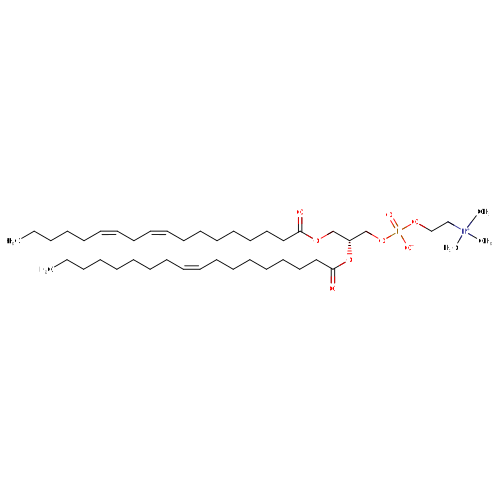
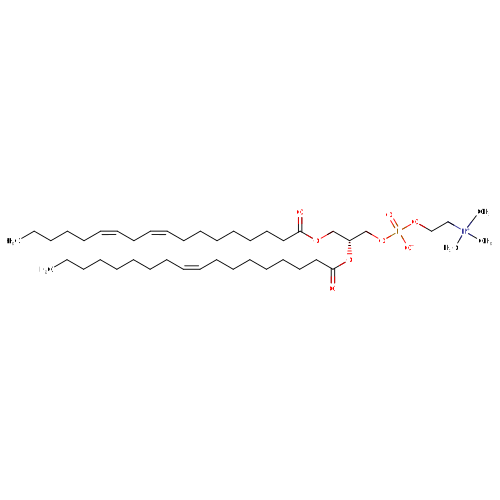
| Description | PC(18:2(9Z,12Z)/18:1(9Z)), also known as gpcho(18:2/18:1) Or gpcho(36:3), Belongs to the class of organic compounds known as phosphatidylcholines. These are glycerophosphocholines in which the two free -OH are attached to one fatty acid each through an ester linkage. Thus, PC(18:2(9Z,12Z)/18:1(9Z)) is considered to be a glycerophosphocholine lipid molecule. PCs can also synthesized by the addition of choline to CDP-activated 1,2-diacylglycerol. PC(18:2(9Z,12Z)/18:1(9Z)) is a very hydrophobic molecule, practically insoluble (in water), and relatively neutral. PC(18:2(9Z,12Z)/18:1(9Z)) exists in all eukaryotes, ranging from yeast to humans. The linoleic acid moiety is derived from seed oils, while the oleic acid moiety is derived from vegetable oils, especially olive and canola oil. A third route to PC synthesis involves the conversion of either PS or PE to PC. Within humans, PC(18:2(9Z,12Z)/18:1(9Z)) participates in a number of enzymatic reactions. In particular, S-adenosylhomocysteine and PC(18:2(9Z,12Z)/18:1(9Z)) can be biosynthesized from S-adenosylmethionine and pe-nme2(18:2(9Z,12Z)/18:1(9Z)); which is mediated by the enzyme phosphatidylethanolamine N-methyltransferase. In addition, cytidine monophosphate and PC(18:2(9Z,12Z)/18:1(9Z)) can be biosynthesized from CDP-choline and DG(18:2(9Z,12Z)/18:1(9Z)/0:0); Which is catalyzed by the enzyme choline/ethanolaminephosphotransferase. In humans, PC(18:2(9Z,12Z)/18:1(9Z)) is involved in phosphatidylcholine biosynthesis. Outside of the human body, PC(18:2(9Z,12Z)/18:1(9Z)) has been detected, but not quantified in, several different foods, such as yellow wax beans, garden cress, lupines, summer grapes, and endives. This could make PC(18:2(9Z,12Z)/18:1(9Z)) a potential biomarker for the consumption of these foods. PC(18:2(9Z,12Z)/18:1(9Z)), in particular, consists of one chain of linoleic acid at the C-1 position and one chain of oleic acid at the C-2 position. In one route, choline is activated first by phosphorylation and then by coupling to CDP prior to attachment to phosphatidic acid. While most phospholipids have a saturated fatty acid on C-1 and an unsaturated fatty acid on C-2 of the glycerol backbone, the fatty acid distribution at the C-1 and C-2 positions of glycerol within phospholipids is continually in flux, owing to phospholipid degradation and the continuous phospholipid remodeling that occurs while these molecules are in membranes. It is a glycerophospholipid in which a phosphorylcholine moiety occupies a glycerol substitution site. PC(18:2(9Z,12Z)/18:1(9Z)) is a phosphatidylcholine (PC or GPCho). Phospholipids, are ubiquitous in nature and are key components of the lipid bilayer of cells, as well as being involved in metabolism and signaling. Fatty acids containing 16, 18 and 20 carbons are the most common. As is the case with diacylglycerols, glycerophosphocholines can have many different combinations of fatty acids of varying lengths and saturation attached at the C-1 and C-2 positions. 1-18:2-2-18:1-phosphatidylcholine is found in Trypanosoma brucei. PCs can be synthesized via three different routes. |
|---|
| Structure | CCCCCCCC\C=C/CCCCCCCC(=O)O[C@]([H])(COC(=O)CCCCCCC\C=C/C\C=C/CCCCC)COP([O-])(=O)OCC[N+](C)(C)C InChI=1S/C44H82NO8P/c1-6-8-10-12-14-16-18-20-22-24-26-28-30-32-34-36-43(46)50-40-42(41-52-54(48,49)51-39-38-45(3,4)5)53-44(47)37-35-33-31-29-27-25-23-21-19-17-15-13-11-9-7-2/h14,16,20-23,42H,6-13,15,17-19,24-41H2,1-5H3/b16-14-,22-20-,23-21-/t42-/m1/s1 |
|---|
| Synonyms | | Value | Source |
|---|
| GPCho(18:2/18:1) | HMDB | | GPCho(36:3) | HMDB | | PC(18:2/18:1) | HMDB | | PC(36:3) | HMDB | | Lecithin | HMDB | | Phosphatidylcholine(36:3) | HMDB | | Phosphatidylcholine(18:2/18:1) | HMDB | | 1-(9Z,12Z-Octadecadienoyl)-2-(9Z-octadecenoyl)-sn-glycero-3-phosphocholine | HMDB | | 1-Linoleoyl-2-oleoyl-sn-glycero-3-phosphocholine | HMDB | | PC(18:2(9Z,12Z)/18:1(9Z)) | Lipid Annotator |
|
|---|
| Chemical Formula | C44H82NO8P |
|---|
| Average Mass | 784.0975 Da |
|---|
| Monoisotopic Mass | 783.57781 Da |
|---|
| IUPAC Name | trimethyl(2-{[(2R)-2-[(9Z)-octadec-9-enoyloxy]-3-[(9Z,12Z)-octadeca-9,12-dienoyloxy]propyl phosphonato]oxy}ethyl)azanium |
|---|
| Traditional Name | lecithin |
|---|
| CAS Registry Number | Not Available |
|---|
| SMILES | CCCCCCCC\C=C/CCCCCCCC(=O)O[C@]([H])(COC(=O)CCCCCCC\C=C/C\C=C/CCCCC)COP([O-])(=O)OCC[N+](C)(C)C |
|---|
| InChI Identifier | InChI=1S/C44H82NO8P/c1-6-8-10-12-14-16-18-20-22-24-26-28-30-32-34-36-43(46)50-40-42(41-52-54(48,49)51-39-38-45(3,4)5)53-44(47)37-35-33-31-29-27-25-23-21-19-17-15-13-11-9-7-2/h14,16,20-23,42H,6-13,15,17-19,24-41H2,1-5H3/b16-14-,22-20-,23-21-/t42-/m1/s1 |
|---|
| InChI Key | RTAZWRZKFSTMOY-NMSVECGZSA-N |
|---|
| Experimental Spectra |
|---|
|
| Not Available | | Predicted Spectra |
|---|
|
| | Spectrum Type | Description | Depositor ID | Depositor Organization | Depositor | Deposition Date | View |
|---|
| 1D NMR | 13C NMR Spectrum (1D, 25 MHz, D2O, predicted) | Wishart Lab | Wishart Lab | David Wishart | 2021-06-20 | View Spectrum | | 1D NMR | 1H NMR Spectrum (1D, 100 MHz, D2O, predicted) | Wishart Lab | Wishart Lab | David Wishart | 2021-06-20 | View Spectrum | | 1D NMR | 13C NMR Spectrum (1D, 252 MHz, D2O, predicted) | Wishart Lab | Wishart Lab | David Wishart | 2021-06-20 | View Spectrum | | 1D NMR | 1H NMR Spectrum (1D, 1000 MHz, D2O, predicted) | Wishart Lab | Wishart Lab | David Wishart | 2021-06-20 | View Spectrum | | 1D NMR | 13C NMR Spectrum (1D, 50 MHz, D2O, predicted) | Wishart Lab | Wishart Lab | David Wishart | 2021-06-20 | View Spectrum | | 1D NMR | 1H NMR Spectrum (1D, 200 MHz, D2O, predicted) | Wishart Lab | Wishart Lab | David Wishart | 2021-06-20 | View Spectrum | | 1D NMR | 13C NMR Spectrum (1D, 75 MHz, D2O, predicted) | Wishart Lab | Wishart Lab | David Wishart | 2021-06-20 | View Spectrum | | 1D NMR | 1H NMR Spectrum (1D, 300 MHz, D2O, predicted) | Wishart Lab | Wishart Lab | David Wishart | 2021-06-20 | View Spectrum | | 1D NMR | 13C NMR Spectrum (1D, 101 MHz, D2O, predicted) | Wishart Lab | Wishart Lab | David Wishart | 2021-06-20 | View Spectrum | | 1D NMR | 1H NMR Spectrum (1D, 400 MHz, D2O, predicted) | Wishart Lab | Wishart Lab | David Wishart | 2021-06-20 | View Spectrum | | 1D NMR | 13C NMR Spectrum (1D, 126 MHz, D2O, predicted) | Wishart Lab | Wishart Lab | David Wishart | 2021-06-20 | View Spectrum | | 1D NMR | 1H NMR Spectrum (1D, 500 MHz, D2O, predicted) | Wishart Lab | Wishart Lab | David Wishart | 2021-06-20 | View Spectrum | | 1D NMR | 13C NMR Spectrum (1D, 151 MHz, D2O, predicted) | Wishart Lab | Wishart Lab | David Wishart | 2021-06-20 | View Spectrum | | 1D NMR | 1H NMR Spectrum (1D, 600 MHz, D2O, predicted) | Wishart Lab | Wishart Lab | David Wishart | 2021-06-20 | View Spectrum | | 1D NMR | 13C NMR Spectrum (1D, 176 MHz, D2O, predicted) | Wishart Lab | Wishart Lab | David Wishart | 2021-06-20 | View Spectrum | | 1D NMR | 1H NMR Spectrum (1D, 700 MHz, D2O, predicted) | Wishart Lab | Wishart Lab | David Wishart | 2021-06-20 | View Spectrum | | 1D NMR | 13C NMR Spectrum (1D, 201 MHz, D2O, predicted) | Wishart Lab | Wishart Lab | David Wishart | 2021-06-20 | View Spectrum | | 1D NMR | 1H NMR Spectrum (1D, 800 MHz, D2O, predicted) | Wishart Lab | Wishart Lab | David Wishart | 2021-06-20 | View Spectrum | | 1D NMR | 13C NMR Spectrum (1D, 226 MHz, D2O, predicted) | Wishart Lab | Wishart Lab | David Wishart | 2021-06-20 | View Spectrum | | 1D NMR | 1H NMR Spectrum (1D, 900 MHz, D2O, predicted) | Wishart Lab | Wishart Lab | David Wishart | 2021-06-20 | View Spectrum |
| | Chemical Shift Submissions |
|---|
|
| Not Available | | Species |
|---|
| Species of Origin | |
|---|
| Chemical Taxonomy |
|---|
| Description | Belongs to the class of organic compounds known as phosphatidylcholines. These are glycerophosphocholines in which the two free -OH are attached to one fatty acid each through an ester linkage. |
|---|
| Kingdom | Organic compounds |
|---|
| Super Class | Lipids and lipid-like molecules |
|---|
| Class | Glycerophospholipids |
|---|
| Sub Class | Glycerophosphocholines |
|---|
| Direct Parent | Phosphatidylcholines |
|---|
| Alternative Parents | |
|---|
| Substituents | - Diacylglycero-3-phosphocholine
- Phosphocholine
- Fatty acid ester
- Dialkyl phosphate
- Dicarboxylic acid or derivatives
- Organic phosphoric acid derivative
- Phosphoric acid ester
- Alkyl phosphate
- Fatty acyl
- Quaternary ammonium salt
- Tetraalkylammonium salt
- Carboxylic acid ester
- Carboxylic acid derivative
- Organic oxygen compound
- Organic nitrogen compound
- Carbonyl group
- Organooxygen compound
- Organonitrogen compound
- Organic oxide
- Organopnictogen compound
- Amine
- Organic salt
- Hydrocarbon derivative
- Aliphatic acyclic compound
|
|---|
| Molecular Framework | Aliphatic acyclic compounds |
|---|
| External Descriptors | |
|---|
| Physical Properties |
|---|
| State | Not Available |
|---|
| Experimental Properties | | Property | Value | Reference |
|---|
| Melting Point | Not Available | Not Available | | Boiling Point | Not Available | Not Available | | Water Solubility | Not Available | Not Available | | LogP | Not Available | Not Available |
|
|---|
| Predicted Properties | |
|---|