Np mrd loader

Record Information
Version2.0
Created at2022-05-11 18:54:36 UTC
Updated at2022-05-11 18:54:36 UTC
NP-MRD IDNP0092008
Secondary Accession NumbersNone
Natural Product Identification
Common NameTriphosphoric acid
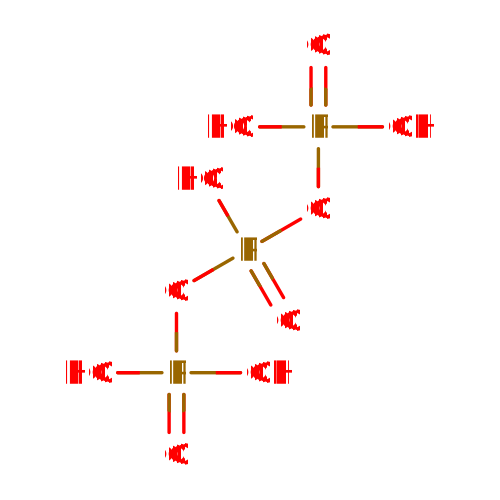
DescriptionTriphosphate, also known as H5P3O10 or triphosphorsaeure, belongs to the class of inorganic compounds known as non-metal phosphates. These are inorganic non-metallic compounds containing a phosphate as its largest oxoanion. Triphosphate is an extremely strong acidic compound (based on its pKa). Triphosphoric acid was first documented in 1996 (PMID: 8864641). Triphosphate exists in all living species, ranging from bacteria to humans (PMID: 11889570) (PMID: 12237739) (PMID: 12560222) (PMID: 15728711).
Structure
Thumb
Synonyms
ValueSource
Acide triphosphoriqueChEBI
Catena-triphosphoric acidChEBI
H5P3O10ChEBI
Inorganic triphosphateChEBI
TriphosphorsaeureChEBI
Tripolyphosphoric acidChEBI
Catena-triphosphateGenerator
Inorganic triphosphoric acidGenerator
TripolyphosphateGenerator
Triphosphoric acidGenerator
(Phosphate)NHMDB
(Phosphate)n+1HMDB
(Phosphate)N-1HMDB
Bis(dihydroxidodioxidophosphato)hydroxidooxidophosphorusHMDB
Bis(phosphonooxy)phosphinic acidHMDB
DADHMDB
DCTHMDB
DGTHMDB
Diphosphono hydrogen phosphateHMDB
DTPHMDB
GTPHMDB
Inorganic open chain tripolyphosphateHMDB
TriphospateHMDB
Triphosphate analogsHMDB
TTPHMDB
Sodium triphosphateHMDB
Tetrasodium tripolyphosphateHMDB
Triphosphoric acid, 99TC-labeled CPDHMDB
Triphosphoric acid, pentasodium saltHMDB
Triphosphoric acid, sodium saltHMDB
Potassium triphosphateHMDB
Sodium tripolyphosphate anhydrousHMDB
Triphosphoric acid, pentapotassium saltHMDB
Triphosphoric acid, sodium, potassium saltHMDB
Pentapotassium triphosphateHMDB
Sodium tripolyphosphateHMDB
PPPiHMDB
TRIphosphATEChEBI
Chemical FormulaH5O10P3
Average Mass257.9550 Da
Monoisotopic Mass257.90956 Da
IUPAC Name{[hydroxy(phosphonooxy)phosphoryl]oxy}phosphonic acid
Traditional Nametripolyphosphate
CAS Registry NumberNot Available
SMILES
OP(O)(=O)OP(O)(=O)OP(O)(O)=O
InChI Identifier
InChI=1S/H5O10P3/c1-11(2,3)9-13(7,8)10-12(4,5)6/h(H,7,8)(H2,1,2,3)(H2,4,5,6)
InChI KeyUNXRWKVEANCORM-UHFFFAOYSA-N
Experimental Spectra
Not Available
Predicted Spectra
Not Available
Chemical Shift Submissions
Not Available
Species
Species of Origin
Species NameSourceReference
Anas platyrhynchosFooDB
AnatidaeFooDB
Anser anserFooDB
Bison bisonFooDB
Bos taurusFooDB
Bos taurus X Bison bisonFooDB
Bubalus bubalisFooDB
Capra aegagrus hircusFooDB
CervidaeFooDB
Cervus canadensisFooDB
ColumbaFooDB
ColumbidaeFooDB
Dromaius novaehollandiaeFooDB
Equus caballusFooDB
Gallus gallusFooDB
Lagopus mutaFooDB
LeporidaeFooDB
Lepus timidusFooDB
Melanitta fuscaFooDB
Meleagris gallopavoFooDB
Numida meleagrisFooDB
OdocoileusFooDB
OryctolagusFooDB
Ovis ariesFooDB
PhasianidaeFooDB
Phasianus colchicusFooDB
Struthio camelusFooDB
Sus scrofaFooDB
Sus scrofa domesticaFooDB
Chemical Taxonomy
Description Belongs to the class of inorganic compounds known as non-metal phosphates. These are inorganic non-metallic compounds containing a phosphate as its largest oxoanion.
KingdomInorganic compounds
Super ClassHomogeneous non-metal compounds
ClassNon-metal oxoanionic compounds
Sub ClassNon-metal phosphates
Direct ParentNon-metal phosphates
Alternative Parents
Substituents
  • Non-metal phosphate
  • Inorganic oxide
Molecular FrameworkNot Available
External Descriptors
Physical Properties
StateNot Available
Experimental Properties
PropertyValueReference
Melting PointNot AvailableNot Available
Boiling PointNot AvailableNot Available
Water SolubilityNot AvailableNot Available
LogPNot AvailableNot Available
Predicted Properties
PropertyValueSource
logP-1.9ChemAxon
pKa (Strongest Acidic)0.89ChemAxon
Physiological Charge-4ChemAxon
Hydrogen Acceptor Count8ChemAxon
Hydrogen Donor Count5ChemAxon
Polar Surface Area170.82 ŲChemAxon
Rotatable Bond Count4ChemAxon
Refractivity36.4 m³·mol⁻¹ChemAxon
Polarizability14.67 ųChemAxon
Number of Rings0ChemAxon
BioavailabilityYesChemAxon
Rule of FiveYesChemAxon
Ghose FilterNoChemAxon
Veber's RuleNoChemAxon
MDDR-like RuleNoChemAxon
HMDB IDHMDB0003379
DrugBank IDDB03896
Phenol Explorer Compound IDNot Available
FoodDB IDFDB028913
KNApSAcK IDNot Available
Chemspider ID958
KEGG Compound IDC02174
BioCyc IDNot Available
BiGG IDNot Available
Wikipedia LinkPolyphosphate
METLIN IDNot Available
PubChem Compound983
PDB IDNot Available
ChEBI ID39949
Good Scents IDNot Available
References
General References
  1. Cseri J, Szappanos H, Szigeti GP, Csernatony Z, Kovacs L, Csernoch L: A purinergic signal transduction pathway in mammalian skeletal muscle cells in culture. Pflugers Arch. 2002 Mar;443(5-6):731-8. doi: 10.1007/s00424-001-0757-x. Epub 2001 Dec 4. [PubMed:11889570 ]
  2. Pelleg A, Schulman ES: Adenosine 5'-triphosphate axis in obstructive airway diseases. Am J Ther. 2002 Sep-Oct;9(5):454-64. doi: 10.1097/00045391-200209000-00014. [PubMed:12237739 ]
  3. Ding Z, Kim S, Dorsam RT, Jin J, Kunapuli SP: Inactivation of the human P2Y12 receptor by thiol reagents requires interaction with both extracellular cysteine residues, Cys17 and Cys270. Blood. 2003 May 15;101(10):3908-14. doi: 10.1182/blood-2002-10-3027. Epub 2003 Jan 30. [PubMed:12560222 ]
  4. Feng YH, Wang L, Wang Q, Li X, Zeng R, Gorodeski GI: ATP stimulates GRK-3 phosphorylation and beta-arrestin-2-dependent internalization of P2X7 receptor. Am J Physiol Cell Physiol. 2005 Jun;288(6):C1342-56. doi: 10.1152/ajpcell.00315.2004. Epub 2005 Feb 23. [PubMed:15728711 ]
  5. Smits P, Bijlstra PJ, Russel FG, Lutterman JA, Thien T: Cardiovascular effects of sulphonylurea derivatives. Diabetes Res Clin Pract. 1996 Jul;31 Suppl:S55-9. doi: 10.1016/0168-8227(96)01230-2. [PubMed:8864641 ]