| Record Information |
|---|
| Version | 2.0 |
|---|
| Created at | 2022-05-11 18:53:36 UTC |
|---|
| Updated at | 2022-05-11 18:53:37 UTC |
|---|
| NP-MRD ID | NP0091974 |
|---|
| Secondary Accession Numbers | None |
|---|
| Natural Product Identification |
|---|
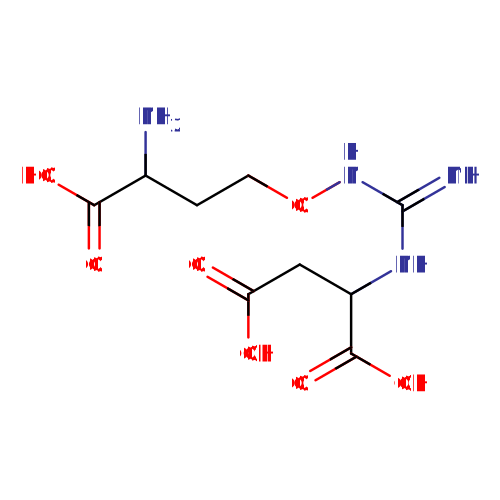
| Common Name | Canavaninosuccinate |
|---|
| Description | Canavaninosuccinate belongs to the class of organic compounds known as aspartic acid and derivatives. Aspartic acid and derivatives are compounds containing an aspartic acid or a derivative thereof resulting from reaction of aspartic acid at the amino group or the carboxy group, or from the replacement of any hydrogen of glycine by a heteroatom. Synthesis of canavaninosuccinate was strongly inhibited by added argininosuccinate, less so by canavaninosuccinate, arginine, canavanine, glycine, or 2,3-dimercaptopropanol. Canavaninosuccinate is a very strong basic compound (based on its pKa). Outside of the human body, Canavaninosuccinate has been detected, but not quantified in, several different foods, such as lemon grass, small-leaf lindens, jew's ears, anises, and bog bilberries. This could make canavaninosuccinate a potential biomarker for the consumption of these foods. Subsequent addition of dithiothreitol in the presence of Fe2+ resulted in the cleavage of some of the synthesized canavaninosuccinate to form guanidinosuccinate and homoserine. All the reactions, starting with canavaninosuccinate and down to the formation of guanidinoacetate and guanidinosuccinate have been demonstrated in human tissue ( (PMID: 241511 ). Canavaninosuccinate is formed from ureidohomoserine and aspartate by a human or bovine liver extract that had high argininosuccinate synthetase (EC6.3.4.5) Activity, and the subsequent formation of guanidinosuccinate is done by reductive cleavage. In the presence of ATP the optimum pH for the synthetic reaction is 8.4. Canavaninosuccinate was first documented in 1975 (PMID: 241511). This reaction can be carried out in either a tris(hydroxymethyl)aminomethane or borate buffer. |
|---|
| Structure | NC(CCONC(=N)NC(CC(O)=O)C(O)=O)C(O)=O InChI=1S/C9H16N4O7/c10-4(7(16)17)1-2-20-13-9(11)12-5(8(18)19)3-6(14)15/h4-5H,1-3,10H2,(H,14,15)(H,16,17)(H,18,19)(H3,11,12,13) |
|---|
| Synonyms | | Value | Source |
|---|
| Canavaninosuccinic acid | Generator | | 2-[N'-(3-amino-3-carboxypropoxy)carbamimidamido]butanedioate | HMDB |
|
|---|
| Chemical Formula | C9H16N4O7 |
|---|
| Average Mass | 292.2459 Da |
|---|
| Monoisotopic Mass | 292.10190 Da |
|---|
| IUPAC Name | 2-[3-(3-amino-3-carboxypropoxy)carbamimidamido]butanedioic acid |
|---|
| Traditional Name | 2-[3-(3-amino-3-carboxypropoxy)carbamimidamido]butanedioic acid |
|---|
| CAS Registry Number | Not Available |
|---|
| SMILES | NC(CCONC(=N)NC(CC(O)=O)C(O)=O)C(O)=O |
|---|
| InChI Identifier | InChI=1S/C9H16N4O7/c10-4(7(16)17)1-2-20-13-9(11)12-5(8(18)19)3-6(14)15/h4-5H,1-3,10H2,(H,14,15)(H,16,17)(H,18,19)(H3,11,12,13) |
|---|
| InChI Key | SGYMGUGIGTWWLU-UHFFFAOYSA-N |
|---|
| Experimental Spectra |
|---|
|
| Not Available | | Predicted Spectra |
|---|
|
| | Spectrum Type | Description | Depositor ID | Depositor Organization | Depositor | Deposition Date | View |
|---|
| 1D NMR | 13C NMR Spectrum (1D, 25 MHz, D2O, predicted) | Wishart Lab | Wishart Lab | David Wishart | 2021-06-20 | View Spectrum | | 1D NMR | 1H NMR Spectrum (1D, 100 MHz, D2O, predicted) | Wishart Lab | Wishart Lab | David Wishart | 2021-06-20 | View Spectrum | | 1D NMR | 13C NMR Spectrum (1D, 252 MHz, D2O, predicted) | Wishart Lab | Wishart Lab | David Wishart | 2021-06-20 | View Spectrum | | 1D NMR | 1H NMR Spectrum (1D, 1000 MHz, D2O, predicted) | Wishart Lab | Wishart Lab | David Wishart | 2021-06-20 | View Spectrum | | 1D NMR | 13C NMR Spectrum (1D, 50 MHz, D2O, predicted) | Wishart Lab | Wishart Lab | David Wishart | 2021-06-20 | View Spectrum | | 1D NMR | 1H NMR Spectrum (1D, 200 MHz, D2O, predicted) | Wishart Lab | Wishart Lab | David Wishart | 2021-06-20 | View Spectrum | | 1D NMR | 13C NMR Spectrum (1D, 75 MHz, D2O, predicted) | Wishart Lab | Wishart Lab | David Wishart | 2021-06-20 | View Spectrum | | 1D NMR | 1H NMR Spectrum (1D, 300 MHz, D2O, predicted) | Wishart Lab | Wishart Lab | David Wishart | 2021-06-20 | View Spectrum | | 1D NMR | 13C NMR Spectrum (1D, 101 MHz, D2O, predicted) | Wishart Lab | Wishart Lab | David Wishart | 2021-06-20 | View Spectrum | | 1D NMR | 1H NMR Spectrum (1D, 400 MHz, D2O, predicted) | Wishart Lab | Wishart Lab | David Wishart | 2021-06-20 | View Spectrum | | 1D NMR | 13C NMR Spectrum (1D, 126 MHz, D2O, predicted) | Wishart Lab | Wishart Lab | David Wishart | 2021-06-20 | View Spectrum | | 1D NMR | 1H NMR Spectrum (1D, 500 MHz, D2O, predicted) | Wishart Lab | Wishart Lab | David Wishart | 2021-06-20 | View Spectrum | | 1D NMR | 13C NMR Spectrum (1D, 151 MHz, D2O, predicted) | Wishart Lab | Wishart Lab | David Wishart | 2021-06-20 | View Spectrum | | 1D NMR | 1H NMR Spectrum (1D, 600 MHz, D2O, predicted) | Wishart Lab | Wishart Lab | David Wishart | 2021-06-20 | View Spectrum | | 1D NMR | 13C NMR Spectrum (1D, 176 MHz, D2O, predicted) | Wishart Lab | Wishart Lab | David Wishart | 2021-06-20 | View Spectrum | | 1D NMR | 1H NMR Spectrum (1D, 700 MHz, D2O, predicted) | Wishart Lab | Wishart Lab | David Wishart | 2021-06-20 | View Spectrum | | 1D NMR | 13C NMR Spectrum (1D, 201 MHz, D2O, predicted) | Wishart Lab | Wishart Lab | David Wishart | 2021-06-20 | View Spectrum | | 1D NMR | 1H NMR Spectrum (1D, 800 MHz, D2O, predicted) | Wishart Lab | Wishart Lab | David Wishart | 2021-06-20 | View Spectrum | | 1D NMR | 13C NMR Spectrum (1D, 226 MHz, D2O, predicted) | Wishart Lab | Wishart Lab | David Wishart | 2021-06-20 | View Spectrum | | 1D NMR | 1H NMR Spectrum (1D, 900 MHz, D2O, predicted) | Wishart Lab | Wishart Lab | David Wishart | 2021-06-20 | View Spectrum |
| | Chemical Shift Submissions |
|---|
|
| Not Available | | Species |
|---|
| Species of Origin | |
|---|
| Chemical Taxonomy |
|---|
| Description | Belongs to the class of organic compounds known as aspartic acid and derivatives. Aspartic acid and derivatives are compounds containing an aspartic acid or a derivative thereof resulting from reaction of aspartic acid at the amino group or the carboxy group, or from the replacement of any hydrogen of glycine by a heteroatom. |
|---|
| Kingdom | Organic compounds |
|---|
| Super Class | Organic acids and derivatives |
|---|
| Class | Carboxylic acids and derivatives |
|---|
| Sub Class | Amino acids, peptides, and analogues |
|---|
| Direct Parent | Aspartic acid and derivatives |
|---|
| Alternative Parents | |
|---|
| Substituents | - Aspartic acid or derivatives
- Alpha-amino acid
- Tricarboxylic acid or derivatives
- Guanidine
- Amino acid
- Organic 1,3-dipolar compound
- Propargyl-type 1,3-dipolar organic compound
- Carboximidamide
- Carboxylic acid
- Organic nitrogen compound
- Hydrocarbon derivative
- Organic oxygen compound
- Primary amine
- Organooxygen compound
- Organonitrogen compound
- Primary aliphatic amine
- Carbonyl group
- Amine
- Organopnictogen compound
- Organic oxide
- Aliphatic acyclic compound
|
|---|
| Molecular Framework | Aliphatic acyclic compounds |
|---|
| External Descriptors | Not Available |
|---|
| Physical Properties |
|---|
| State | Not Available |
|---|
| Experimental Properties | | Property | Value | Reference |
|---|
| Melting Point | Not Available | Not Available | | Boiling Point | Not Available | Not Available | | Water Solubility | Not Available | Not Available | | LogP | Not Available | Not Available |
|
|---|
| Predicted Properties | |
|---|