| Record Information |
|---|
| Version | 2.0 |
|---|
| Created at | 2022-05-11 18:51:27 UTC |
|---|
| Updated at | 2022-05-11 18:51:27 UTC |
|---|
| NP-MRD ID | NP0091899 |
|---|
| Secondary Accession Numbers | None |
|---|
| Natural Product Identification |
|---|
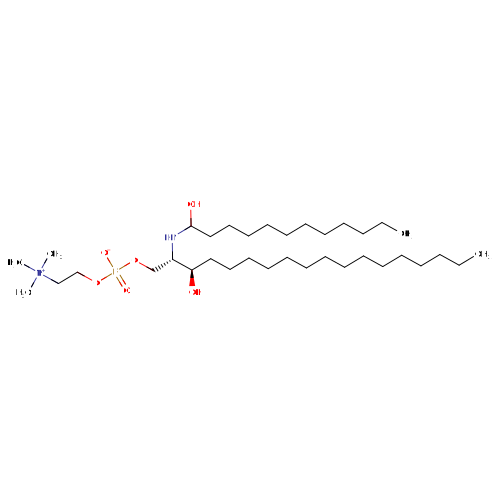
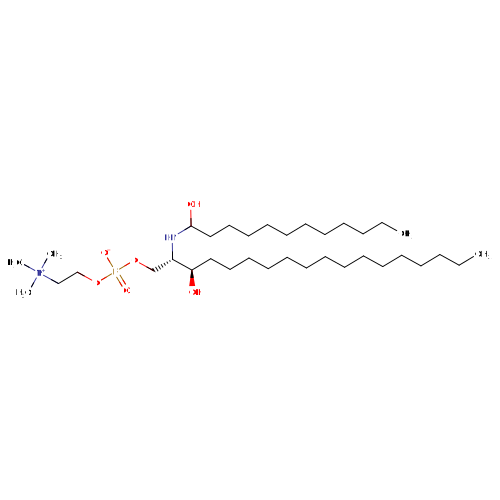
| Common Name | SM(d18:0/12:0) |
|---|
| Description | SM(d18:0/12:0), Also known as sphingomyelin, belongs to the class of organic compounds known as phosphosphingolipids. These are sphingolipids with a structure based on a sphingoid base that is attached to a phosphate head group. They differ from phosphonospingolipids which have a phosphonate head group. SM(d18:0/12:0) Is a very strong basic compound (based on its pKa). SM(d18:0/12:0) (D18:0/12:0) Or SM(d18:0/12:0) Is a type of sphingolipid found in animal cell membranes, especially in the membranous myelin sheath which surrounds some nerve cell axons. However, there is some evidence that there may also be a SM(d18:0/12:0) Pool in the inner leaflet of the membrane. In humans, SM(d18:0/12:0) Is the only membrane phospholipid not derived from glycerol. In addition it contains one polar head group, which is either phosphocholine or phosphoethanolamine. SMs play a role in signal transduction. SM(d18:0/12:0) Can accumulate in a rare hereditary disease called Niemann-Pick Disease, types A and B. SM(d18:0/12:0) was first documented in 1997 (PMID: 9034165). Niemann-Pick disease is a genetically-inherited disease caused by a deficiency in the enzyme Sphingomyelinase, which causes the accumulation of SM(d18:0/12:0) In spleen, liver, lungs, bone marrow, and the brain, causing irreversible neurological damage. |
|---|
| Structure | CCCCCCCCCCCCCCC[C@@H](O)[C@H](COP([O-])(=O)OCC[N+](C)(C)C)NC(O)CCCCCCCCCCC InChI=1S/C35H75N2O6P/c1-6-8-10-12-14-16-17-18-19-21-22-24-26-28-34(38)33(32-43-44(40,41)42-31-30-37(3,4)5)36-35(39)29-27-25-23-20-15-13-11-9-7-2/h33-36,38-39H,6-32H2,1-5H3/t33-,34+,35?/m0/s1 |
|---|
| Synonyms | | Value | Source |
|---|
| C12 Sphingomyelin | HMDB | | N-(Dodecanoyl)-sphing-4-enine-1-phosphocholine | HMDB | | Sphingomyelin | HMDB | | Sphingomyelin (D18:0/12:0) | HMDB | | N-(Dodecanoyl)-1-phosphocholine-sphinganine | HMDB | | Sphingomyelin(D18:0/12:0) | HMDB | | N-(Dodecanoyl)-1-phosphocholine-dihydrosphingosine | HMDB | | N-(Dodecanoyl)-1-phosphocholine-D-erythro-sphinganine | HMDB |
|
|---|
| Chemical Formula | C35H75N2O6P |
|---|
| Average Mass | 650.9536 Da |
|---|
| Monoisotopic Mass | 650.53627 Da |
|---|
| IUPAC Name | (2-{[(2S,3R)-3-hydroxy-2-[(1-hydroxydodecyl)amino]octadecyl phosphonato]oxy}ethyl)trimethylazanium |
|---|
| Traditional Name | (2-{[(2S,3R)-3-hydroxy-2-[(1-hydroxydodecyl)amino]octadecyl phosphonato]oxy}ethyl)trimethylazanium |
|---|
| CAS Registry Number | Not Available |
|---|
| SMILES | CCCCCCCCCCCCCCC[C@@H](O)[C@H](COP([O-])(=O)OCC[N+](C)(C)C)NC(O)CCCCCCCCCCC |
|---|
| InChI Identifier | InChI=1S/C35H75N2O6P/c1-6-8-10-12-14-16-17-18-19-21-22-24-26-28-34(38)33(32-43-44(40,41)42-31-30-37(3,4)5)36-35(39)29-27-25-23-20-15-13-11-9-7-2/h33-36,38-39H,6-32H2,1-5H3/t33-,34+,35?/m0/s1 |
|---|
| InChI Key | DBRCJAPVYYEHRO-GWDKEWMYSA-N |
|---|
| Experimental Spectra |
|---|
|
| Not Available | | Predicted Spectra |
|---|
|
| | Spectrum Type | Description | Depositor ID | Depositor Organization | Depositor | Deposition Date | View |
|---|
| 1D NMR | 13C NMR Spectrum (1D, 25 MHz, D2O, predicted) | Wishart Lab | Wishart Lab | David Wishart | 2021-06-20 | View Spectrum | | 1D NMR | 1H NMR Spectrum (1D, 100 MHz, D2O, predicted) | Wishart Lab | Wishart Lab | David Wishart | 2021-06-20 | View Spectrum | | 1D NMR | 13C NMR Spectrum (1D, 252 MHz, D2O, predicted) | Wishart Lab | Wishart Lab | David Wishart | 2021-06-20 | View Spectrum | | 1D NMR | 1H NMR Spectrum (1D, 1000 MHz, D2O, predicted) | Wishart Lab | Wishart Lab | David Wishart | 2021-06-20 | View Spectrum | | 1D NMR | 13C NMR Spectrum (1D, 50 MHz, D2O, predicted) | Wishart Lab | Wishart Lab | David Wishart | 2021-06-20 | View Spectrum | | 1D NMR | 1H NMR Spectrum (1D, 200 MHz, D2O, predicted) | Wishart Lab | Wishart Lab | David Wishart | 2021-06-20 | View Spectrum | | 1D NMR | 13C NMR Spectrum (1D, 75 MHz, D2O, predicted) | Wishart Lab | Wishart Lab | David Wishart | 2021-06-20 | View Spectrum | | 1D NMR | 1H NMR Spectrum (1D, 300 MHz, D2O, predicted) | Wishart Lab | Wishart Lab | David Wishart | 2021-06-20 | View Spectrum | | 1D NMR | 13C NMR Spectrum (1D, 101 MHz, D2O, predicted) | Wishart Lab | Wishart Lab | David Wishart | 2021-06-20 | View Spectrum | | 1D NMR | 1H NMR Spectrum (1D, 400 MHz, D2O, predicted) | Wishart Lab | Wishart Lab | David Wishart | 2021-06-20 | View Spectrum | | 1D NMR | 13C NMR Spectrum (1D, 126 MHz, D2O, predicted) | Wishart Lab | Wishart Lab | David Wishart | 2021-06-20 | View Spectrum | | 1D NMR | 1H NMR Spectrum (1D, 500 MHz, D2O, predicted) | Wishart Lab | Wishart Lab | David Wishart | 2021-06-20 | View Spectrum | | 1D NMR | 13C NMR Spectrum (1D, 151 MHz, D2O, predicted) | Wishart Lab | Wishart Lab | David Wishart | 2021-06-20 | View Spectrum | | 1D NMR | 1H NMR Spectrum (1D, 600 MHz, D2O, predicted) | Wishart Lab | Wishart Lab | David Wishart | 2021-06-20 | View Spectrum | | 1D NMR | 13C NMR Spectrum (1D, 176 MHz, D2O, predicted) | Wishart Lab | Wishart Lab | David Wishart | 2021-06-20 | View Spectrum | | 1D NMR | 1H NMR Spectrum (1D, 700 MHz, D2O, predicted) | Wishart Lab | Wishart Lab | David Wishart | 2021-06-20 | View Spectrum | | 1D NMR | 13C NMR Spectrum (1D, 201 MHz, D2O, predicted) | Wishart Lab | Wishart Lab | David Wishart | 2021-06-20 | View Spectrum | | 1D NMR | 1H NMR Spectrum (1D, 800 MHz, D2O, predicted) | Wishart Lab | Wishart Lab | David Wishart | 2021-06-20 | View Spectrum | | 1D NMR | 13C NMR Spectrum (1D, 226 MHz, D2O, predicted) | Wishart Lab | Wishart Lab | David Wishart | 2021-06-20 | View Spectrum | | 1D NMR | 1H NMR Spectrum (1D, 900 MHz, D2O, predicted) | Wishart Lab | Wishart Lab | David Wishart | 2021-06-20 | View Spectrum |
| | Chemical Shift Submissions |
|---|
|
| Not Available | | Species |
|---|
| Species of Origin | |
|---|
| Chemical Taxonomy |
|---|
| Description | Belongs to the class of organic compounds known as phosphosphingolipids. These are sphingolipids with a structure based on a sphingoid base that is attached to a phosphate head group. They differ from phosphonospingolipids which have a phosphonate head group. |
|---|
| Kingdom | Organic compounds |
|---|
| Super Class | Lipids and lipid-like molecules |
|---|
| Class | Sphingolipids |
|---|
| Sub Class | Phosphosphingolipids |
|---|
| Direct Parent | Phosphosphingolipids |
|---|
| Alternative Parents | |
|---|
| Substituents | - Sphingoid-1-phosphate or derivatives
- Phosphocholine
- Phosphoethanolamine
- Dialkyl phosphate
- Organic phosphoric acid derivative
- Phosphoric acid ester
- Alkyl phosphate
- Tetraalkylammonium salt
- Quaternary ammonium salt
- Hemiaminal
- Secondary alcohol
- Secondary amine
- Secondary aliphatic amine
- Alkanolamine
- Hydrocarbon derivative
- Organic oxide
- Organopnictogen compound
- Organic oxygen compound
- Organooxygen compound
- Organonitrogen compound
- Organic nitrogen compound
- Alcohol
- Amine
- Organic salt
- Organic zwitterion
- Aliphatic acyclic compound
|
|---|
| Molecular Framework | Aliphatic acyclic compounds |
|---|
| External Descriptors | Not Available |
|---|
| Physical Properties |
|---|
| State | Not Available |
|---|
| Experimental Properties | | Property | Value | Reference |
|---|
| Melting Point | Not Available | Not Available | | Boiling Point | Not Available | Not Available | | Water Solubility | Not Available | Not Available | | LogP | Not Available | Not Available |
|
|---|
| Predicted Properties | |
|---|