| Record Information |
|---|
| Version | 2.0 |
|---|
| Created at | 2022-05-11 18:41:08 UTC |
|---|
| Updated at | 2022-05-11 18:41:09 UTC |
|---|
| NP-MRD ID | NP0091552 |
|---|
| Secondary Accession Numbers | None |
|---|
| Natural Product Identification |
|---|
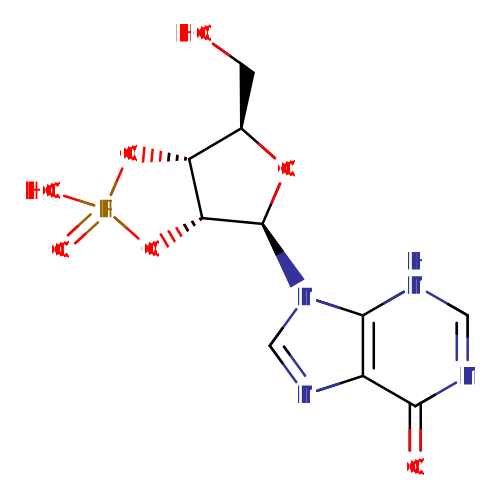
| Common Name | Inosine 2',3'-cyclic phosphate |
|---|
| Description | Coproporphyrinogen I belongs to the class of organic compounds known as porphyrins. Porphyrins are compounds containing a fundamental skeleton of four pyrrole nuclei united through the alpha-positions by four methine groups to form a macrocyclic structure. Coproporphyrinogen I is a weakly acidic compound (based on its pKa). Coproporphyrinogen I exists in all living species, ranging from bacteria to humans. In humans, coproporphyrinogen I is involved in the metabolic disorder called the acute intermittent porphyria pathway. A large number of factors are capable of increasing porphyrin excretion, owing to different and multiple causes and etiologies: (1) The main site of the chronic hepatic porphyria disease process concentrates on the liver, (2) a functional and morphologic liver injury is almost regularly associated with this chronic porphyria, and (3) the toxic form due to occupational and environmental exposure takes mainly a subclinical course. Hepatic porphyrias are characterized by acute neurological attacks (seizures, psychosis, extreme back and abdominal pain, and an acute polyneuropathy), while the erythropoietic forms present with skin problems (usually a light-sensitive blistering rash and increased hair growth). Outside of the human body, Coproporphyrinogen I has been detected, but not quantified in, several different foods, such as pak choy, pepper (c. Chinense), tea leaf willows, rosemaries, and mung beans. This could make coproporphyrinogen I a potential biomarker for the consumption of these foods. A neurotoxin causes damage to nerve cells and nerve tissues. Coproporphyrinogen I is a porphyrin metabolite arising from heme synthesis. Coproporphyrinogen I is biosynthesized from the tetrapyrrole hydroxymethylbilane, which is converted by the action of uroporphyrinogen synthase to uroporphyrinogen I. Uroporphyrinogen I is subsequently converted into coproporphyrinogen I through a series of four decarboxylations. Decreased biliary excretion of coproporphyrin leading to a compensatory urinary excretion. Inosine 2',3'-cyclic phosphate was first documented in 1983 (PMID: 6821943). Coproporphyrinogen I can be found in a number of food items, including cascade huckleberry, hyacinth bean, horseradish tree, and watercress (PMID: 11504054) (PMID: 8778203). |
|---|
| Structure | OC[C@H]1O[C@H]([C@@H]2OP(O)(=O)O[C@H]12)N1C=NC2=C1NC=NC2=O InChI=1S/C10H11N4O7P/c15-1-4-6-7(21-22(17,18)20-6)10(19-4)14-3-13-5-8(14)11-2-12-9(5)16/h2-4,6-7,10,15H,1H2,(H,17,18)(H,11,12,16)/t4-,6-,7-,10-/m1/s1 |
|---|
| Synonyms | | Value | Source |
|---|
| 3,8,13,18-Tetramethyl-5,10,15,20,22,24-hexahydroporphyrin-2,7,12,17-tetrapropionic acid | ChEBI | | COPROPORPHYRIN I | ChEBI | | 3,8,13,18-Tetramethyl-5,10,15,20,22,24-hexahydroporphyrin-2,7,12,17-tetrapropionate | Generator | | 3,8,13,18-Tetramethyl-5,10,15,20,22,24-hexahydroporphyrin-2,7,12,17-tetrapropanoate | HMDB | | 3,8,13,18-Tetramethyl-5,10,15,20,22,24-hexahydroporphyrin-2,7,12,17-tetrapropanoic acid | HMDB | | 2',3' Cyclic imp | HMDB | | Inosine cyclic 2',3'-(hydrogen phosphate) | HMDB | | Inosine cyclic 2',3'-monophosphate | HMDB | | Inosine cyclic 2,3 monophosphate | HMDB | | Inosine cyclic-2',3'-monophosphate | HMDB | | 2',3'-Cyclic imp | MeSH, HMDB | | Inosine 2',3'-cyclic phosphoric acid | Generator |
|
|---|
| Chemical Formula | C10H11N4O7P |
|---|
| Average Mass | 330.1907 Da |
|---|
| Monoisotopic Mass | 330.03654 Da |
|---|
| IUPAC Name | 9-[(3aR,4R,6R,6aR)-2-hydroxy-6-(hydroxymethyl)-2-oxo-tetrahydro-2H-2λ⁵-furo[3,4-d][1,3,2]dioxaphosphol-4-yl]-6,9-dihydro-3H-purin-6-one |
|---|
| Traditional Name | 9-[(3aR,4R,6R,6aR)-2-hydroxy-6-(hydroxymethyl)-2-oxo-tetrahydro-2λ⁵-furo[3,4-d][1,3,2]dioxaphosphol-4-yl]-3H-purin-6-one |
|---|
| CAS Registry Number | Not Available |
|---|
| SMILES | OC[C@H]1O[C@H]([C@@H]2OP(O)(=O)O[C@H]12)N1C=NC2=C1NC=NC2=O |
|---|
| InChI Identifier | InChI=1S/C10H11N4O7P/c15-1-4-6-7(21-22(17,18)20-6)10(19-4)14-3-13-5-8(14)11-2-12-9(5)16/h2-4,6-7,10,15H,1H2,(H,17,18)(H,11,12,16)/t4-,6-,7-,10-/m1/s1 |
|---|
| InChI Key | SBJVDTBACUMFFD-KQYNXXCUSA-N |
|---|
| Experimental Spectra |
|---|
|
| Not Available | | Predicted Spectra |
|---|
|
| | Spectrum Type | Description | Depositor ID | Depositor Organization | Depositor | Deposition Date | View |
|---|
| 1D NMR | 13C NMR Spectrum (1D, 25 MHz, D2O, predicted) | Wishart Lab | Wishart Lab | David Wishart | 2021-06-20 | View Spectrum | | 1D NMR | 1H NMR Spectrum (1D, 100 MHz, D2O, predicted) | Wishart Lab | Wishart Lab | David Wishart | 2021-06-20 | View Spectrum | | 1D NMR | 13C NMR Spectrum (1D, 252 MHz, D2O, predicted) | Wishart Lab | Wishart Lab | David Wishart | 2021-06-20 | View Spectrum | | 1D NMR | 1H NMR Spectrum (1D, 1000 MHz, D2O, predicted) | Wishart Lab | Wishart Lab | David Wishart | 2021-06-20 | View Spectrum | | 1D NMR | 13C NMR Spectrum (1D, 50 MHz, D2O, predicted) | Wishart Lab | Wishart Lab | David Wishart | 2021-06-20 | View Spectrum | | 1D NMR | 1H NMR Spectrum (1D, 200 MHz, D2O, predicted) | Wishart Lab | Wishart Lab | David Wishart | 2021-06-20 | View Spectrum | | 1D NMR | 13C NMR Spectrum (1D, 75 MHz, D2O, predicted) | Wishart Lab | Wishart Lab | David Wishart | 2021-06-20 | View Spectrum | | 1D NMR | 1H NMR Spectrum (1D, 300 MHz, D2O, predicted) | Wishart Lab | Wishart Lab | David Wishart | 2021-06-20 | View Spectrum | | 1D NMR | 13C NMR Spectrum (1D, 101 MHz, D2O, predicted) | Wishart Lab | Wishart Lab | David Wishart | 2021-06-20 | View Spectrum | | 1D NMR | 1H NMR Spectrum (1D, 400 MHz, D2O, predicted) | Wishart Lab | Wishart Lab | David Wishart | 2021-06-20 | View Spectrum | | 1D NMR | 13C NMR Spectrum (1D, 126 MHz, D2O, predicted) | Wishart Lab | Wishart Lab | David Wishart | 2021-06-20 | View Spectrum | | 1D NMR | 1H NMR Spectrum (1D, 500 MHz, D2O, predicted) | Wishart Lab | Wishart Lab | David Wishart | 2021-06-20 | View Spectrum | | 1D NMR | 13C NMR Spectrum (1D, 151 MHz, D2O, predicted) | Wishart Lab | Wishart Lab | David Wishart | 2021-06-20 | View Spectrum | | 1D NMR | 1H NMR Spectrum (1D, 600 MHz, D2O, predicted) | Wishart Lab | Wishart Lab | David Wishart | 2021-06-20 | View Spectrum | | 1D NMR | 13C NMR Spectrum (1D, 176 MHz, D2O, predicted) | Wishart Lab | Wishart Lab | David Wishart | 2021-06-20 | View Spectrum | | 1D NMR | 1H NMR Spectrum (1D, 700 MHz, D2O, predicted) | Wishart Lab | Wishart Lab | David Wishart | 2021-06-20 | View Spectrum | | 1D NMR | 13C NMR Spectrum (1D, 201 MHz, D2O, predicted) | Wishart Lab | Wishart Lab | David Wishart | 2021-06-20 | View Spectrum | | 1D NMR | 1H NMR Spectrum (1D, 800 MHz, D2O, predicted) | Wishart Lab | Wishart Lab | David Wishart | 2021-06-20 | View Spectrum | | 1D NMR | 13C NMR Spectrum (1D, 226 MHz, D2O, predicted) | Wishart Lab | Wishart Lab | David Wishart | 2021-06-20 | View Spectrum | | 1D NMR | 1H NMR Spectrum (1D, 900 MHz, D2O, predicted) | Wishart Lab | Wishart Lab | David Wishart | 2021-06-20 | View Spectrum |
| | Chemical Shift Submissions |
|---|
|
| Not Available | | Species |
|---|
| Species of Origin | |
|---|
| Chemical Taxonomy |
|---|
| Description | Belongs to the class of organic compounds known as porphyrins. Porphyrins are compounds containing a fundamental skeleton of four pyrrole nuclei united through the alpha-positions by four methine groups to form a macrocyclic structure. |
|---|
| Kingdom | Organic compounds |
|---|
| Super Class | Organoheterocyclic compounds |
|---|
| Class | Tetrapyrroles and derivatives |
|---|
| Sub Class | Porphyrins |
|---|
| Direct Parent | Porphyrins |
|---|
| Alternative Parents | |
|---|
| Substituents | - Porphyrin
- Tetracarboxylic acid or derivatives
- Substituted pyrrole
- Pyrrole
- Heteroaromatic compound
- Carboxylic acid derivative
- Carboxylic acid
- Azacycle
- Carbonyl group
- Hydrocarbon derivative
- Organic oxide
- Organopnictogen compound
- Organooxygen compound
- Organonitrogen compound
- Organic oxygen compound
- Organic nitrogen compound
- Aromatic heteropolycyclic compound
|
|---|
| Molecular Framework | Aromatic heteropolycyclic compounds |
|---|
| External Descriptors | |
|---|
| Physical Properties |
|---|
| State | Not Available |
|---|
| Experimental Properties | | Property | Value | Reference |
|---|
| Melting Point | Not Available | Not Available | | Boiling Point | Not Available | Not Available | | Water Solubility | Not Available | Not Available | | LogP | Not Available | Not Available |
|
|---|
| Predicted Properties | |
|---|