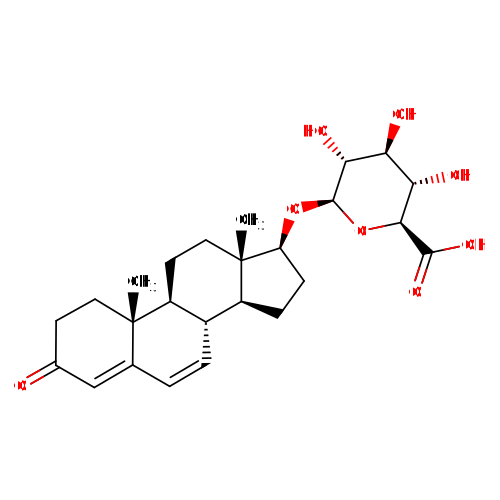
| Record Information |
|---|
| Version | 2.0 |
|---|
| Created at | 2022-05-11 18:25:15 UTC |
|---|
| Updated at | 2022-05-11 18:25:15 UTC |
|---|
| NP-MRD ID | NP0090892 |
|---|
| Secondary Accession Numbers | None |
|---|
| Natural Product Identification |
|---|
| Common Name | 6-Dehydrotestosterone glucuronide |
|---|
| Description | Thymine, also known as 5-methyluracil, belongs to the class of organic compounds known as hydroxypyrimidines. These are organic compounds containing a hydroxyl group attached to a pyrimidine ring. Pyrimidine is a 6-membered ring consisting of four carbon atoms and two nitrogen centers at the 1- and 3- ring positions. Thymine is an extremely weak basic (essentially neutral) compound (based on its pKa). Thymine exists in all living species, ranging from bacteria to humans. Within humans, thymine participates in a number of enzymatic reactions. In particular, thymine and deoxyribose 1-phosphate can be biosynthesized from thymidine through its interaction with the enzyme thymidine phosphorylase. In addition, thymine can be converted into dihydrothymine through its interaction with the enzyme dihydropyrimidine dehydrogenase [nadp(+)]. In humans, thymine is involved in the metabolic disorder called the beta-ureidopropionase deficiency pathway. Outside of the human body, Thymine has been detected, but not quantified in, several different foods, such as cupuaçus, welsh onions, wild leeks, jujubes, and black raspberries. This could make thymine a potential biomarker for the consumption of these foods. Thymine is a potentially toxic compound. A pyrimidine nucleobase that is uracil in which the hydrogen at position 5 is replaced by a methyl group. 6-Dehydrotestosterone glucuronide was first documented in 2000 (PMID: 10877825). Thymine, with regard to humans, has been found to be associated with several diseases such as colorectal cancer, thymidine treatment, and periodontal probing depth; thymine has also been linked to several inborn metabolic disorders including dihydropyrimidine dehydrogenase deficiency and beta-ureidopropionase deficiency (PMID: 12926795) (PMID: 23438684) (PMID: 29565828) (PMID: 23237383). |
|---|
| Structure | [H][C@@]12CC[C@H](O[C@@H]3O[C@@H]([C@@H](O)[C@H](O)[C@H]3O)C(O)=O)[C@@]1(C)CC[C@@]1([H])[C@@]2([H])C=CC2=CC(=O)CC[C@]12C InChI=1S/C25H34O8/c1-24-9-7-13(26)11-12(24)3-4-14-15-5-6-17(25(15,2)10-8-16(14)24)32-23-20(29)18(27)19(28)21(33-23)22(30)31/h3-4,11,14-21,23,27-29H,5-10H2,1-2H3,(H,30,31)/t14-,15-,16-,17-,18-,19-,20+,21-,23+,24-,25-/m0/s1 |
|---|
| Synonyms | | Value | Source |
|---|
| 2,4-Dihydroxy-5-methylpyrimidine | ChEBI | | 5-Methyl-2,4(1H,3H)-pyrimidinedione | ChEBI | | 5-Methylpyrimidine-2,4(1H,3H)-dione | ChEBI | | 5-Methyluracil | ChEBI | | T | ChEBI | | Thy | ChEBI | | Thymin | ChEBI | | 4-Hydroxy-5-methylpyrimidin-2(1H)-one | HMDB | | 5-Methyl-1,2,3,4-tetrahydropyrimidine-2,4-dione | HMDB | | 5-Methyl-2,4-dihydroxypyrimidine | HMDB | | 5-Methylpyrimidine-2,4-dione | HMDB | | 5 Methyluracil | HMDB | | 6,7-Didehydrotestosterone O-glucuronide | ChEBI | | 6-Dehydrotestosterone O-glucuronide | ChEBI | | 3-Oxoandrosta-4,6-dien-17beta-yl beta-D-glucopyranosiduronic acid | HMDB | | 3-Oxoandrosta-4,6-dien-17beta-yl beta-delta-glucopyranosiduronic acid | HMDB | | 6-Dehydrotestosterone 17-glucosiduronic acid | HMDB | | 6-Dehydrotestosterone 17-glucosiduronate | Generator |
|
|---|
| Chemical Formula | C25H34O8 |
|---|
| Average Mass | 462.5327 Da |
|---|
| Monoisotopic Mass | 462.22537 Da |
|---|
| IUPAC Name | (2S,3S,4S,5R,6R)-6-{[(1S,2R,10R,11S,14S,15S)-2,15-dimethyl-5-oxotetracyclo[8.7.0.0²,⁷.0¹¹,¹⁵]heptadeca-6,8-dien-14-yl]oxy}-3,4,5-trihydroxyoxane-2-carboxylic acid |
|---|
| Traditional Name | (2S,3S,4S,5R,6R)-6-{[(1S,2R,10R,11S,14S,15S)-2,15-dimethyl-5-oxotetracyclo[8.7.0.0²,⁷.0¹¹,¹⁵]heptadeca-6,8-dien-14-yl]oxy}-3,4,5-trihydroxyoxane-2-carboxylic acid |
|---|
| CAS Registry Number | Not Available |
|---|
| SMILES | [H][C@@]12CC[C@H](O[C@@H]3O[C@@H]([C@@H](O)[C@H](O)[C@H]3O)C(O)=O)[C@@]1(C)CC[C@@]1([H])[C@@]2([H])C=CC2=CC(=O)CC[C@]12C |
|---|
| InChI Identifier | InChI=1S/C25H34O8/c1-24-9-7-13(26)11-12(24)3-4-14-15-5-6-17(25(15,2)10-8-16(14)24)32-23-20(29)18(27)19(28)21(33-23)22(30)31/h3-4,11,14-21,23,27-29H,5-10H2,1-2H3,(H,30,31)/t14-,15-,16-,17-,18-,19-,20+,21-,23+,24-,25-/m0/s1 |
|---|
| InChI Key | GCIVSXAHMONYLO-HMAFJQTKSA-N |
|---|
| Experimental Spectra |
|---|
|
| Not Available | | Predicted Spectra |
|---|
|
| | Spectrum Type | Description | Depositor ID | Depositor Organization | Depositor | Deposition Date | View |
|---|
| 1D NMR | 13C NMR Spectrum (1D, 25 MHz, D2O, predicted) | Wishart Lab | Wishart Lab | David Wishart | 2021-06-20 | View Spectrum | | 1D NMR | 1H NMR Spectrum (1D, 100 MHz, D2O, predicted) | Wishart Lab | Wishart Lab | David Wishart | 2021-06-20 | View Spectrum | | 1D NMR | 13C NMR Spectrum (1D, 252 MHz, D2O, predicted) | Wishart Lab | Wishart Lab | David Wishart | 2021-06-20 | View Spectrum | | 1D NMR | 1H NMR Spectrum (1D, 1000 MHz, D2O, predicted) | Wishart Lab | Wishart Lab | David Wishart | 2021-06-20 | View Spectrum | | 1D NMR | 13C NMR Spectrum (1D, 50 MHz, D2O, predicted) | Wishart Lab | Wishart Lab | David Wishart | 2021-06-20 | View Spectrum | | 1D NMR | 1H NMR Spectrum (1D, 200 MHz, D2O, predicted) | Wishart Lab | Wishart Lab | David Wishart | 2021-06-20 | View Spectrum | | 1D NMR | 13C NMR Spectrum (1D, 75 MHz, D2O, predicted) | Wishart Lab | Wishart Lab | David Wishart | 2021-06-20 | View Spectrum | | 1D NMR | 1H NMR Spectrum (1D, 300 MHz, D2O, predicted) | Wishart Lab | Wishart Lab | David Wishart | 2021-06-20 | View Spectrum | | 1D NMR | 13C NMR Spectrum (1D, 101 MHz, D2O, predicted) | Wishart Lab | Wishart Lab | David Wishart | 2021-06-20 | View Spectrum | | 1D NMR | 1H NMR Spectrum (1D, 400 MHz, D2O, predicted) | Wishart Lab | Wishart Lab | David Wishart | 2021-06-20 | View Spectrum | | 1D NMR | 13C NMR Spectrum (1D, 126 MHz, D2O, predicted) | Wishart Lab | Wishart Lab | David Wishart | 2021-06-20 | View Spectrum | | 1D NMR | 1H NMR Spectrum (1D, 500 MHz, D2O, predicted) | Wishart Lab | Wishart Lab | David Wishart | 2021-06-20 | View Spectrum | | 1D NMR | 13C NMR Spectrum (1D, 151 MHz, D2O, predicted) | Wishart Lab | Wishart Lab | David Wishart | 2021-06-20 | View Spectrum | | 1D NMR | 1H NMR Spectrum (1D, 600 MHz, D2O, predicted) | Wishart Lab | Wishart Lab | David Wishart | 2021-06-20 | View Spectrum | | 1D NMR | 13C NMR Spectrum (1D, 176 MHz, D2O, predicted) | Wishart Lab | Wishart Lab | David Wishart | 2021-06-20 | View Spectrum | | 1D NMR | 1H NMR Spectrum (1D, 700 MHz, D2O, predicted) | Wishart Lab | Wishart Lab | David Wishart | 2021-06-20 | View Spectrum | | 1D NMR | 13C NMR Spectrum (1D, 201 MHz, D2O, predicted) | Wishart Lab | Wishart Lab | David Wishart | 2021-06-20 | View Spectrum | | 1D NMR | 1H NMR Spectrum (1D, 800 MHz, D2O, predicted) | Wishart Lab | Wishart Lab | David Wishart | 2021-06-20 | View Spectrum | | 1D NMR | 13C NMR Spectrum (1D, 226 MHz, D2O, predicted) | Wishart Lab | Wishart Lab | David Wishart | 2021-06-20 | View Spectrum | | 1D NMR | 1H NMR Spectrum (1D, 900 MHz, D2O, predicted) | Wishart Lab | Wishart Lab | David Wishart | 2021-06-20 | View Spectrum |
| | Chemical Shift Submissions |
|---|
|
| Not Available | | Species |
|---|
| Species of Origin | |
|---|
| Chemical Taxonomy |
|---|
| Description | Belongs to the class of organic compounds known as hydroxypyrimidines. These are organic compounds containing a hydroxyl group attached to a pyrimidine ring. Pyrimidine is a 6-membered ring consisting of four carbon atoms and two nitrogen centers at the 1- and 3- ring positions. |
|---|
| Kingdom | Organic compounds |
|---|
| Super Class | Organoheterocyclic compounds |
|---|
| Class | Diazines |
|---|
| Sub Class | Pyrimidines and pyrimidine derivatives |
|---|
| Direct Parent | Hydroxypyrimidines |
|---|
| Alternative Parents | |
|---|
| Substituents | - Hydroxypyrimidine
- Heteroaromatic compound
- Azacycle
- Organic nitrogen compound
- Organic oxygen compound
- Organopnictogen compound
- Hydrocarbon derivative
- Organooxygen compound
- Organonitrogen compound
- Aromatic heteromonocyclic compound
|
|---|
| Molecular Framework | Aromatic heteromonocyclic compounds |
|---|
| External Descriptors | |
|---|
| Physical Properties |
|---|
| State | Not Available |
|---|
| Experimental Properties | | Property | Value | Reference |
|---|
| Melting Point | Not Available | Not Available | | Boiling Point | Not Available | Not Available | | Water Solubility | Not Available | Not Available | | LogP | Not Available | Not Available |
|
|---|
| Predicted Properties | |
|---|