| Record Information |
|---|
| Version | 2.0 |
|---|
| Created at | 2022-05-11 16:54:55 UTC |
|---|
| Updated at | 2022-05-11 16:54:55 UTC |
|---|
| NP-MRD ID | NP0087617 |
|---|
| Secondary Accession Numbers | None |
|---|
| Natural Product Identification |
|---|
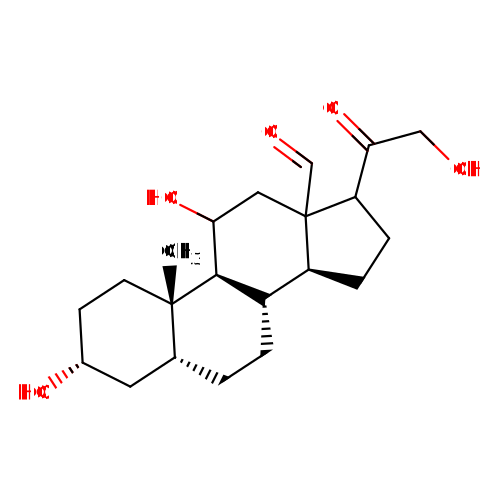
| Common Name | 11beta,21-Dihydroxy-3,20-oxo-5beta-pregnan-18-al |
|---|
| Description | DG(22:5(4Z,7Z,10Z,13Z,16Z)/16:1(9Z)/0:0) Belongs to the class of organic compounds known as 1,2-diacylglycerols. These are diacylglycerols containing a glycerol acylated at positions 1 and 2. Mono- and diacylglycerols are common food additives used to blend together certain ingredients, such as oil and water, which would not otherwise blend well. Since diacylglycerols are synthesized via phosphatidic acid, they will usually contain a saturated fatty acid at the C-1 position on the glycerol moiety and an unsaturated fatty acid at the C-2 position. DG(22:5(4Z,7Z,10Z,13Z,16Z)/16:1(9Z)/0:0) Is an extremely weak basic (essentially neutral) compound (based on its pKa). Within humans, DG(22:5(4Z,7Z,10Z,13Z,16Z)/16:1(9Z)/0:0) Participates in a number of enzymatic reactions. In particular, DG(22:5(4Z,7Z,10Z,13Z,16Z)/16:1(9Z)/0:0) Can be biosynthesized from PA(22:5(4Z,7Z,10Z,13Z,16Z)/16:1(9Z)); which is mediated by the enzyme phosphatidate phosphatase. In addition, DG(22:5(4Z,7Z,10Z,13Z,16Z)/16:1(9Z)/0:0) And clupanodonoyl-CoA can be converted into TG(22:5(4Z,7Z,10Z,13Z,16Z)/16:1(9Z)/22:5(7Z,10Z,13Z,16Z,19Z)); which is mediated by the enzyme diacylglycerol O-acyltransferase. In humans, DG(22:5(4Z,7Z,10Z,13Z,16Z)/16:1(9Z)/0:0) Is involved in the metabolic disorder called de novo triacylglycerol biosynthesis pathway. Glycerol-3-phosphate is first acylated with acyl-coenzyme A (acyl-CoA) to form lysophosphatidic acid, which is then acylated with another molecule of acyl-CoA to yield phosphatidic acid. It is a glyceride consisting of two fatty acid chains covalently bonded to a glycerol molecule through ester linkages. Diacylglycerols can have many different combinations of fatty acids attached at both the C-1 and C-2 positions. Synthesis of diacylglycerol begins with glycerol-3-phosphate, which is derived primarily from dihydroxyacetone phosphate, a product of glycolysis (usually in the cytoplasm of liver or adipose tissue cells). Phosphatidic acid is then de-phosphorylated to form diacylglycerol. The docosapentaenoic acid moiety is derived from animal fats and brain, while the palmitoleic acid moiety is derived from animal fats and vegetable oils. DG(22:5(4Z,7Z,10Z,13Z,16Z)/16:1(9Z)/0:0), In particular, consists of one chain of docosapentaenoic acid at the C-1 position and one chain of palmitoleic acid at the C-2 position. Diacylglycerols are precursors to triacylglycerols (triglyceride), which are formed by the addition of a third fatty acid to the diacylglycerol under the catalysis of diglyceride acyltransferase. DG(22:5(4Z,7Z,10Z,13Z,16Z)/16:1(9Z)/0:0) Is a diglyceride, or a diacylglycerol (DAG). Dacylglycerols are often found in bakery products, beverages, ice cream, chewing gum, shortening, whipped toppings, margarine, and confections. |
|---|
| Structure | [H][C@@]12CCC(C(=O)CO)C1(CC(O)[C@@]1([H])[C@@]2([H])CC[C@]2([H])C[C@H](O)CC[C@]12C)C=O InChI=1S/C21H32O5/c1-20-7-6-13(24)8-12(20)2-3-14-15-4-5-16(18(26)10-22)21(15,11-23)9-17(25)19(14)20/h11-17,19,22,24-25H,2-10H2,1H3/t12-,13-,14+,15+,16?,17?,19-,20+,21?/m1/s1 |
|---|
| Synonyms | | Value | Source |
|---|
| 11beta,21-Dihydroxy-3,20-oxo-5beta-pregnan-18-al | HMDB |
|
|---|
| Chemical Formula | C21H32O5 |
|---|
| Average Mass | 364.4758 Da |
|---|
| Monoisotopic Mass | 364.22497 Da |
|---|
| IUPAC Name | (1S,2S,5R,7R,10S,11S)-5,17-dihydroxy-14-(2-hydroxyacetyl)-2-methyltetracyclo[8.7.0.0²,⁷.0¹¹,¹⁵]heptadecane-15-carbaldehyde |
|---|
| Traditional Name | (1S,2S,5R,7R,10S,11S)-5,17-dihydroxy-14-(2-hydroxyacetyl)-2-methyltetracyclo[8.7.0.0²,⁷.0¹¹,¹⁵]heptadecane-15-carbaldehyde |
|---|
| CAS Registry Number | Not Available |
|---|
| SMILES | [H][C@@]12CCC(C(=O)CO)C1(CC(O)[C@@]1([H])[C@@]2([H])CC[C@]2([H])C[C@H](O)CC[C@]12C)C=O |
|---|
| InChI Identifier | InChI=1S/C21H32O5/c1-20-7-6-13(24)8-12(20)2-3-14-15-4-5-16(18(26)10-22)21(15,11-23)9-17(25)19(14)20/h11-17,19,22,24-25H,2-10H2,1H3/t12-,13-,14+,15+,16?,17?,19-,20+,21?/m1/s1 |
|---|
| InChI Key | YWTDWORQGPLRLL-SXWUTGHTSA-N |
|---|
| Experimental Spectra |
|---|
|
| Not Available | | Predicted Spectra |
|---|
|
| | Spectrum Type | Description | Depositor ID | Depositor Organization | Depositor | Deposition Date | View |
|---|
| 1D NMR | 13C NMR Spectrum (1D, 25 MHz, D2O, predicted) | Wishart Lab | Wishart Lab | David Wishart | 2021-06-20 | View Spectrum | | 1D NMR | 1H NMR Spectrum (1D, 100 MHz, D2O, predicted) | Wishart Lab | Wishart Lab | David Wishart | 2021-06-20 | View Spectrum | | 1D NMR | 13C NMR Spectrum (1D, 252 MHz, D2O, predicted) | Wishart Lab | Wishart Lab | David Wishart | 2021-06-20 | View Spectrum | | 1D NMR | 1H NMR Spectrum (1D, 1000 MHz, D2O, predicted) | Wishart Lab | Wishart Lab | David Wishart | 2021-06-20 | View Spectrum | | 1D NMR | 13C NMR Spectrum (1D, 50 MHz, D2O, predicted) | Wishart Lab | Wishart Lab | David Wishart | 2021-06-20 | View Spectrum | | 1D NMR | 1H NMR Spectrum (1D, 200 MHz, D2O, predicted) | Wishart Lab | Wishart Lab | David Wishart | 2021-06-20 | View Spectrum | | 1D NMR | 13C NMR Spectrum (1D, 75 MHz, D2O, predicted) | Wishart Lab | Wishart Lab | David Wishart | 2021-06-20 | View Spectrum | | 1D NMR | 1H NMR Spectrum (1D, 300 MHz, D2O, predicted) | Wishart Lab | Wishart Lab | David Wishart | 2021-06-20 | View Spectrum | | 1D NMR | 13C NMR Spectrum (1D, 101 MHz, D2O, predicted) | Wishart Lab | Wishart Lab | David Wishart | 2021-06-20 | View Spectrum | | 1D NMR | 1H NMR Spectrum (1D, 400 MHz, D2O, predicted) | Wishart Lab | Wishart Lab | David Wishart | 2021-06-20 | View Spectrum | | 1D NMR | 13C NMR Spectrum (1D, 126 MHz, D2O, predicted) | Wishart Lab | Wishart Lab | David Wishart | 2021-06-20 | View Spectrum | | 1D NMR | 1H NMR Spectrum (1D, 500 MHz, D2O, predicted) | Wishart Lab | Wishart Lab | David Wishart | 2021-06-20 | View Spectrum | | 1D NMR | 13C NMR Spectrum (1D, 151 MHz, D2O, predicted) | Wishart Lab | Wishart Lab | David Wishart | 2021-06-20 | View Spectrum | | 1D NMR | 1H NMR Spectrum (1D, 600 MHz, D2O, predicted) | Wishart Lab | Wishart Lab | David Wishart | 2021-06-20 | View Spectrum | | 1D NMR | 13C NMR Spectrum (1D, 176 MHz, D2O, predicted) | Wishart Lab | Wishart Lab | David Wishart | 2021-06-20 | View Spectrum | | 1D NMR | 1H NMR Spectrum (1D, 700 MHz, D2O, predicted) | Wishart Lab | Wishart Lab | David Wishart | 2021-06-20 | View Spectrum | | 1D NMR | 13C NMR Spectrum (1D, 201 MHz, D2O, predicted) | Wishart Lab | Wishart Lab | David Wishart | 2021-06-20 | View Spectrum | | 1D NMR | 1H NMR Spectrum (1D, 800 MHz, D2O, predicted) | Wishart Lab | Wishart Lab | David Wishart | 2021-06-20 | View Spectrum | | 1D NMR | 13C NMR Spectrum (1D, 226 MHz, D2O, predicted) | Wishart Lab | Wishart Lab | David Wishart | 2021-06-20 | View Spectrum | | 1D NMR | 1H NMR Spectrum (1D, 900 MHz, D2O, predicted) | Wishart Lab | Wishart Lab | David Wishart | 2021-06-20 | View Spectrum |
| | Chemical Shift Submissions |
|---|
|
| Not Available | | Species |
|---|
| Species of Origin | |
|---|
| Chemical Taxonomy |
|---|
| Description | Belongs to the class of organic compounds known as 1,2-diacylglycerols. These are diacylglycerols containing a glycerol acylated at positions 1 and 2. |
|---|
| Kingdom | Organic compounds |
|---|
| Super Class | Lipids and lipid-like molecules |
|---|
| Class | Glycerolipids |
|---|
| Sub Class | Diradylglycerols |
|---|
| Direct Parent | 1,2-diacylglycerols |
|---|
| Alternative Parents | |
|---|
| Substituents | - 1,2-acyl-sn-glycerol
- Fatty acid ester
- Fatty acyl
- Dicarboxylic acid or derivatives
- Carboxylic acid ester
- Carboxylic acid derivative
- Organic oxygen compound
- Organic oxide
- Hydrocarbon derivative
- Primary alcohol
- Organooxygen compound
- Carbonyl group
- Alcohol
- Aliphatic acyclic compound
|
|---|
| Molecular Framework | Aliphatic acyclic compounds |
|---|
| External Descriptors | Not Available |
|---|
| Physical Properties |
|---|
| State | Not Available |
|---|
| Experimental Properties | | Property | Value | Reference |
|---|
| Melting Point | Not Available | Not Available | | Boiling Point | Not Available | Not Available | | Water Solubility | Not Available | Not Available | | LogP | Not Available | Not Available |
|
|---|
| Predicted Properties | |
|---|