| Record Information |
|---|
| Version | 2.0 |
|---|
| Created at | 2022-05-11 16:53:17 UTC |
|---|
| Updated at | 2022-05-11 16:53:17 UTC |
|---|
| NP-MRD ID | NP0087569 |
|---|
| Secondary Accession Numbers | None |
|---|
| Natural Product Identification |
|---|
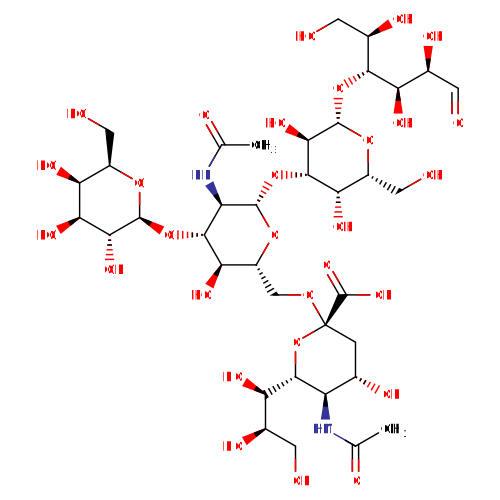
| Common Name | Sialyllacto-N-tetraose b |
|---|
| Description | Sialyllacto-N-tetraose b, also known as LS-tetrasaccharide b or LSTB, belongs to the class of organic compounds known as n-acylneuraminic acids. These are neuraminic acids carrying an N-acyl substituent. Sialylated oligosaccharides are important components of glycoproteins and glycolipids and also occur as free oligosaccharides in several body fluids. The levels of sialyllacto-N-tetraose are higher on day 3 than on day 1. Sialyllacto-N-tetraose b is an extremely weak basic (essentially neutral) compound (based on its pKa). Sialyl oligosaccharides of human milk/colostrum are generally believed to be of biological significance, for example providing precursors for biosynthesis of brain. In human milk, both free and bound sialylated oligosaccharides have potential biological activity and are known to inhibit viral infection. The acidic oligosaccharides of human milk are predominantly sialyloligosaccharides. These results are consistent with the view that during the first 3 d of lactation, the concentration of sialyl oligosaccharides in human colostrum change in accordance with the physiological demands of newborn infants. Sialyllacto-N-tetraose b is a sialylated oligosaccharide normally occurring in human breast milk. Pathogens that bind sialic acid-containing glycans on their host mucosal surfaces may be inhibited by human milk sialyloligosaccharides. |
|---|
| Structure | CC(=O)N[C@@H]1[C@@H](O)C[C@@](OC[C@H]2O[C@@H](O[C@H]3[C@@H](O)[C@@H](CO)O[C@@H](O[C@H]([C@H](O)CO)[C@H](O)[C@@H](O)C=O)[C@@H]3O)[C@H](NC(C)=O)[C@@H](O[C@@H]3O[C@H](CO)[C@H](O)[C@H](O)[C@H]3O)[C@@H]2O)(O[C@H]1[C@H](O)[C@H](O)CO)C(O)=O InChI=1S/C37H62N2O29/c1-10(45)38-19-12(47)3-37(36(59)60,68-31(19)22(52)14(49)5-41)61-9-18-25(55)30(66-34-27(57)26(56)23(53)16(7-43)62-34)20(39-11(2)46)33(64-18)67-32-24(54)17(8-44)63-35(28(32)58)65-29(15(50)6-42)21(51)13(48)4-40/h4,12-35,41-44,47-58H,3,5-9H2,1-2H3,(H,38,45)(H,39,46)(H,59,60)/t12-,13-,14+,15+,16+,17+,18+,19+,20+,21+,22+,23-,24-,25+,26-,27+,28+,29+,30+,31+,32-,33-,34-,35-,37+/m0/s1 |
|---|
| Synonyms | | Value | Source |
|---|
| LS-Tetrasaccharide b | HMDB | | LSTB | HMDB | | O-(N-Acetyl-alpha-neuraminosyl)-(2->6)-O-[beta-D-galactopyranosyl-(1->3)]-O-2-(acetylamino)-2-deoxy-beta-D-glucopyranosyl-(1->3)-O-beta-D-galactopyranosyl-(1->4)- D-glucose | HMDB | | O-(N-Acetyl-alpha-neuraminosyl)-(2->6)-O-[beta-delta-galactopyranosyl-(1->3)]-O-2-(acetylamino)-2-deoxy-beta-delta-glucopyranosyl-(1->3)-O-beta-delta-galactopyranosyl-(1->4)- D-glucose | HMDB | | (2R,4S,5R,6R)-2-{[(2R,3S,4R,5R,6S)-6-{[(2R,3S,4S,5R,6S)-3,5-dihydroxy-2-(hydroxymethyl)-6-{[(2R,3R,4R,5R)-1,2,4,5-tetrahydroxy-6-oxohexan-3-yl]oxy}oxan-4-yl]oxy}-3-hydroxy-5-[(1-hydroxyethylidene)amino]-4-{[(2R,3R,4S,5R,6R)-3,4,5-trihydroxy-6-(hydroxymethyl)oxan-2-yl]oxy}oxan-2-yl]methoxy}-4-hydroxy-5-[(1-hydroxyethylidene)amino]-6-[(1R,2R)-1,2,3-trihydroxypropyl]oxane-2-carboxylate | HMDB |
|
|---|
| Chemical Formula | C37H62N2O29 |
|---|
| Average Mass | 998.8842 Da |
|---|
| Monoisotopic Mass | 998.34382 Da |
|---|
| IUPAC Name | (2R,4S,5R,6R)-2-{[(2R,3S,4R,5R,6S)-6-{[(2R,3S,4S,5R,6S)-3,5-dihydroxy-2-(hydroxymethyl)-6-{[(2R,3R,4R,5R)-1,2,4,5-tetrahydroxy-6-oxohexan-3-yl]oxy}oxan-4-yl]oxy}-5-acetamido-3-hydroxy-4-{[(2R,3R,4S,5R,6R)-3,4,5-trihydroxy-6-(hydroxymethyl)oxan-2-yl]oxy}oxan-2-yl]methoxy}-5-acetamido-4-hydroxy-6-[(1R,2R)-1,2,3-trihydroxypropyl]oxane-2-carboxylic acid |
|---|
| Traditional Name | (2R,4S,5R,6R)-2-{[(2R,3S,4R,5R,6S)-6-{[(2R,3S,4S,5R,6S)-3,5-dihydroxy-2-(hydroxymethyl)-6-{[(2R,3R,4R,5R)-1,2,4,5-tetrahydroxy-6-oxohexan-3-yl]oxy}oxan-4-yl]oxy}-5-acetamido-3-hydroxy-4-{[(2R,3R,4S,5R,6R)-3,4,5-trihydroxy-6-(hydroxymethyl)oxan-2-yl]oxy}oxan-2-yl]methoxy}-5-acetamido-4-hydroxy-6-[(1R,2R)-1,2,3-trihydroxypropyl]oxane-2-carboxylic acid |
|---|
| CAS Registry Number | Not Available |
|---|
| SMILES | CC(=O)N[C@@H]1[C@@H](O)C[C@@](OC[C@H]2O[C@@H](O[C@H]3[C@@H](O)[C@@H](CO)O[C@@H](O[C@H]([C@H](O)CO)[C@H](O)[C@@H](O)C=O)[C@@H]3O)[C@H](NC(C)=O)[C@@H](O[C@@H]3O[C@H](CO)[C@H](O)[C@H](O)[C@H]3O)[C@@H]2O)(O[C@H]1[C@H](O)[C@H](O)CO)C(O)=O |
|---|
| InChI Identifier | InChI=1S/C37H62N2O29/c1-10(45)38-19-12(47)3-37(36(59)60,68-31(19)22(52)14(49)5-41)61-9-18-25(55)30(66-34-27(57)26(56)23(53)16(7-43)62-34)20(39-11(2)46)33(64-18)67-32-24(54)17(8-44)63-35(28(32)58)65-29(15(50)6-42)21(51)13(48)4-40/h4,12-35,41-44,47-58H,3,5-9H2,1-2H3,(H,38,45)(H,39,46)(H,59,60)/t12-,13-,14+,15+,16+,17+,18+,19+,20+,21+,22+,23-,24-,25+,26-,27+,28+,29+,30+,31+,32-,33-,34-,35-,37+/m0/s1 |
|---|
| InChI Key | SFMRPVLZMVJKGZ-JRZQLMJNSA-N |
|---|
| Experimental Spectra |
|---|
|
| Not Available | | Predicted Spectra |
|---|
|
| | Spectrum Type | Description | Depositor ID | Depositor Organization | Depositor | Deposition Date | View |
|---|
| 1D NMR | 13C NMR Spectrum (1D, 25 MHz, D2O, predicted) | Wishart Lab | Wishart Lab | David Wishart | 2021-06-20 | View Spectrum | | 1D NMR | 1H NMR Spectrum (1D, 100 MHz, D2O, predicted) | Wishart Lab | Wishart Lab | David Wishart | 2021-06-20 | View Spectrum | | 1D NMR | 13C NMR Spectrum (1D, 252 MHz, D2O, predicted) | Wishart Lab | Wishart Lab | David Wishart | 2021-06-20 | View Spectrum | | 1D NMR | 1H NMR Spectrum (1D, 1000 MHz, D2O, predicted) | Wishart Lab | Wishart Lab | David Wishart | 2021-06-20 | View Spectrum | | 1D NMR | 13C NMR Spectrum (1D, 50 MHz, D2O, predicted) | Wishart Lab | Wishart Lab | David Wishart | 2021-06-20 | View Spectrum | | 1D NMR | 1H NMR Spectrum (1D, 200 MHz, D2O, predicted) | Wishart Lab | Wishart Lab | David Wishart | 2021-06-20 | View Spectrum | | 1D NMR | 13C NMR Spectrum (1D, 75 MHz, D2O, predicted) | Wishart Lab | Wishart Lab | David Wishart | 2021-06-20 | View Spectrum | | 1D NMR | 1H NMR Spectrum (1D, 300 MHz, D2O, predicted) | Wishart Lab | Wishart Lab | David Wishart | 2021-06-20 | View Spectrum | | 1D NMR | 13C NMR Spectrum (1D, 101 MHz, D2O, predicted) | Wishart Lab | Wishart Lab | David Wishart | 2021-06-20 | View Spectrum | | 1D NMR | 1H NMR Spectrum (1D, 400 MHz, D2O, predicted) | Wishart Lab | Wishart Lab | David Wishart | 2021-06-20 | View Spectrum | | 1D NMR | 13C NMR Spectrum (1D, 126 MHz, D2O, predicted) | Wishart Lab | Wishart Lab | David Wishart | 2021-06-20 | View Spectrum | | 1D NMR | 1H NMR Spectrum (1D, 500 MHz, D2O, predicted) | Wishart Lab | Wishart Lab | David Wishart | 2021-06-20 | View Spectrum | | 1D NMR | 13C NMR Spectrum (1D, 151 MHz, D2O, predicted) | Wishart Lab | Wishart Lab | David Wishart | 2021-06-20 | View Spectrum | | 1D NMR | 1H NMR Spectrum (1D, 600 MHz, D2O, predicted) | Wishart Lab | Wishart Lab | David Wishart | 2021-06-20 | View Spectrum | | 1D NMR | 13C NMR Spectrum (1D, 176 MHz, D2O, predicted) | Wishart Lab | Wishart Lab | David Wishart | 2021-06-20 | View Spectrum | | 1D NMR | 1H NMR Spectrum (1D, 700 MHz, D2O, predicted) | Wishart Lab | Wishart Lab | David Wishart | 2021-06-20 | View Spectrum | | 1D NMR | 13C NMR Spectrum (1D, 201 MHz, D2O, predicted) | Wishart Lab | Wishart Lab | David Wishart | 2021-06-20 | View Spectrum | | 1D NMR | 1H NMR Spectrum (1D, 800 MHz, D2O, predicted) | Wishart Lab | Wishart Lab | David Wishart | 2021-06-20 | View Spectrum | | 1D NMR | 13C NMR Spectrum (1D, 226 MHz, D2O, predicted) | Wishart Lab | Wishart Lab | David Wishart | 2021-06-20 | View Spectrum | | 1D NMR | 1H NMR Spectrum (1D, 900 MHz, D2O, predicted) | Wishart Lab | Wishart Lab | David Wishart | 2021-06-20 | View Spectrum |
| | Chemical Shift Submissions |
|---|
|
| Not Available | | Species |
|---|
| Species of Origin | |
|---|
| Chemical Taxonomy |
|---|
| Description | Belongs to the class of organic compounds known as n-acylneuraminic acids. These are neuraminic acids carrying an N-acyl substituent. |
|---|
| Kingdom | Organic compounds |
|---|
| Super Class | Organic oxygen compounds |
|---|
| Class | Organooxygen compounds |
|---|
| Sub Class | Carbohydrates and carbohydrate conjugates |
|---|
| Direct Parent | N-acylneuraminic acids |
|---|
| Alternative Parents | |
|---|
| Substituents | - Oligosaccharide
- N-acylneuraminic acid
- Neuraminic acid
- Fatty acyl glycoside
- N-acyl-alpha-hexosamine
- C-glucuronide
- Alkyl glycoside
- C-glycosyl compound
- Glycosyl compound
- O-glycosyl compound
- Ketal
- Beta-hydroxy aldehyde
- Fatty acyl
- Pyran
- Oxane
- Acetamide
- Alpha-hydroxyaldehyde
- Carboxamide group
- Secondary alcohol
- Secondary carboxylic acid amide
- Polyol
- Carboxylic acid derivative
- Carboxylic acid
- Oxacycle
- Acetal
- Monocarboxylic acid or derivatives
- Organoheterocyclic compound
- Organonitrogen compound
- Carbonyl group
- Hydrocarbon derivative
- Primary alcohol
- Aldehyde
- Organic nitrogen compound
- Organopnictogen compound
- Organic oxide
- Alcohol
- Aliphatic heteromonocyclic compound
|
|---|
| Molecular Framework | Aliphatic heteromonocyclic compounds |
|---|
| External Descriptors | Not Available |
|---|
| Physical Properties |
|---|
| State | Not Available |
|---|
| Experimental Properties | | Property | Value | Reference |
|---|
| Melting Point | Not Available | Not Available | | Boiling Point | Not Available | Not Available | | Water Solubility | Not Available | Not Available | | LogP | Not Available | Not Available |
|
|---|
| Predicted Properties | |
|---|