| Record Information |
|---|
| Version | 2.0 |
|---|
| Created at | 2022-05-11 16:49:58 UTC |
|---|
| Updated at | 2022-05-11 16:49:58 UTC |
|---|
| NP-MRD ID | NP0087449 |
|---|
| Secondary Accession Numbers | None |
|---|
| Natural Product Identification |
|---|
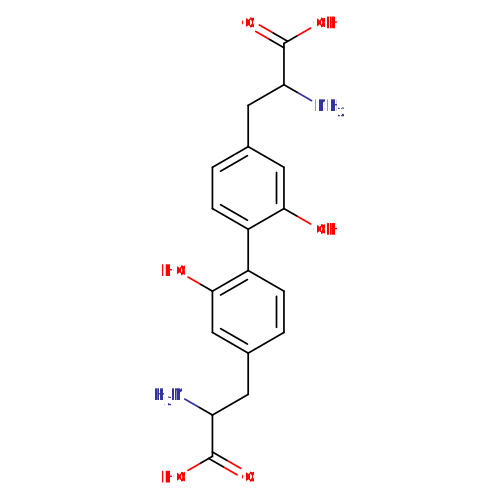
| Common Name | Dityrosine |
|---|
| Description | Dityrosine, also known as O,o'-dityrosine, belongs to the class of organic compounds known as lignans, neolignans and related compounds. These are plant products of low molecular weight formed primarily from oxidative coupling of two p-propylphenol moieties. They can also be described as micromolecules with two phenylpropanoid units coupled together. They can be attached in various manners, like C5-C5', C8-C8'. Most known natural lignans are oxidized at C9 and C9´ and, based upon the way in which oxygen is incorporated into the skeleton and on the cyclization patterns, a wide range of lignans of very different structural types can be formed. Dityrosine has also been found in oxidative/nitrative stress under a variety of conditions and biological systems. Dityrosine is a very strong basic compound (based on its pKa). Dityrosine is a fluorescent molecule formed as a result of normal posttranslational processing. The continued development of, and increased accessibility to, improved mass spectrometric instrumentation will expand the capability, feasibility, and sensitivity with which specific biomarkers like dityrosine can be measured. The presence of elevated levels of dityrosine in mammalian tissue and urine samples has been measured by chromatographic separation followed by mass spectrometry GC-MS and HPLC-MS/MS. Increases in dityrosine levels have been associated with pathologies such as eye cataracts, atherosclerosis, acute inflammation, and Alzheimer's disease. Dityrosine was first documented in 1997 (PMID: 9323538). In this regard, it has been used as an important biomarker for oxidatively modified proteins during UV and gamma-irradiation, aging, and exposure to oxygen free radicals, nitrogen dioxide, peroxynitrite, and lipid hydroperoxides (PMID: 10211406) (PMID: 17019703). |
|---|
| Structure | NC(CC1=CC(O)=C(C=C1)C1=CC=C(CC(N)C(O)=O)C=C1O)C(O)=O InChI=1S/C18H20N2O6/c19-13(17(23)24)5-9-1-3-11(15(21)7-9)12-4-2-10(8-16(12)22)6-14(20)18(25)26/h1-4,7-8,13-14,21-22H,5-6,19-20H2,(H,23,24)(H,25,26) |
|---|
| Synonyms | | Value | Source |
|---|
| Bityrosine | HMDB | | O,O'-dityrosine | HMDB | | O,O-Dityrosine | HMDB | | 2-Amino-3-[4'-(2-amino-2-carboxyethyl)-2,2'-dihydroxy-[1,1'-biphenyl]-4-yl]propanoate | HMDB |
|
|---|
| Chemical Formula | C18H20N2O6 |
|---|
| Average Mass | 360.3612 Da |
|---|
| Monoisotopic Mass | 360.13214 Da |
|---|
| IUPAC Name | 2-amino-3-{4-[4-(2-amino-2-carboxyethyl)-2-hydroxyphenyl]-3-hydroxyphenyl}propanoic acid |
|---|
| Traditional Name | 2-amino-3-{4-[4-(2-amino-2-carboxyethyl)-2-hydroxyphenyl]-3-hydroxyphenyl}propanoic acid |
|---|
| CAS Registry Number | Not Available |
|---|
| SMILES | NC(CC1=CC(O)=C(C=C1)C1=CC=C(CC(N)C(O)=O)C=C1O)C(O)=O |
|---|
| InChI Identifier | InChI=1S/C18H20N2O6/c19-13(17(23)24)5-9-1-3-11(15(21)7-9)12-4-2-10(8-16(12)22)6-14(20)18(25)26/h1-4,7-8,13-14,21-22H,5-6,19-20H2,(H,23,24)(H,25,26) |
|---|
| InChI Key | FHOZGLMQYMAREG-UHFFFAOYSA-N |
|---|
| Experimental Spectra |
|---|
|
| Not Available | | Predicted Spectra |
|---|
|
| | Spectrum Type | Description | Depositor ID | Depositor Organization | Depositor | Deposition Date | View |
|---|
| 1D NMR | 13C NMR Spectrum (1D, 25 MHz, D2O, predicted) | Wishart Lab | Wishart Lab | David Wishart | 2021-06-20 | View Spectrum | | 1D NMR | 1H NMR Spectrum (1D, 100 MHz, D2O, predicted) | Wishart Lab | Wishart Lab | David Wishart | 2021-06-20 | View Spectrum | | 1D NMR | 13C NMR Spectrum (1D, 252 MHz, D2O, predicted) | Wishart Lab | Wishart Lab | David Wishart | 2021-06-20 | View Spectrum | | 1D NMR | 1H NMR Spectrum (1D, 1000 MHz, D2O, predicted) | Wishart Lab | Wishart Lab | David Wishart | 2021-06-20 | View Spectrum | | 1D NMR | 13C NMR Spectrum (1D, 50 MHz, D2O, predicted) | Wishart Lab | Wishart Lab | David Wishart | 2021-06-20 | View Spectrum | | 1D NMR | 1H NMR Spectrum (1D, 200 MHz, D2O, predicted) | Wishart Lab | Wishart Lab | David Wishart | 2021-06-20 | View Spectrum | | 1D NMR | 13C NMR Spectrum (1D, 75 MHz, D2O, predicted) | Wishart Lab | Wishart Lab | David Wishart | 2021-06-20 | View Spectrum | | 1D NMR | 1H NMR Spectrum (1D, 300 MHz, D2O, predicted) | Wishart Lab | Wishart Lab | David Wishart | 2021-06-20 | View Spectrum | | 1D NMR | 13C NMR Spectrum (1D, 101 MHz, D2O, predicted) | Wishart Lab | Wishart Lab | David Wishart | 2021-06-20 | View Spectrum | | 1D NMR | 1H NMR Spectrum (1D, 400 MHz, D2O, predicted) | Wishart Lab | Wishart Lab | David Wishart | 2021-06-20 | View Spectrum | | 1D NMR | 13C NMR Spectrum (1D, 126 MHz, D2O, predicted) | Wishart Lab | Wishart Lab | David Wishart | 2021-06-20 | View Spectrum | | 1D NMR | 1H NMR Spectrum (1D, 500 MHz, D2O, predicted) | Wishart Lab | Wishart Lab | David Wishart | 2021-06-20 | View Spectrum | | 1D NMR | 13C NMR Spectrum (1D, 151 MHz, D2O, predicted) | Wishart Lab | Wishart Lab | David Wishart | 2021-06-20 | View Spectrum | | 1D NMR | 1H NMR Spectrum (1D, 600 MHz, D2O, predicted) | Wishart Lab | Wishart Lab | David Wishart | 2021-06-20 | View Spectrum | | 1D NMR | 13C NMR Spectrum (1D, 176 MHz, D2O, predicted) | Wishart Lab | Wishart Lab | David Wishart | 2021-06-20 | View Spectrum | | 1D NMR | 1H NMR Spectrum (1D, 700 MHz, D2O, predicted) | Wishart Lab | Wishart Lab | David Wishart | 2021-06-20 | View Spectrum | | 1D NMR | 13C NMR Spectrum (1D, 201 MHz, D2O, predicted) | Wishart Lab | Wishart Lab | David Wishart | 2021-06-20 | View Spectrum | | 1D NMR | 1H NMR Spectrum (1D, 800 MHz, D2O, predicted) | Wishart Lab | Wishart Lab | David Wishart | 2021-06-20 | View Spectrum | | 1D NMR | 13C NMR Spectrum (1D, 226 MHz, D2O, predicted) | Wishart Lab | Wishart Lab | David Wishart | 2021-06-20 | View Spectrum | | 1D NMR | 1H NMR Spectrum (1D, 900 MHz, D2O, predicted) | Wishart Lab | Wishart Lab | David Wishart | 2021-06-20 | View Spectrum |
| | Chemical Shift Submissions |
|---|
|
| Not Available | | Species |
|---|
| Species of Origin | |
|---|
| Chemical Taxonomy |
|---|
| Description | Belongs to the class of organic compounds known as lignans, neolignans and related compounds. These are plant products of low molecular weight formed primarily from oxidative coupling of two p-propylphenol moieties. They can also be described as micromolecules with two phenylpropanoid units coupled together. They can be attached in various manners, like C5-C5', C8-C8'. Most known natural lignans are oxidized at C9 and C9´ and, based upon the way in which oxygen is incorporated into the skeleton and on the cyclization patterns, a wide range of lignans of very different structural types can be formed. |
|---|
| Kingdom | Organic compounds |
|---|
| Super Class | Lignans, neolignans and related compounds |
|---|
| Class | Not Available |
|---|
| Sub Class | Not Available |
|---|
| Direct Parent | Lignans, neolignans and related compounds |
|---|
| Alternative Parents | |
|---|
| Substituents | - Phenylalanine or derivatives
- Neolignan skeleton
- Biphenyl
- 3-phenylpropanoic-acid
- Alpha-amino acid
- Alpha-amino acid or derivatives
- Amphetamine or derivatives
- 1-hydroxy-4-unsubstituted benzenoid
- 1-hydroxy-2-unsubstituted benzenoid
- Aralkylamine
- Phenol
- Monocyclic benzene moiety
- Dicarboxylic acid or derivatives
- Benzenoid
- Amino acid or derivatives
- Amino acid
- Carboxylic acid
- Carboxylic acid derivative
- Primary aliphatic amine
- Primary amine
- Hydrocarbon derivative
- Carbonyl group
- Organic oxygen compound
- Organic oxide
- Organopnictogen compound
- Organic nitrogen compound
- Amine
- Organonitrogen compound
- Organooxygen compound
- Aromatic homomonocyclic compound
|
|---|
| Molecular Framework | Aromatic homomonocyclic compounds |
|---|
| External Descriptors | Not Available |
|---|
| Physical Properties |
|---|
| State | Not Available |
|---|
| Experimental Properties | | Property | Value | Reference |
|---|
| Melting Point | Not Available | Not Available | | Boiling Point | Not Available | Not Available | | Water Solubility | Not Available | Not Available | | LogP | Not Available | Not Available |
|
|---|
| Predicted Properties | |
|---|