| Record Information |
|---|
| Version | 2.0 |
|---|
| Created at | 2022-05-11 16:42:03 UTC |
|---|
| Updated at | 2022-05-11 16:42:03 UTC |
|---|
| NP-MRD ID | NP0087169 |
|---|
| Secondary Accession Numbers | None |
|---|
| Natural Product Identification |
|---|
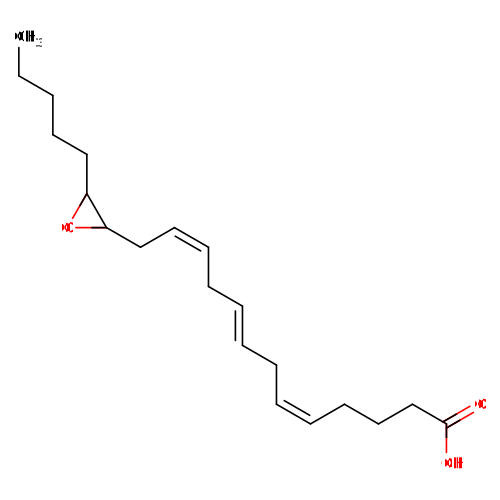
| Common Name | 14,15-Epoxy-5,8,11-eicosatrienoic acid |
|---|
| Description | 14,15-Epoxy-5,8,11-eicosatrienoic acid belongs to the class of organic compounds known as long-chain fatty acids. These are fatty acids with an aliphatic tail that contains between 13 and 21 carbon atoms. Blockade of EET formation is associated with salt-sensitive hypertension. 14,15-Epoxy-5,8,11-eicosatrienoic acid is an extremely weak basic (essentially neutral) compound (based on its pKa). 14,15-Epoxy-5,8,11-eicosatrienoic acid can be converted into 14,15-dihetre; which is catalyzed by the enzyme epoxide hydratase 2. The P450 eicosanoids epoxyeicosatrienoic acids (EETs) are endogenous lipid mediators produced by P450 epoxygenases and metabolized through multiple pathways including soluble epoxide hydrolase (sEH). In humans, 14,15-epoxy-5,8,11-eicosatrienoic acid is involved in mefenamic acid action pathway. These hydration products are more stable and less biologically active than EETs. Upon hydration by soluble epoxide hydrolase (sEH), EET are metabolized to dihydroxyeicosatrienoic acids (DHET). The cytochrome P-450 (P450) monooxygenase pathway includes enzymes of the CYP1A, CYP2B, CYP2C, CYP2E, and CYP2J subfamilies that catalyze the formation of four regioisomeric products, 5,6-, 8,9-, 11,12-, and 14,15-epoxyeicosatrienoic acid. EETs have vasodilator and natriuretic effect. EETs are produced in brain and perform important biological functions, including protection from ischemic injury. EETs may be involved in the development of hypertension and endothelial dysfunction in DOCA-salt rats, but not in excessive collagen deposition or electrophysiological abnormalities. Both light flashes and direct glial stimulation produce vasodilatation mediated by EETs. 14,15-Epoxy-5,8,11-eicosatrienoic acid is an epoxyeicosatrienoic acid (EET), a metabolite of arachidonic acid. 14,15-Epoxy-5,8,11-eicosatrienoic acid is found in Mus musculus. Four regioisomeric cis-EET are primary products of arachidonic acid metabolism by cytochrome P450 epoxygenases. |
|---|
| Structure | CCCCCC1OC1CC=CCC=CCC=CCCCC(O)=O InChI=1S/C20H32O3/c1-2-3-12-15-18-19(23-18)16-13-10-8-6-4-5-7-9-11-14-17-20(21)22/h4,6-7,9-10,13,18-19H,2-3,5,8,11-12,14-17H2,1H3,(H,21,22) |
|---|
| Synonyms | | Value | Source |
|---|
| 14,15-Epoxy-5,8,11-eicosatrienoate | Generator | | 14,15-Epoxy-5,8,11-eicosatrienoic acid, (2alpha(5Z,8Z,11Z),3alpha)-isomer | MeSH | | 14,15-EET | MeSH | | 14,15-Epoxyeicosatrienoic acid | MeSH | | 14,15-oxido-5,8,11-Eicosatrienoic acid | MeSH | | 14,15-Epoxy-5,8,11-eicosatrienoic acid | MeSH |
|
|---|
| Chemical Formula | C20H32O3 |
|---|
| Average Mass | 320.4663 Da |
|---|
| Monoisotopic Mass | 320.23514 Da |
|---|
| IUPAC Name | 13-(3-pentyloxiran-2-yl)trideca-5,8,11-trienoic acid |
|---|
| Traditional Name | 13-(3-pentyloxiran-2-yl)trideca-5,8,11-trienoic acid |
|---|
| CAS Registry Number | Not Available |
|---|
| SMILES | CCCCCC1OC1CC=CCC=CCC=CCCCC(O)=O |
|---|
| InChI Identifier | InChI=1S/C20H32O3/c1-2-3-12-15-18-19(23-18)16-13-10-8-6-4-5-7-9-11-14-17-20(21)22/h4,6-7,9-10,13,18-19H,2-3,5,8,11-12,14-17H2,1H3,(H,21,22) |
|---|
| InChI Key | JBSCUHKPLGKXKH-UHFFFAOYSA-N |
|---|
| Experimental Spectra |
|---|
|
| Not Available | | Predicted Spectra |
|---|
|
| | Spectrum Type | Description | Depositor ID | Depositor Organization | Depositor | Deposition Date | View |
|---|
| 1D NMR | 13C NMR Spectrum (1D, 25 MHz, D2O, predicted) | Wishart Lab | Wishart Lab | David Wishart | 2021-06-20 | View Spectrum | | 1D NMR | 1H NMR Spectrum (1D, 100 MHz, D2O, predicted) | Wishart Lab | Wishart Lab | David Wishart | 2021-06-20 | View Spectrum | | 1D NMR | 13C NMR Spectrum (1D, 252 MHz, D2O, predicted) | Wishart Lab | Wishart Lab | David Wishart | 2021-06-20 | View Spectrum | | 1D NMR | 1H NMR Spectrum (1D, 1000 MHz, D2O, predicted) | Wishart Lab | Wishart Lab | David Wishart | 2021-06-20 | View Spectrum | | 1D NMR | 13C NMR Spectrum (1D, 50 MHz, D2O, predicted) | Wishart Lab | Wishart Lab | David Wishart | 2021-06-20 | View Spectrum | | 1D NMR | 1H NMR Spectrum (1D, 200 MHz, D2O, predicted) | Wishart Lab | Wishart Lab | David Wishart | 2021-06-20 | View Spectrum | | 1D NMR | 13C NMR Spectrum (1D, 75 MHz, D2O, predicted) | Wishart Lab | Wishart Lab | David Wishart | 2021-06-20 | View Spectrum | | 1D NMR | 1H NMR Spectrum (1D, 300 MHz, D2O, predicted) | Wishart Lab | Wishart Lab | David Wishart | 2021-06-20 | View Spectrum | | 1D NMR | 13C NMR Spectrum (1D, 101 MHz, D2O, predicted) | Wishart Lab | Wishart Lab | David Wishart | 2021-06-20 | View Spectrum | | 1D NMR | 1H NMR Spectrum (1D, 400 MHz, D2O, predicted) | Wishart Lab | Wishart Lab | David Wishart | 2021-06-20 | View Spectrum | | 1D NMR | 13C NMR Spectrum (1D, 126 MHz, D2O, predicted) | Wishart Lab | Wishart Lab | David Wishart | 2021-06-20 | View Spectrum | | 1D NMR | 1H NMR Spectrum (1D, 500 MHz, D2O, predicted) | Wishart Lab | Wishart Lab | David Wishart | 2021-06-20 | View Spectrum | | 1D NMR | 13C NMR Spectrum (1D, 151 MHz, D2O, predicted) | Wishart Lab | Wishart Lab | David Wishart | 2021-06-20 | View Spectrum | | 1D NMR | 1H NMR Spectrum (1D, 600 MHz, D2O, predicted) | Wishart Lab | Wishart Lab | David Wishart | 2021-06-20 | View Spectrum | | 1D NMR | 13C NMR Spectrum (1D, 176 MHz, D2O, predicted) | Wishart Lab | Wishart Lab | David Wishart | 2021-06-20 | View Spectrum | | 1D NMR | 1H NMR Spectrum (1D, 700 MHz, D2O, predicted) | Wishart Lab | Wishart Lab | David Wishart | 2021-06-20 | View Spectrum | | 1D NMR | 13C NMR Spectrum (1D, 201 MHz, D2O, predicted) | Wishart Lab | Wishart Lab | David Wishart | 2021-06-20 | View Spectrum | | 1D NMR | 1H NMR Spectrum (1D, 800 MHz, D2O, predicted) | Wishart Lab | Wishart Lab | David Wishart | 2021-06-20 | View Spectrum | | 1D NMR | 13C NMR Spectrum (1D, 226 MHz, D2O, predicted) | Wishart Lab | Wishart Lab | David Wishart | 2021-06-20 | View Spectrum | | 1D NMR | 1H NMR Spectrum (1D, 900 MHz, D2O, predicted) | Wishart Lab | Wishart Lab | David Wishart | 2021-06-20 | View Spectrum |
| | Chemical Shift Submissions |
|---|
|
| Not Available | | Species |
|---|
| Species of Origin | |
|---|
| Chemical Taxonomy |
|---|
| Description | Belongs to the class of organic compounds known as long-chain fatty acids. These are fatty acids with an aliphatic tail that contains between 13 and 21 carbon atoms. |
|---|
| Kingdom | Organic compounds |
|---|
| Super Class | Lipids and lipid-like molecules |
|---|
| Class | Fatty Acyls |
|---|
| Sub Class | Fatty acids and conjugates |
|---|
| Direct Parent | Long-chain fatty acids |
|---|
| Alternative Parents | |
|---|
| Substituents | - Long-chain fatty acid
- Epoxy fatty acid
- Heterocyclic fatty acid
- Unsaturated fatty acid
- Carboxylic acid derivative
- Carboxylic acid
- Dialkyl ether
- Oxirane
- Ether
- Monocarboxylic acid or derivatives
- Organoheterocyclic compound
- Oxacycle
- Organic oxide
- Hydrocarbon derivative
- Carbonyl group
- Organooxygen compound
- Organic oxygen compound
- Aliphatic heteromonocyclic compound
|
|---|
| Molecular Framework | Aliphatic heteromonocyclic compounds |
|---|
| External Descriptors | Not Available |
|---|
| Physical Properties |
|---|
| State | Not Available |
|---|
| Experimental Properties | | Property | Value | Reference |
|---|
| Melting Point | Not Available | Not Available | | Boiling Point | Not Available | Not Available | | Water Solubility | Not Available | Not Available | | LogP | Not Available | Not Available |
|
|---|
| Predicted Properties | |
|---|