| Record Information |
|---|
| Version | 2.0 |
|---|
| Created at | 2022-05-11 16:40:54 UTC |
|---|
| Updated at | 2022-05-11 16:40:54 UTC |
|---|
| NP-MRD ID | NP0087128 |
|---|
| Secondary Accession Numbers | None |
|---|
| Natural Product Identification |
|---|
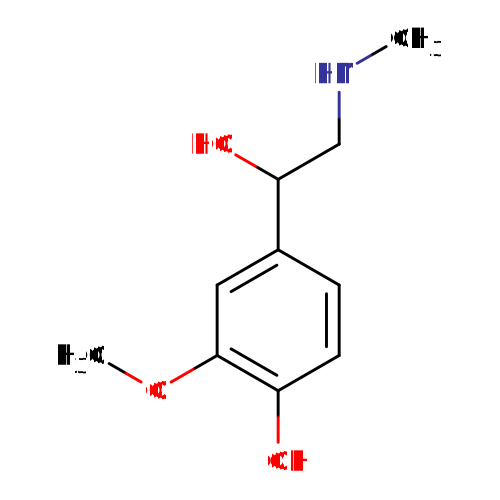
| Common Name | Metanephrine |
|---|
| Description | Metanephrine, also known as metadrenaline, belongs to the class of organic compounds known as methoxyphenols. Methoxyphenols are compounds containing a methoxy group attached to the benzene ring of a phenol moiety. Metanephrine is a very strong basic compound (based on its pKa). Within humans, metanephrine participates in a number of enzymatic reactions. In particular, metanephrine can be converted into 3-methoxy-4-hydroxyphenylglycolaldehyde through its interaction with the enzyme amine oxidase [flavin-containing] a. In addition, metanephrine and pyrocatechol can be biosynthesized from epinephrine and guaiacol through the action of the enzyme catechol O-methyltransferase. Metanephrine was first documented in 1979 (PMID: 434011). In humans, metanephrine is involved in the metabolic disorder called tyrosinemia type I (PMID: 7251775) (PMID: 10338428) (PMID: 12153741) (PMID: 7058845). |
|---|
| Structure | CNCC(O)C1=CC(OC)=C(O)C=C1 InChI=1S/C10H15NO3/c1-11-6-9(13)7-3-4-8(12)10(5-7)14-2/h3-5,9,11-13H,6H2,1-2H3 |
|---|
| Synonyms | | Value | Source |
|---|
| (+/-)-metanephrine | HMDB | | 3-Methoxy-adrenaline | HMDB | | 3-Methoxyadrenaline | HMDB | | 3-O-Methyl-adrenaline | HMDB | | 3-O-Methylepinephrine | HMDB | | 4-Hydroxy-3-methoxy-N-methylphenethanolamine | HMDB | | DL-3-O-Methyladrenaline | HMDB | | DL-Metanephrine | HMDB | | m-O-Methyladrenaline | HMDB | | Metadrenaline | HMDB |
|
|---|
| Chemical Formula | C10H15NO3 |
|---|
| Average Mass | 197.2310 Da |
|---|
| Monoisotopic Mass | 197.10519 Da |
|---|
| IUPAC Name | 4-[1-hydroxy-2-(methylamino)ethyl]-2-methoxyphenol |
|---|
| Traditional Name | (+/-)-metanephrine |
|---|
| CAS Registry Number | Not Available |
|---|
| SMILES | CNCC(O)C1=CC(OC)=C(O)C=C1 |
|---|
| InChI Identifier | InChI=1S/C10H15NO3/c1-11-6-9(13)7-3-4-8(12)10(5-7)14-2/h3-5,9,11-13H,6H2,1-2H3 |
|---|
| InChI Key | JWJCTZKFYGDABJ-UHFFFAOYSA-N |
|---|
| Experimental Spectra |
|---|
|
| Not Available | | Predicted Spectra |
|---|
|
| | Spectrum Type | Description | Depositor ID | Depositor Organization | Depositor | Deposition Date | View |
|---|
| 1D NMR | 13C NMR Spectrum (1D, 25 MHz, D2O, predicted) | Wishart Lab | Wishart Lab | David Wishart | 2021-06-20 | View Spectrum | | 1D NMR | 1H NMR Spectrum (1D, 100 MHz, D2O, predicted) | Wishart Lab | Wishart Lab | David Wishart | 2021-06-20 | View Spectrum | | 1D NMR | 13C NMR Spectrum (1D, 252 MHz, D2O, predicted) | Wishart Lab | Wishart Lab | David Wishart | 2021-06-20 | View Spectrum | | 1D NMR | 1H NMR Spectrum (1D, 1000 MHz, D2O, predicted) | Wishart Lab | Wishart Lab | David Wishart | 2021-06-20 | View Spectrum | | 1D NMR | 13C NMR Spectrum (1D, 50 MHz, D2O, predicted) | Wishart Lab | Wishart Lab | David Wishart | 2021-06-20 | View Spectrum | | 1D NMR | 1H NMR Spectrum (1D, 200 MHz, D2O, predicted) | Wishart Lab | Wishart Lab | David Wishart | 2021-06-20 | View Spectrum | | 1D NMR | 13C NMR Spectrum (1D, 75 MHz, D2O, predicted) | Wishart Lab | Wishart Lab | David Wishart | 2021-06-20 | View Spectrum | | 1D NMR | 1H NMR Spectrum (1D, 300 MHz, D2O, predicted) | Wishart Lab | Wishart Lab | David Wishart | 2021-06-20 | View Spectrum | | 1D NMR | 13C NMR Spectrum (1D, 101 MHz, D2O, predicted) | Wishart Lab | Wishart Lab | David Wishart | 2021-06-20 | View Spectrum | | 1D NMR | 1H NMR Spectrum (1D, 400 MHz, D2O, predicted) | Wishart Lab | Wishart Lab | David Wishart | 2021-06-20 | View Spectrum | | 1D NMR | 13C NMR Spectrum (1D, 126 MHz, D2O, predicted) | Wishart Lab | Wishart Lab | David Wishart | 2021-06-20 | View Spectrum | | 1D NMR | 1H NMR Spectrum (1D, 500 MHz, D2O, predicted) | Wishart Lab | Wishart Lab | David Wishart | 2021-06-20 | View Spectrum | | 1D NMR | 13C NMR Spectrum (1D, 151 MHz, D2O, predicted) | Wishart Lab | Wishart Lab | David Wishart | 2021-06-20 | View Spectrum | | 1D NMR | 1H NMR Spectrum (1D, 600 MHz, D2O, predicted) | Wishart Lab | Wishart Lab | David Wishart | 2021-06-20 | View Spectrum | | 1D NMR | 13C NMR Spectrum (1D, 176 MHz, D2O, predicted) | Wishart Lab | Wishart Lab | David Wishart | 2021-06-20 | View Spectrum | | 1D NMR | 1H NMR Spectrum (1D, 700 MHz, D2O, predicted) | Wishart Lab | Wishart Lab | David Wishart | 2021-06-20 | View Spectrum | | 1D NMR | 13C NMR Spectrum (1D, 201 MHz, D2O, predicted) | Wishart Lab | Wishart Lab | David Wishart | 2021-06-20 | View Spectrum | | 1D NMR | 1H NMR Spectrum (1D, 800 MHz, D2O, predicted) | Wishart Lab | Wishart Lab | David Wishart | 2021-06-20 | View Spectrum | | 1D NMR | 13C NMR Spectrum (1D, 226 MHz, D2O, predicted) | Wishart Lab | Wishart Lab | David Wishart | 2021-06-20 | View Spectrum | | 1D NMR | 1H NMR Spectrum (1D, 900 MHz, D2O, predicted) | Wishart Lab | Wishart Lab | David Wishart | 2021-06-20 | View Spectrum |
| | Chemical Shift Submissions |
|---|
|
| Not Available | | Species |
|---|
| Species of Origin | |
|---|
| Chemical Taxonomy |
|---|
| Description | Belongs to the class of organic compounds known as methoxyphenols. Methoxyphenols are compounds containing a methoxy group attached to the benzene ring of a phenol moiety. |
|---|
| Kingdom | Organic compounds |
|---|
| Super Class | Benzenoids |
|---|
| Class | Phenols |
|---|
| Sub Class | Methoxyphenols |
|---|
| Direct Parent | Methoxyphenols |
|---|
| Alternative Parents | |
|---|
| Substituents | - Methoxyphenol
- Phenoxy compound
- Anisole
- Phenol ether
- Methoxybenzene
- Alkyl aryl ether
- 1-hydroxy-2-unsubstituted benzenoid
- Aralkylamine
- Monocyclic benzene moiety
- Secondary alcohol
- 1,2-aminoalcohol
- Secondary amine
- Ether
- Secondary aliphatic amine
- Hydrocarbon derivative
- Organooxygen compound
- Organonitrogen compound
- Organopnictogen compound
- Organic oxygen compound
- Amine
- Organic nitrogen compound
- Alcohol
- Aromatic alcohol
- Aromatic homomonocyclic compound
|
|---|
| Molecular Framework | Aromatic homomonocyclic compounds |
|---|
| External Descriptors | |
|---|
| Physical Properties |
|---|
| State | Not Available |
|---|
| Experimental Properties | | Property | Value | Reference |
|---|
| Melting Point | Not Available | Not Available | | Boiling Point | Not Available | Not Available | | Water Solubility | Not Available | Not Available | | LogP | Not Available | Not Available |
|
|---|
| Predicted Properties | |
|---|
| General References | - Uchikura K, Horikawa R, Tanimura T, Kabasawa Y: Determination of catecholamines by radioenzymatic assay using ion-pair liquid chromatography. J Chromatogr. 1981 Apr 10;223(1):41-50. [PubMed:7251775 ]
- Schmidt J, Mohr VD, Metzger P, Zirngibl H: Posttraumatic hypertension secondary to adrenal hemorrhage mimicking pheochromocytoma: case report. J Trauma. 1999 May;46(5):973-5. [PubMed:10338428 ]
- van Dam PS, van Gils A, Canninga-van Dijk MR, de Koning EJ, Hofland LJ, de Herder WW: Sequential ACTH and catecholamine secretion in a phaeochromocytoma. Eur J Endocrinol. 2002 Aug;147(2):201-6. doi: 10.1530/eje.0.1470201. [PubMed:12153741 ]
- Artal R, Platt LD, Kammula RK, Strassner HT, Gratacos J, Golde SH: Sympathoadrenal activity in infants of diabetic mothers. Am J Obstet Gynecol. 1982 Feb 15;142(4):436-9. doi: 10.1016/s0002-9378(16)32386-9. [PubMed:7058845 ]
- Artal R, Hobel CJ, Lam R, Oddie TH, Fisher DA: Free metanephrine in human amniotic fluid as an index of fetal sympathetic nervous system maturation. Am J Obstet Gynecol. 1979 Feb 15;133(4):452-4. [PubMed:434011 ]
|
|---|