| Record Information |
|---|
| Version | 2.0 |
|---|
| Created at | 2022-05-11 16:38:02 UTC |
|---|
| Updated at | 2022-05-11 16:38:02 UTC |
|---|
| NP-MRD ID | NP0087035 |
|---|
| Secondary Accession Numbers | None |
|---|
| Natural Product Identification |
|---|
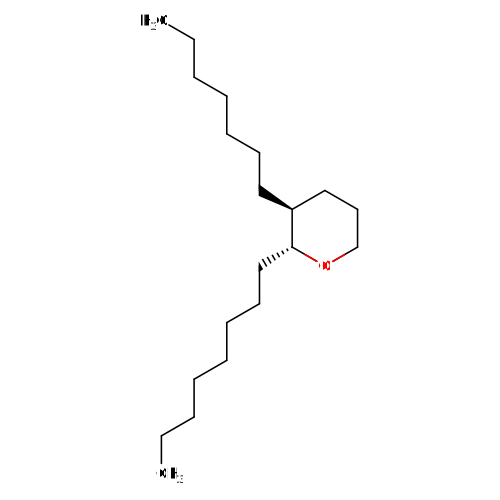
| Common Name | Thromboxane |
|---|
| Description | Thromboxane belongs to the class of organic compounds known as thromboxanes. These are eicosanoids structurally characterized by the presence of a 6-member ether containing ring. Thus, thromboxane is considered to be an eicosanoid lipid molecule. Thromboxane is a very hydrophobic molecule, practically insoluble (in water), and relatively neutral. Thromboxane is a vasoconstrictor, potent hypertensive agent, and facilitates the clumping of platelets. Thromboxane is a member of the family of lipids known as eicosanoids. It is in homeostatic balance in the circulatory system with prostacyclin, a related compound. In humans, thromboxane is involved in mefenamic acid action pathway. All eicosanoids function locally at the site of synthesis, through receptor-mediated G-protein linked signaling pathways. Thromboxane was first documented in 1983 (PMID: 6338043). All mammalian cells except erythrocytes synthesize eicosanoids (PMID: 12075265) (PMID: 8607099) (PMID: 14966927) (PMID: 10086775) (PMID: 11350265) (PMID: 15992996). |
|---|
| Structure | CCCCCCCC[C@H]1OCCC[C@@H]1CCCCCCC InChI=1S/C20H40O/c1-3-5-7-9-11-13-17-20-19(16-14-18-21-20)15-12-10-8-6-4-2/h19-20H,3-18H2,1-2H3/t19-,20+/m0/s1 |
|---|
| Synonyms | | Value | Source |
|---|
| Thromboxane a2 | HMDB |
|
|---|
| Chemical Formula | C20H40O |
|---|
| Average Mass | 296.5310 Da |
|---|
| Monoisotopic Mass | 296.30792 Da |
|---|
| IUPAC Name | (2R,3S)-3-heptyl-2-octyloxane |
|---|
| Traditional Name | (2R,3S)-3-heptyl-2-octyl-oxane |
|---|
| CAS Registry Number | Not Available |
|---|
| SMILES | CCCCCCCC[C@H]1OCCC[C@@H]1CCCCCCC |
|---|
| InChI Identifier | InChI=1S/C20H40O/c1-3-5-7-9-11-13-17-20-19(16-14-18-21-20)15-12-10-8-6-4-2/h19-20H,3-18H2,1-2H3/t19-,20+/m0/s1 |
|---|
| InChI Key | RZWIIPASKMUIAC-VQTJNVASSA-N |
|---|
| Experimental Spectra |
|---|
|
| Not Available | | Predicted Spectra |
|---|
|
| | Spectrum Type | Description | Depositor ID | Depositor Organization | Depositor | Deposition Date | View |
|---|
| 1D NMR | 13C NMR Spectrum (1D, 25 MHz, D2O, predicted) | Wishart Lab | Wishart Lab | David Wishart | 2021-06-20 | View Spectrum | | 1D NMR | 1H NMR Spectrum (1D, 100 MHz, D2O, predicted) | Wishart Lab | Wishart Lab | David Wishart | 2021-06-20 | View Spectrum | | 1D NMR | 13C NMR Spectrum (1D, 252 MHz, D2O, predicted) | Wishart Lab | Wishart Lab | David Wishart | 2021-06-20 | View Spectrum | | 1D NMR | 1H NMR Spectrum (1D, 1000 MHz, D2O, predicted) | Wishart Lab | Wishart Lab | David Wishart | 2021-06-20 | View Spectrum | | 1D NMR | 13C NMR Spectrum (1D, 50 MHz, D2O, predicted) | Wishart Lab | Wishart Lab | David Wishart | 2021-06-20 | View Spectrum | | 1D NMR | 1H NMR Spectrum (1D, 200 MHz, D2O, predicted) | Wishart Lab | Wishart Lab | David Wishart | 2021-06-20 | View Spectrum | | 1D NMR | 13C NMR Spectrum (1D, 75 MHz, D2O, predicted) | Wishart Lab | Wishart Lab | David Wishart | 2021-06-20 | View Spectrum | | 1D NMR | 1H NMR Spectrum (1D, 300 MHz, D2O, predicted) | Wishart Lab | Wishart Lab | David Wishart | 2021-06-20 | View Spectrum | | 1D NMR | 13C NMR Spectrum (1D, 101 MHz, D2O, predicted) | Wishart Lab | Wishart Lab | David Wishart | 2021-06-20 | View Spectrum | | 1D NMR | 1H NMR Spectrum (1D, 400 MHz, D2O, predicted) | Wishart Lab | Wishart Lab | David Wishart | 2021-06-20 | View Spectrum | | 1D NMR | 13C NMR Spectrum (1D, 126 MHz, D2O, predicted) | Wishart Lab | Wishart Lab | David Wishart | 2021-06-20 | View Spectrum | | 1D NMR | 1H NMR Spectrum (1D, 500 MHz, D2O, predicted) | Wishart Lab | Wishart Lab | David Wishart | 2021-06-20 | View Spectrum | | 1D NMR | 13C NMR Spectrum (1D, 151 MHz, D2O, predicted) | Wishart Lab | Wishart Lab | David Wishart | 2021-06-20 | View Spectrum | | 1D NMR | 1H NMR Spectrum (1D, 600 MHz, D2O, predicted) | Wishart Lab | Wishart Lab | David Wishart | 2021-06-20 | View Spectrum | | 1D NMR | 13C NMR Spectrum (1D, 176 MHz, D2O, predicted) | Wishart Lab | Wishart Lab | David Wishart | 2021-06-20 | View Spectrum | | 1D NMR | 1H NMR Spectrum (1D, 700 MHz, D2O, predicted) | Wishart Lab | Wishart Lab | David Wishart | 2021-06-20 | View Spectrum | | 1D NMR | 13C NMR Spectrum (1D, 201 MHz, D2O, predicted) | Wishart Lab | Wishart Lab | David Wishart | 2021-06-20 | View Spectrum | | 1D NMR | 1H NMR Spectrum (1D, 800 MHz, D2O, predicted) | Wishart Lab | Wishart Lab | David Wishart | 2021-06-20 | View Spectrum | | 1D NMR | 13C NMR Spectrum (1D, 226 MHz, D2O, predicted) | Wishart Lab | Wishart Lab | David Wishart | 2021-06-20 | View Spectrum | | 1D NMR | 1H NMR Spectrum (1D, 900 MHz, D2O, predicted) | Wishart Lab | Wishart Lab | David Wishart | 2021-06-20 | View Spectrum |
| | Chemical Shift Submissions |
|---|
|
| Not Available | | Species |
|---|
| Species of Origin | |
|---|
| Chemical Taxonomy |
|---|
| Description | Belongs to the class of organic compounds known as thromboxanes. These are eicosanoids structurally characterized by the presence of a 6-member ether containing ring. |
|---|
| Kingdom | Organic compounds |
|---|
| Super Class | Lipids and lipid-like molecules |
|---|
| Class | Fatty Acyls |
|---|
| Sub Class | Eicosanoids |
|---|
| Direct Parent | Thromboxanes |
|---|
| Alternative Parents | |
|---|
| Substituents | - Thromboxane
- Oxane
- Oxacycle
- Organoheterocyclic compound
- Ether
- Dialkyl ether
- Organic oxygen compound
- Hydrocarbon derivative
- Organooxygen compound
- Aliphatic heteromonocyclic compound
|
|---|
| Molecular Framework | Aliphatic heteromonocyclic compounds |
|---|
| External Descriptors | Not Available |
|---|
| Physical Properties |
|---|
| State | Not Available |
|---|
| Experimental Properties | | Property | Value | Reference |
|---|
| Melting Point | Not Available | Not Available | | Boiling Point | Not Available | Not Available | | Water Solubility | Not Available | Not Available | | LogP | Not Available | Not Available |
|
|---|
| Predicted Properties | |
|---|
| General References | - Gurbel PA, Gattis WA, Fuzaylov SF, Gaulden L, Hasselblad V, Serebruany VL, O'Connor CM: Evaluation of platelets in heart failure: is platelet activity related to etiology, functional class, or clinical outcomes? Am Heart J. 2002 Jun;143(6):1068-75. doi: 10.1067/mhj.2002.121261. [PubMed:12075265 ]
- Rocca B, Ciabattoni G, Tartaglione R, Cortelazzo S, Barbui T, Patrono C, Landolfi R: Increased thromboxane biosynthesis in essential thrombocythemia. Thromb Haemost. 1995 Nov;74(5):1225-30. [PubMed:8607099 ]
- Dong WG, Liu SP, Zhu HH, Luo HS, Yu JP: Abnormal function of platelets and role of angelica sinensis in patients with ulcerative colitis. World J Gastroenterol. 2004 Feb 15;10(4):606-9. doi: 10.3748/wjg.v10.i4.606. [PubMed:14966927 ]
- van Genderen PJ, Prins FJ, Michiels JJ, Schror K: Thromboxane-dependent platelet activation in vivo precedes arterial thrombosis in thrombocythaemia: a rationale for the use of low-dose aspirin as an antithrombotic agent. Br J Haematol. 1999 Mar;104(3):438-41. doi: 10.1046/j.1365-2141.1999.01224.x. [PubMed:10086775 ]
- FitzGerald GA, Oates JA, Hawiger J, Maas RL, Roberts LJ 2nd, Lawson JA, Brash AR: Endogenous biosynthesis of prostacyclin and thromboxane and platelet function during chronic administration of aspirin in man. J Clin Invest. 1983 Mar;71(3):676-88. doi: 10.1172/jci110814. [PubMed:6338043 ]
- Karamouzis M, Langberg H, Skovgaard D, Bulow J, Kjaer M, Saltin B: In situ microdialysis of intramuscular prostaglandin and thromboxane in contracting skeletal muscle in humans. Acta Physiol Scand. 2001 Jan;171(1):71-6. doi: 10.1046/j.1365-201X.2001.00775.x. [PubMed:11350265 ]
- Wacker MJ, Tyburski JB, Ammar CP, Adams MC, Orr JA: Detection of thromboxane A(2) receptor mRNA in rabbit nodose ganglion neurons. Neurosci Lett. 2005 Sep 30;386(2):121-6. doi: 10.1016/j.neulet.2005.05.066. [PubMed:15992996 ]
- Pfister SL, Hughes MJ, Rosolowsky M, Campbell WB: Role of contaminating platelets in thromboxane synthesis in primary cultures of human umbilical vein endothelial cells. Prostaglandins Other Lipid Mediat. 2002 Sep;70(1-2):39-49. doi: 10.1016/s0090-6980(02)00009-6. [PubMed:12428677 ]
- Hsu CY, Halushka PV, Hogan EL, Cox RD: Increased thromboxane level in experimental spinal cord injury. J Neurol Sci. 1986 Jul;74(2-3):289-96. doi: 10.1016/0022-510x(86)90114-0. [PubMed:3525758 ]
- Dogne JM, de Leval X, Delarge J, David JL, Masereel B: New trends in thromboxane and prostacyclin modulators. Curr Med Chem. 2000 Jun;7(6):609-28. doi: 10.2174/0929867003374868. [PubMed:10702629 ]
|
|---|