| Record Information |
|---|
| Version | 2.0 |
|---|
| Created at | 2022-05-11 16:34:04 UTC |
|---|
| Updated at | 2022-05-11 16:34:04 UTC |
|---|
| NP-MRD ID | NP0086897 |
|---|
| Secondary Accession Numbers | None |
|---|
| Natural Product Identification |
|---|
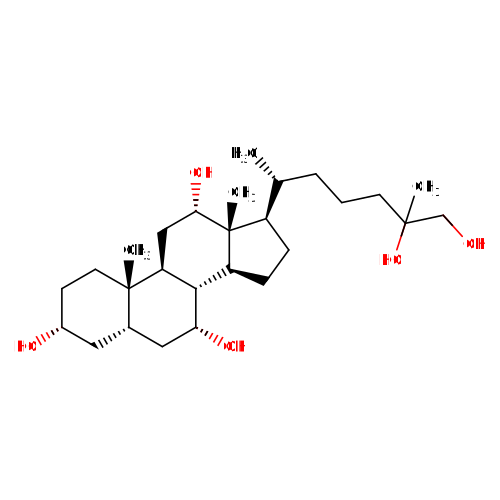
| Common Name | 5b-Cholestane-3a,7a,12a,25,26-pentol |
|---|
| Description | DG(18:1(11Z)/18:1(11Z)/0:0) Belongs to the class of organic compounds known as 1,2-diacylglycerols. These are diacylglycerols containing a glycerol acylated at positions 1 and 2. DG(18:1(11Z)/18:1(11Z)/0:0) Is an extremely weak basic (essentially neutral) compound (based on its pKa). Since diacylglycerols are synthesized via phosphatidic acid, they will usually contain a saturated fatty acid at the C-1 position on the glycerol moiety and an unsaturated fatty acid at the C-2 position. CDP-ethanolamine and DG(18:1(11Z)/18:1(11Z)/0:0) Can be converted into cytidine monophosphate and PE(18:1(11Z)/18:1(11Z)); which is mediated by the enzyme choline/ethanolaminephosphotransferase. In humans, DG(18:1(11Z)/18:1(11Z)/0:0) Is involved in phosphatidylethanolamine biosynthesis. Dacylglycerols are often found in bakery products, beverages, ice cream, chewing gum, shortening, whipped toppings, margarine, and confections. Glycerol-3-phosphate is first acylated with acyl-coenzyme A (acyl-CoA) to form lysophosphatidic acid, which is then acylated with another molecule of acyl-CoA to yield phosphatidic acid. DG(18:1(11Z)/18:1(11Z)/0:0) Is a diglyceride, or a diacylglycerol (DAG). Phosphatidic acid is then de-phosphorylated to form diacylglycerol. DG(18:1(11Z)/18:1(11Z)/0:0), In particular, consists of two chains of vaccenic acid at the C-1 and C-2 positions. It is a glyceride consisting of two fatty acid chains covalently bonded to a glycerol molecule through ester linkages. Diacylglycerols are precursors to triacylglycerols (triglyceride), which are formed by the addition of a third fatty acid to the diacylglycerol under the catalysis of diglyceride acyltransferase. Synthesis of diacylglycerol begins with glycerol-3-phosphate, which is derived primarily from dihydroxyacetone phosphate, a product of glycolysis (usually in the cytoplasm of liver or adipose tissue cells). Diacylglycerols can have many different combinations of fatty acids attached at both the C-1 and C-2 positions. The vaccenic acid moieties are derived from butter fat and animal fat. |
|---|
| Structure | [H][C@@]1(CC[C@@]2([H])[C@]3([H])[C@H](O)C[C@]4([H])C[C@H](O)CC[C@]4(C)[C@@]3([H])C[C@H](O)[C@]12C)[C@H](C)CCCC(C)(O)CO InChI=1S/C27H48O5/c1-16(6-5-10-25(2,32)15-28)19-7-8-20-24-21(14-23(31)27(19,20)4)26(3)11-9-18(29)12-17(26)13-22(24)30/h16-24,28-32H,5-15H2,1-4H3/t16-,17+,18-,19-,20+,21+,22-,23+,24+,25?,26+,27-/m1/s1 |
|---|
| Synonyms | | Value | Source |
|---|
| 3alpha,7alpha,12alpha,25,27-Pentahydroxy-5beta-cholestane | HMDB | | 5beta-Cholestane-3alpha,7alpha,12alpha,25,26-pentol | HMDB | | 5β-cholestane-3α,7α,12α,25,26-pentol | HMDB | | 5 beta-Bufol | MeSH, HMDB | | Cholestane-3,7,12,25,26-pentol | MeSH, HMDB |
|
|---|
| Chemical Formula | C27H48O5 |
|---|
| Average Mass | 452.6670 Da |
|---|
| Monoisotopic Mass | 452.35017 Da |
|---|
| IUPAC Name | (1S,2S,5R,7S,9R,10R,11S,14R,15R,16S)-14-[(2R)-6,7-dihydroxy-6-methylheptan-2-yl]-2,15-dimethyltetracyclo[8.7.0.0²,⁷.0¹¹,¹⁵]heptadecane-5,9,16-triol |
|---|
| Traditional Name | (1S,2S,5R,7S,9R,10R,11S,14R,15R,16S)-14-[(2R)-6,7-dihydroxy-6-methylheptan-2-yl]-2,15-dimethyltetracyclo[8.7.0.0²,⁷.0¹¹,¹⁵]heptadecane-5,9,16-triol |
|---|
| CAS Registry Number | Not Available |
|---|
| SMILES | [H][C@@]1(CC[C@@]2([H])[C@]3([H])[C@H](O)C[C@]4([H])C[C@H](O)CC[C@]4(C)[C@@]3([H])C[C@H](O)[C@]12C)[C@H](C)CCCC(C)(O)CO |
|---|
| InChI Identifier | InChI=1S/C27H48O5/c1-16(6-5-10-25(2,32)15-28)19-7-8-20-24-21(14-23(31)27(19,20)4)26(3)11-9-18(29)12-17(26)13-22(24)30/h16-24,28-32H,5-15H2,1-4H3/t16-,17+,18-,19-,20+,21+,22-,23+,24+,25?,26+,27-/m1/s1 |
|---|
| InChI Key | XZDHXPDYLPEFQI-FIMPYCPFSA-N |
|---|
| Experimental Spectra |
|---|
|
| Not Available | | Predicted Spectra |
|---|
|
| | Spectrum Type | Description | Depositor ID | Depositor Organization | Depositor | Deposition Date | View |
|---|
| 1D NMR | 13C NMR Spectrum (1D, 25 MHz, D2O, predicted) | Wishart Lab | Wishart Lab | David Wishart | 2021-06-20 | View Spectrum | | 1D NMR | 1H NMR Spectrum (1D, 100 MHz, D2O, predicted) | Wishart Lab | Wishart Lab | David Wishart | 2021-06-20 | View Spectrum | | 1D NMR | 13C NMR Spectrum (1D, 252 MHz, D2O, predicted) | Wishart Lab | Wishart Lab | David Wishart | 2021-06-20 | View Spectrum | | 1D NMR | 1H NMR Spectrum (1D, 1000 MHz, D2O, predicted) | Wishart Lab | Wishart Lab | David Wishart | 2021-06-20 | View Spectrum | | 1D NMR | 13C NMR Spectrum (1D, 50 MHz, D2O, predicted) | Wishart Lab | Wishart Lab | David Wishart | 2021-06-20 | View Spectrum | | 1D NMR | 1H NMR Spectrum (1D, 200 MHz, D2O, predicted) | Wishart Lab | Wishart Lab | David Wishart | 2021-06-20 | View Spectrum | | 1D NMR | 13C NMR Spectrum (1D, 75 MHz, D2O, predicted) | Wishart Lab | Wishart Lab | David Wishart | 2021-06-20 | View Spectrum | | 1D NMR | 1H NMR Spectrum (1D, 300 MHz, D2O, predicted) | Wishart Lab | Wishart Lab | David Wishart | 2021-06-20 | View Spectrum | | 1D NMR | 13C NMR Spectrum (1D, 101 MHz, D2O, predicted) | Wishart Lab | Wishart Lab | David Wishart | 2021-06-20 | View Spectrum | | 1D NMR | 1H NMR Spectrum (1D, 400 MHz, D2O, predicted) | Wishart Lab | Wishart Lab | David Wishart | 2021-06-20 | View Spectrum | | 1D NMR | 13C NMR Spectrum (1D, 126 MHz, D2O, predicted) | Wishart Lab | Wishart Lab | David Wishart | 2021-06-20 | View Spectrum | | 1D NMR | 1H NMR Spectrum (1D, 500 MHz, D2O, predicted) | Wishart Lab | Wishart Lab | David Wishart | 2021-06-20 | View Spectrum | | 1D NMR | 13C NMR Spectrum (1D, 151 MHz, D2O, predicted) | Wishart Lab | Wishart Lab | David Wishart | 2021-06-20 | View Spectrum | | 1D NMR | 1H NMR Spectrum (1D, 600 MHz, D2O, predicted) | Wishart Lab | Wishart Lab | David Wishart | 2021-06-20 | View Spectrum | | 1D NMR | 13C NMR Spectrum (1D, 176 MHz, D2O, predicted) | Wishart Lab | Wishart Lab | David Wishart | 2021-06-20 | View Spectrum | | 1D NMR | 1H NMR Spectrum (1D, 700 MHz, D2O, predicted) | Wishart Lab | Wishart Lab | David Wishart | 2021-06-20 | View Spectrum | | 1D NMR | 13C NMR Spectrum (1D, 201 MHz, D2O, predicted) | Wishart Lab | Wishart Lab | David Wishart | 2021-06-20 | View Spectrum | | 1D NMR | 1H NMR Spectrum (1D, 800 MHz, D2O, predicted) | Wishart Lab | Wishart Lab | David Wishart | 2021-06-20 | View Spectrum | | 1D NMR | 13C NMR Spectrum (1D, 226 MHz, D2O, predicted) | Wishart Lab | Wishart Lab | David Wishart | 2021-06-20 | View Spectrum | | 1D NMR | 1H NMR Spectrum (1D, 900 MHz, D2O, predicted) | Wishart Lab | Wishart Lab | David Wishart | 2021-06-20 | View Spectrum |
| | Chemical Shift Submissions |
|---|
|
| Not Available | | Species |
|---|
| Species of Origin | |
|---|
| Chemical Taxonomy |
|---|
| Description | Belongs to the class of organic compounds known as 1,2-diacylglycerols. These are diacylglycerols containing a glycerol acylated at positions 1 and 2. |
|---|
| Kingdom | Organic compounds |
|---|
| Super Class | Lipids and lipid-like molecules |
|---|
| Class | Glycerolipids |
|---|
| Sub Class | Diradylglycerols |
|---|
| Direct Parent | 1,2-diacylglycerols |
|---|
| Alternative Parents | |
|---|
| Substituents | - 1,2-acyl-sn-glycerol
- Fatty acid ester
- Fatty acyl
- Dicarboxylic acid or derivatives
- Carboxylic acid ester
- Carboxylic acid derivative
- Organic oxygen compound
- Organic oxide
- Hydrocarbon derivative
- Primary alcohol
- Organooxygen compound
- Carbonyl group
- Alcohol
- Aliphatic acyclic compound
|
|---|
| Molecular Framework | Aliphatic acyclic compounds |
|---|
| External Descriptors | Not Available |
|---|
| Physical Properties |
|---|
| State | Not Available |
|---|
| Experimental Properties | | Property | Value | Reference |
|---|
| Melting Point | Not Available | Not Available | | Boiling Point | Not Available | Not Available | | Water Solubility | Not Available | Not Available | | LogP | Not Available | Not Available |
|
|---|
| Predicted Properties | |
|---|