| Record Information |
|---|
| Version | 2.0 |
|---|
| Created at | 2022-05-11 16:32:30 UTC |
|---|
| Updated at | 2022-05-11 16:32:30 UTC |
|---|
| NP-MRD ID | NP0086841 |
|---|
| Secondary Accession Numbers | None |
|---|
| Natural Product Identification |
|---|
| Common Name | Cystathionine ketimine |
|---|
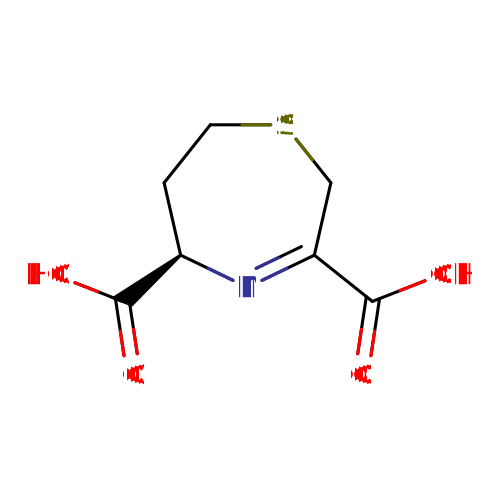
| Description | Cystathionine ketimine, also known as CT, belongs to the class of organic compounds known as alpha amino acids and derivatives. These are amino acids in which the amino group is attached to the carbon atom immediately adjacent to the carboxylate group (alpha carbon), or a derivative thereof. Among the cystathionine metabolites, cystathionine ketimine and N-acetyl-S-(3-oxo-3-carboxy-n-propyl) cysteine (NAc-OCPC) significantly enhanced the N-formylmethionylleucylphenylalanine (fMLP)-induced superoxide generation, but cystathionine, NAc-cystathionine, and cyclothionine did not enhance the superoxide generation. Cystathionine ketimine is an extremely weak basic (essentially neutral) compound (based on its pKa). Superoxide generation induced by cystathionine ketimine and NAc-OCPC was inhibited by genistein, an inhibitor of tyrosine kinase, and was enhanced by 1-(5-isoquinoline sulfonyl)-2-methylpiperazine (H-7), an inhibitor of protein kinase C. D-cystathionine ketimine and L-cystathionine ketimine enhance superoxide generation by human neutrophils in a different manner. Cystathionine ketimine was found in the urine of a cystathioninuria patient (PMID: 8373176 ). D-Cystathionine ketimine and L-cystathionine ketimine enhance superoxide generation by human neutrophils in two different manners. Cystathionine ketimine was first documented in 1988 (PMID: 3254164). Cystathionine ketimine (CT) is a cyclic amino acid that was found to have a priming effeCystathionine ketimine on superoxide generation in human neutrophils (PMID: 10708546 ) (PMID: 8373176) (PMID: 2361849) (PMID: 10049498) (PMID: 10708546). |
|---|
| Structure | OC(=O)[C@H]1CCSCC(=N1)C(O)=O InChI=1S/C7H9NO4S/c9-6(10)4-1-2-13-3-5(8-4)7(11)12/h4H,1-3H2,(H,9,10)(H,11,12)/t4-/m1/s1 |
|---|
| Synonyms | | Value | Source |
|---|
| (5R)-2,5,6,7-Tetrahydro-1,4-thiazepine-3,5-dicarboxylic acid | HMDB | | (5R)-2,5,6,7-Tetrahydro-1,4-thiazepine-3,5-dicarboxylate | HMDB | | CT | HMDB | | Cystathionine ketimine | MeSH |
|
|---|
| Chemical Formula | C7H9NO4S |
|---|
| Average Mass | 203.2160 Da |
|---|
| Monoisotopic Mass | 203.02523 Da |
|---|
| IUPAC Name | (5R)-2,5,6,7-tetrahydro-1,4-thiazepine-3,5-dicarboxylic acid |
|---|
| Traditional Name | cystathionine ketimine |
|---|
| CAS Registry Number | Not Available |
|---|
| SMILES | OC(=O)[C@H]1CCSCC(=N1)C(O)=O |
|---|
| InChI Identifier | InChI=1S/C7H9NO4S/c9-6(10)4-1-2-13-3-5(8-4)7(11)12/h4H,1-3H2,(H,9,10)(H,11,12)/t4-/m1/s1 |
|---|
| InChI Key | XJUQJVUYGRTQGI-SCSAIBSYSA-N |
|---|
| Experimental Spectra |
|---|
|
| Not Available | | Predicted Spectra |
|---|
|
| | Spectrum Type | Description | Depositor ID | Depositor Organization | Depositor | Deposition Date | View |
|---|
| 1D NMR | 13C NMR Spectrum (1D, 25 MHz, D2O, predicted) | Wishart Lab | Wishart Lab | David Wishart | 2021-06-20 | View Spectrum | | 1D NMR | 1H NMR Spectrum (1D, 100 MHz, D2O, predicted) | Wishart Lab | Wishart Lab | David Wishart | 2021-06-20 | View Spectrum | | 1D NMR | 13C NMR Spectrum (1D, 252 MHz, D2O, predicted) | Wishart Lab | Wishart Lab | David Wishart | 2021-06-20 | View Spectrum | | 1D NMR | 1H NMR Spectrum (1D, 1000 MHz, D2O, predicted) | Wishart Lab | Wishart Lab | David Wishart | 2021-06-20 | View Spectrum | | 1D NMR | 13C NMR Spectrum (1D, 50 MHz, D2O, predicted) | Wishart Lab | Wishart Lab | David Wishart | 2021-06-20 | View Spectrum | | 1D NMR | 1H NMR Spectrum (1D, 200 MHz, D2O, predicted) | Wishart Lab | Wishart Lab | David Wishart | 2021-06-20 | View Spectrum | | 1D NMR | 13C NMR Spectrum (1D, 75 MHz, D2O, predicted) | Wishart Lab | Wishart Lab | David Wishart | 2021-06-20 | View Spectrum | | 1D NMR | 1H NMR Spectrum (1D, 300 MHz, D2O, predicted) | Wishart Lab | Wishart Lab | David Wishart | 2021-06-20 | View Spectrum | | 1D NMR | 13C NMR Spectrum (1D, 101 MHz, D2O, predicted) | Wishart Lab | Wishart Lab | David Wishart | 2021-06-20 | View Spectrum | | 1D NMR | 1H NMR Spectrum (1D, 400 MHz, D2O, predicted) | Wishart Lab | Wishart Lab | David Wishart | 2021-06-20 | View Spectrum | | 1D NMR | 13C NMR Spectrum (1D, 126 MHz, D2O, predicted) | Wishart Lab | Wishart Lab | David Wishart | 2021-06-20 | View Spectrum | | 1D NMR | 1H NMR Spectrum (1D, 500 MHz, D2O, predicted) | Wishart Lab | Wishart Lab | David Wishart | 2021-06-20 | View Spectrum | | 1D NMR | 13C NMR Spectrum (1D, 151 MHz, D2O, predicted) | Wishart Lab | Wishart Lab | David Wishart | 2021-06-20 | View Spectrum | | 1D NMR | 1H NMR Spectrum (1D, 600 MHz, D2O, predicted) | Wishart Lab | Wishart Lab | David Wishart | 2021-06-20 | View Spectrum | | 1D NMR | 13C NMR Spectrum (1D, 176 MHz, D2O, predicted) | Wishart Lab | Wishart Lab | David Wishart | 2021-06-20 | View Spectrum | | 1D NMR | 1H NMR Spectrum (1D, 700 MHz, D2O, predicted) | Wishart Lab | Wishart Lab | David Wishart | 2021-06-20 | View Spectrum | | 1D NMR | 13C NMR Spectrum (1D, 201 MHz, D2O, predicted) | Wishart Lab | Wishart Lab | David Wishart | 2021-06-20 | View Spectrum | | 1D NMR | 1H NMR Spectrum (1D, 800 MHz, D2O, predicted) | Wishart Lab | Wishart Lab | David Wishart | 2021-06-20 | View Spectrum | | 1D NMR | 13C NMR Spectrum (1D, 226 MHz, D2O, predicted) | Wishart Lab | Wishart Lab | David Wishart | 2021-06-20 | View Spectrum | | 1D NMR | 1H NMR Spectrum (1D, 900 MHz, D2O, predicted) | Wishart Lab | Wishart Lab | David Wishart | 2021-06-20 | View Spectrum |
| | Chemical Shift Submissions |
|---|
|
| Not Available | | Species |
|---|
| Species of Origin | |
|---|
| Chemical Taxonomy |
|---|
| Description | Belongs to the class of organic compounds known as alpha amino acids and derivatives. These are amino acids in which the amino group is attached to the carbon atom immediately adjacent to the carboxylate group (alpha carbon), or a derivative thereof. |
|---|
| Kingdom | Organic compounds |
|---|
| Super Class | Organic acids and derivatives |
|---|
| Class | Carboxylic acids and derivatives |
|---|
| Sub Class | Amino acids, peptides, and analogues |
|---|
| Direct Parent | Alpha amino acids and derivatives |
|---|
| Alternative Parents | |
|---|
| Substituents | - Alpha-amino acid or derivatives
- Dicarboxylic acid or derivatives
- Ketimine
- Carboxylic acid
- Thioether
- Azacycle
- Organoheterocyclic compound
- Dialkylthioether
- Organic 1,3-dipolar compound
- Propargyl-type 1,3-dipolar organic compound
- Organic nitrogen compound
- Hydrocarbon derivative
- Organooxygen compound
- Organonitrogen compound
- Organic oxide
- Imine
- Organopnictogen compound
- Organic oxygen compound
- Carbonyl group
- Aliphatic heteromonocyclic compound
|
|---|
| Molecular Framework | Aliphatic heteromonocyclic compounds |
|---|
| External Descriptors | Not Available |
|---|
| Physical Properties |
|---|
| State | Not Available |
|---|
| Experimental Properties | | Property | Value | Reference |
|---|
| Melting Point | Not Available | Not Available | | Boiling Point | Not Available | Not Available | | Water Solubility | Not Available | Not Available | | LogP | Not Available | Not Available |
|
|---|
| Predicted Properties | |
|---|
| General References | - Pecci L, Antonucci A, Nardini M, Cavallini D: Detection of cystathionine and lanthionine ketimines in human urine. Biochem Int. 1988 Nov;17(5):877-83. [PubMed:3254164 ]
- Okada T, Takechi T, Wakiguchi H, Kurashige T, Sugahara K, Kodama H: Identification of new cystathionine mono-oxo acids, S-(3-oxo-3-carboxy-n-propyl) cysteine and S-(2-oxo-2-carboxyethyl) homocysteine, in the urine of a patient with cystathioninuria. Arch Biochem Biophys. 1993 Sep;305(2):385-91. doi: 10.1006/abbi.1993.1436. [PubMed:8373176 ]
- Antonucci A, Pecci L, Fontana M, Cavallini D: Influence of diet on cystathionine ketimine and lanthionine ketimine content in human urine. Ital J Biochem. 1990 Mar-Apr;39(2):100-5. [PubMed:2361849 ]
- Zhang J, Zhang M, Sugahara K, Sagara Y, Spirito A, Dupre, Kodama H: D-cystathionine ketimine and L-cystathionine ketimine enhance superoxide generation by human neutrophils in a different manner. Arch Biochem Biophys. 1999 Mar 1;363(1):55-9. doi: 10.1006/abbi.1998.1063. [PubMed:10049498 ]
- Kodama H, Zhang J, Sugahara K: Novel priming compounds of cystathionine metabolites on superoxide generation in human neutrophils. Biochem Biophys Res Commun. 2000 Mar 16;269(2):297-301. doi: 10.1006/bbrc.1999.1970. [PubMed:10708546 ]
|
|---|