| Record Information |
|---|
| Version | 2.0 |
|---|
| Created at | 2022-05-11 16:31:50 UTC |
|---|
| Updated at | 2022-05-11 16:31:50 UTC |
|---|
| NP-MRD ID | NP0086817 |
|---|
| Secondary Accession Numbers | None |
|---|
| Natural Product Identification |
|---|
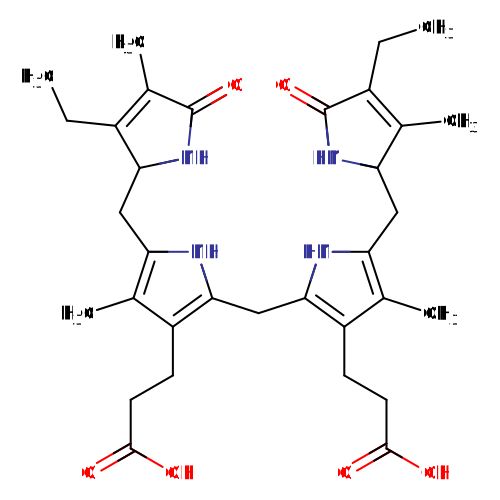
| Common Name | Mesobilirubinogen |
|---|
| Description | Mesobilirubinogen, also known as urobilinogen, belongs to the class of organic compounds known as bilirubins. These are organic compounds containing a dicarboxylic acyclic tetrapyrrole derivative. Mesobilirubinogen is an extremely weak basic (essentially neutral) compound (based on its pKa). Mesobilirubinogen is an uribiniloid, the product of bilirubin reduction in multiple sequential reactions. Only negligible amounts of fecal urobilinoids are present in the intestinal lumen of infants during the first months of their life, due to undeveloped intestinal microflora capable of reducing bilirubin. At times, it is re-excreted in the urine, where it may be later oxidized to urobilin. Under normal conditions only small amounts of bilirubin can be found in stools of adults while urobilinoids are predominant bile pigments (50-250 mg/day). In adults, the urobilinoid production is highly efficient. This presumably contributes importantly to the pathogenesis of neonatal jaundice. Mesobilirubinogen was first documented in 2006 (PMID: 16504607). Urobilinogens are colorless chromogens that may in turn be oxidized to respective yellow oxidation products, urobilins (PMID: 21614935) (PMID: 24709296) (PMID: 24714521). |
|---|
| Structure | CCC1=C(C)C(=O)NC1CC1=C(C)C(CCC(O)=O)=C(CC2=C(CCC(O)=O)C(C)=C(CC3NC(=O)C(CC)=C3C)N2)N1 InChI=1S/C33H44N4O6/c1-7-20-19(6)32(42)37-27(20)14-25-18(5)23(10-12-31(40)41)29(35-25)15-28-22(9-11-30(38)39)17(4)24(34-28)13-26-16(3)21(8-2)33(43)36-26/h26-27,34-35H,7-15H2,1-6H3,(H,36,43)(H,37,42)(H,38,39)(H,40,41) |
|---|
| Synonyms | | Value | Source |
|---|
| 2,17-Diethyl-1,4,5,10,15,16,19,22,23,24-decahydro-3,7,13,18-tetramethyl-1,19-dioxo-21H-biline-8,12-dipropanoic acid | ChEBI | | 8,12-Bis(2-carboxyethyl)-3,18-diethyl-2,7,13,17-tetramethylbilane-1,19(4H,16H)-dione | ChEBI | | I-urobilinogen | ChEBI | | Mesobilirubinogen ixalpha | ChEBI | | Urobilinogen ixalpha | ChEBI | | Urobilinogen | Kegg | | 2,17-Diethyl-1,4,5,10,15,16,19,22,23,24-decahydro-3,7,13,18-tetramethyl-1,19-dioxo-21H-biline-8,12-dipropanoate | Generator | | 2,17-Diethyl-1,4,5,10,15,16,19,22,23,24-decahydro-3,7,13,18-tetramethyl-1,19-dioxo-biline-8,12-dipropionic acid | HMDB | | Mesobilirubinogen ixα | HMDB | | Urobilinogen ixα | HMDB | | Mesobilirubinogen | ChEBI |
|
|---|
| Chemical Formula | C33H44N4O6 |
|---|
| Average Mass | 592.7257 Da |
|---|
| Monoisotopic Mass | 592.32609 Da |
|---|
| IUPAC Name | 3-(2-{[3-(2-carboxyethyl)-5-[(4-ethyl-3-methyl-5-oxo-2,5-dihydro-1H-pyrrol-2-yl)methyl]-4-methyl-1H-pyrrol-2-yl]methyl}-5-[(3-ethyl-4-methyl-5-oxo-2,5-dihydro-1H-pyrrol-2-yl)methyl]-4-methyl-1H-pyrrol-3-yl)propanoic acid |
|---|
| Traditional Name | urobilinogen |
|---|
| CAS Registry Number | Not Available |
|---|
| SMILES | CCC1=C(C)C(=O)NC1CC1=C(C)C(CCC(O)=O)=C(CC2=C(CCC(O)=O)C(C)=C(CC3NC(=O)C(CC)=C3C)N2)N1 |
|---|
| InChI Identifier | InChI=1S/C33H44N4O6/c1-7-20-19(6)32(42)37-27(20)14-25-18(5)23(10-12-31(40)41)29(35-25)15-28-22(9-11-30(38)39)17(4)24(34-28)13-26-16(3)21(8-2)33(43)36-26/h26-27,34-35H,7-15H2,1-6H3,(H,36,43)(H,37,42)(H,38,39)(H,40,41) |
|---|
| InChI Key | OBHRVMZSZIDDEK-UHFFFAOYSA-N |
|---|
| Experimental Spectra |
|---|
|
| Not Available | | Predicted Spectra |
|---|
|
| | Spectrum Type | Description | Depositor ID | Depositor Organization | Depositor | Deposition Date | View |
|---|
| 1D NMR | 13C NMR Spectrum (1D, 25 MHz, D2O, predicted) | Wishart Lab | Wishart Lab | David Wishart | 2021-06-20 | View Spectrum | | 1D NMR | 1H NMR Spectrum (1D, 100 MHz, D2O, predicted) | Wishart Lab | Wishart Lab | David Wishart | 2021-06-20 | View Spectrum | | 1D NMR | 13C NMR Spectrum (1D, 252 MHz, D2O, predicted) | Wishart Lab | Wishart Lab | David Wishart | 2021-06-20 | View Spectrum | | 1D NMR | 1H NMR Spectrum (1D, 1000 MHz, D2O, predicted) | Wishart Lab | Wishart Lab | David Wishart | 2021-06-20 | View Spectrum | | 1D NMR | 13C NMR Spectrum (1D, 50 MHz, D2O, predicted) | Wishart Lab | Wishart Lab | David Wishart | 2021-06-20 | View Spectrum | | 1D NMR | 1H NMR Spectrum (1D, 200 MHz, D2O, predicted) | Wishart Lab | Wishart Lab | David Wishart | 2021-06-20 | View Spectrum | | 1D NMR | 13C NMR Spectrum (1D, 75 MHz, D2O, predicted) | Wishart Lab | Wishart Lab | David Wishart | 2021-06-20 | View Spectrum | | 1D NMR | 1H NMR Spectrum (1D, 300 MHz, D2O, predicted) | Wishart Lab | Wishart Lab | David Wishart | 2021-06-20 | View Spectrum | | 1D NMR | 13C NMR Spectrum (1D, 101 MHz, D2O, predicted) | Wishart Lab | Wishart Lab | David Wishart | 2021-06-20 | View Spectrum | | 1D NMR | 1H NMR Spectrum (1D, 400 MHz, D2O, predicted) | Wishart Lab | Wishart Lab | David Wishart | 2021-06-20 | View Spectrum | | 1D NMR | 13C NMR Spectrum (1D, 126 MHz, D2O, predicted) | Wishart Lab | Wishart Lab | David Wishart | 2021-06-20 | View Spectrum | | 1D NMR | 1H NMR Spectrum (1D, 500 MHz, D2O, predicted) | Wishart Lab | Wishart Lab | David Wishart | 2021-06-20 | View Spectrum | | 1D NMR | 13C NMR Spectrum (1D, 151 MHz, D2O, predicted) | Wishart Lab | Wishart Lab | David Wishart | 2021-06-20 | View Spectrum | | 1D NMR | 1H NMR Spectrum (1D, 600 MHz, D2O, predicted) | Wishart Lab | Wishart Lab | David Wishart | 2021-06-20 | View Spectrum | | 1D NMR | 13C NMR Spectrum (1D, 176 MHz, D2O, predicted) | Wishart Lab | Wishart Lab | David Wishart | 2021-06-20 | View Spectrum | | 1D NMR | 1H NMR Spectrum (1D, 700 MHz, D2O, predicted) | Wishart Lab | Wishart Lab | David Wishart | 2021-06-20 | View Spectrum | | 1D NMR | 13C NMR Spectrum (1D, 201 MHz, D2O, predicted) | Wishart Lab | Wishart Lab | David Wishart | 2021-06-20 | View Spectrum | | 1D NMR | 1H NMR Spectrum (1D, 800 MHz, D2O, predicted) | Wishart Lab | Wishart Lab | David Wishart | 2021-06-20 | View Spectrum | | 1D NMR | 13C NMR Spectrum (1D, 226 MHz, D2O, predicted) | Wishart Lab | Wishart Lab | David Wishart | 2021-06-20 | View Spectrum | | 1D NMR | 1H NMR Spectrum (1D, 900 MHz, D2O, predicted) | Wishart Lab | Wishart Lab | David Wishart | 2021-06-20 | View Spectrum |
| | Chemical Shift Submissions |
|---|
|
| Not Available | | Species |
|---|
| Species of Origin | |
|---|
| Chemical Taxonomy |
|---|
| Description | Belongs to the class of organic compounds known as bilirubins. These are organic compounds containing a dicarboxylic acyclic tetrapyrrole derivative. |
|---|
| Kingdom | Organic compounds |
|---|
| Super Class | Organoheterocyclic compounds |
|---|
| Class | Tetrapyrroles and derivatives |
|---|
| Sub Class | Bilirubins |
|---|
| Direct Parent | Bilirubins |
|---|
| Alternative Parents | |
|---|
| Substituents | - Bilirubin skeleton
- Dicarboxylic acid or derivatives
- Substituted pyrrole
- Pyrrole
- Pyrroline
- Heteroaromatic compound
- Secondary carboxylic acid amide
- Lactam
- Carboxamide group
- Azacycle
- Carboxylic acid
- Carboxylic acid derivative
- Organopnictogen compound
- Organic nitrogen compound
- Organooxygen compound
- Organonitrogen compound
- Organic oxygen compound
- Carbonyl group
- Hydrocarbon derivative
- Organic oxide
- Aromatic heteromonocyclic compound
|
|---|
| Molecular Framework | Aromatic heteromonocyclic compounds |
|---|
| External Descriptors | |
|---|
| Physical Properties |
|---|
| State | Not Available |
|---|
| Experimental Properties | | Property | Value | Reference |
|---|
| Melting Point | Not Available | Not Available | | Boiling Point | Not Available | Not Available | | Water Solubility | Not Available | Not Available | | LogP | Not Available | Not Available |
|
|---|
| Predicted Properties | |
|---|
| General References | - Vitek L, Majer F, Muchova L, Zelenka J, Jiraskova A, Branny P, Malina J, Ubik K: Identification of bilirubin reduction products formed by Clostridium perfringens isolated from human neonatal fecal flora. J Chromatogr B Analyt Technol Biomed Life Sci. 2006 Apr 3;833(2):149-57. doi: 10.1016/j.jchromb.2006.01.032. Epub 2006 Feb 28. [PubMed:16504607 ]
- Kataoka R, Kimata A, Yamamoto K, Hirosawa N, Ueyama J, Kondo T, Okada R, Kawai S, Hishida A, Naito M, Morita E, Wakai K, Hamajima N: Association of UGT1A1 Gly71Arg with urine urobilinogen. Nagoya J Med Sci. 2011 Feb;73(1-2):33-40. [PubMed:21614935 ]
- Chindarkar NS, Rentmeester LL, Ly BT, Fitzgerald RL: Black urine due to urobilinogen in a patient with alcoholic pellagra. Clin Biochem. 2014 Aug;47(12):1132-5. doi: 10.1016/j.clinbiochem.2014.03.016. Epub 2014 Apr 5. [PubMed:24709296 ]
- Spegar J, Riha H, Kotulak T, Vanek T: Hereditary spherocytosis in a patient undergoing coronary artery bypass grafting with cardiopulmonary bypass--a case report. Perfusion. 2015 Jan;30(1):77-81. doi: 10.1177/0267659114529323. Epub 2014 Apr 8. [PubMed:24714521 ]
|
|---|