| Record Information |
|---|
| Version | 2.0 |
|---|
| Created at | 2022-05-11 16:29:35 UTC |
|---|
| Updated at | 2022-05-11 16:29:35 UTC |
|---|
| NP-MRD ID | NP0086737 |
|---|
| Secondary Accession Numbers | None |
|---|
| Natural Product Identification |
|---|
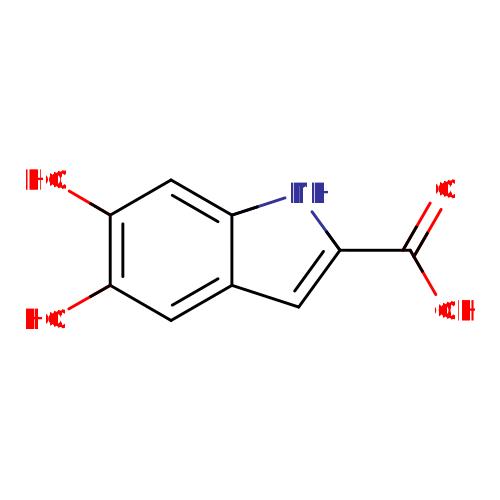
| Common Name | 5,6-Dihydroxyindole-2-carboxylic acid |
|---|
| Description | 5,6-Dihydroxyindole-2-carboxylic acid, also known as DHICA, belongs to the class of organic compounds known as indolecarboxylic acids and derivatives. Indolecarboxylic acids and derivatives are compounds containing a carboxylic acid group (or a derivative thereof) linked to an indole. A dihydroxyindole that is indole-2-carboxylic acid substituted by hydroxy groups at positions 5 and 6. 5,6-Dihydroxyindole-2-carboxylic acid is an extremely weak basic (essentially neutral) compound (based on its pKa). Within humans, 5,6-dihydroxyindole-2-carboxylic acid participates in a number of enzymatic reactions. In particular, 5,6-dihydroxyindole-2-carboxylic acid can be biosynthesized from L-dopachrome through its interaction with the enzyme L-dopachrome tautomerase. In addition, 5,6-dihydroxyindole-2-carboxylic acid can be converted into indole-5,6-quinone-2-carboxylate; which is catalyzed by the enzyme tyrosinase. 5,6-Dihydroxyindole-2-carboxylic acid is found in Mus musculus. 5,6-Dihydroxyindole-2-carboxylic acid was first documented in 1988 (PMID: 3176811). In humans, 5,6-dihydroxyindole-2-carboxylic acid is involved in eumelanin biosynthesis (PMID: 1580656) (PMID: 25450182). |
|---|
| Structure | OC(=O)C1=CC2=CC(O)=C(O)C=C2N1 InChI=1S/C9H7NO4/c11-7-2-4-1-6(9(13)14)10-5(4)3-8(7)12/h1-3,10-12H,(H,13,14) |
|---|
| Synonyms | | Value | Source |
|---|
| 5,6-DHICA | ChEBI | | 5,6-Dihydroxy-2-indolecarboxylic acid | ChEBI | | 5,6-Dihydroxy-2-indolylcarboxylic acid | ChEBI | | 5,6-Dihydroxyindole-2-carboxylate | ChEBI | | DHI2c | ChEBI | | DHICA | ChEBI | | 5,6-Dihydroxy-2-indolecarboxylate | Generator | | 5,6-Dihydroxy-2-indolylcarboxylate | Generator | | 5,6-Dihydroxy-1H-indole-2-carboxylate | HMDB | | 5,6-Dihydroxy-1H-indole-2-carboxylic acid | HMDB | | 2-Carboxy-5,6-dihydroxyindole | HMDB | | 5,6-Dihydroxy-2-carboxyindole | HMDB | | 5,6-Dihydroxyindole-2-carboxylic acid | HMDB |
|
|---|
| Chemical Formula | C9H7NO4 |
|---|
| Average Mass | 193.1562 Da |
|---|
| Monoisotopic Mass | 193.03751 Da |
|---|
| IUPAC Name | 5,6-dihydroxy-1H-indole-2-carboxylic acid |
|---|
| Traditional Name | dhica |
|---|
| CAS Registry Number | Not Available |
|---|
| SMILES | OC(=O)C1=CC2=CC(O)=C(O)C=C2N1 |
|---|
| InChI Identifier | InChI=1S/C9H7NO4/c11-7-2-4-1-6(9(13)14)10-5(4)3-8(7)12/h1-3,10-12H,(H,13,14) |
|---|
| InChI Key | YFTGOBNOJKXZJC-UHFFFAOYSA-N |
|---|
| Experimental Spectra |
|---|
|
| Not Available | | Predicted Spectra |
|---|
|
| | Spectrum Type | Description | Depositor ID | Depositor Organization | Depositor | Deposition Date | View |
|---|
| 1D NMR | 13C NMR Spectrum (1D, 25 MHz, D2O, predicted) | Wishart Lab | Wishart Lab | David Wishart | 2021-06-20 | View Spectrum | | 1D NMR | 1H NMR Spectrum (1D, 100 MHz, D2O, predicted) | Wishart Lab | Wishart Lab | David Wishart | 2021-06-20 | View Spectrum | | 1D NMR | 13C NMR Spectrum (1D, 252 MHz, D2O, predicted) | Wishart Lab | Wishart Lab | David Wishart | 2021-06-20 | View Spectrum | | 1D NMR | 1H NMR Spectrum (1D, 1000 MHz, D2O, predicted) | Wishart Lab | Wishart Lab | David Wishart | 2021-06-20 | View Spectrum | | 1D NMR | 13C NMR Spectrum (1D, 50 MHz, D2O, predicted) | Wishart Lab | Wishart Lab | David Wishart | 2021-06-20 | View Spectrum | | 1D NMR | 1H NMR Spectrum (1D, 200 MHz, D2O, predicted) | Wishart Lab | Wishart Lab | David Wishart | 2021-06-20 | View Spectrum | | 1D NMR | 13C NMR Spectrum (1D, 75 MHz, D2O, predicted) | Wishart Lab | Wishart Lab | David Wishart | 2021-06-20 | View Spectrum | | 1D NMR | 1H NMR Spectrum (1D, 300 MHz, D2O, predicted) | Wishart Lab | Wishart Lab | David Wishart | 2021-06-20 | View Spectrum | | 1D NMR | 13C NMR Spectrum (1D, 101 MHz, D2O, predicted) | Wishart Lab | Wishart Lab | David Wishart | 2021-06-20 | View Spectrum | | 1D NMR | 1H NMR Spectrum (1D, 400 MHz, D2O, predicted) | Wishart Lab | Wishart Lab | David Wishart | 2021-06-20 | View Spectrum | | 1D NMR | 13C NMR Spectrum (1D, 126 MHz, D2O, predicted) | Wishart Lab | Wishart Lab | David Wishart | 2021-06-20 | View Spectrum | | 1D NMR | 1H NMR Spectrum (1D, 500 MHz, D2O, predicted) | Wishart Lab | Wishart Lab | David Wishart | 2021-06-20 | View Spectrum | | 1D NMR | 13C NMR Spectrum (1D, 151 MHz, D2O, predicted) | Wishart Lab | Wishart Lab | David Wishart | 2021-06-20 | View Spectrum | | 1D NMR | 1H NMR Spectrum (1D, 600 MHz, D2O, predicted) | Wishart Lab | Wishart Lab | David Wishart | 2021-06-20 | View Spectrum | | 1D NMR | 13C NMR Spectrum (1D, 176 MHz, D2O, predicted) | Wishart Lab | Wishart Lab | David Wishart | 2021-06-20 | View Spectrum | | 1D NMR | 1H NMR Spectrum (1D, 700 MHz, D2O, predicted) | Wishart Lab | Wishart Lab | David Wishart | 2021-06-20 | View Spectrum | | 1D NMR | 13C NMR Spectrum (1D, 201 MHz, D2O, predicted) | Wishart Lab | Wishart Lab | David Wishart | 2021-06-20 | View Spectrum | | 1D NMR | 1H NMR Spectrum (1D, 800 MHz, D2O, predicted) | Wishart Lab | Wishart Lab | David Wishart | 2021-06-20 | View Spectrum | | 1D NMR | 13C NMR Spectrum (1D, 226 MHz, D2O, predicted) | Wishart Lab | Wishart Lab | David Wishart | 2021-06-20 | View Spectrum | | 1D NMR | 1H NMR Spectrum (1D, 900 MHz, D2O, predicted) | Wishart Lab | Wishart Lab | David Wishart | 2021-06-20 | View Spectrum |
| | Chemical Shift Submissions |
|---|
|
| Not Available | | Species |
|---|
| Species of Origin | |
|---|
| Chemical Taxonomy |
|---|
| Description | Belongs to the class of organic compounds known as indolecarboxylic acids and derivatives. Indolecarboxylic acids and derivatives are compounds containing a carboxylic acid group (or a derivative thereof) linked to an indole. |
|---|
| Kingdom | Organic compounds |
|---|
| Super Class | Organoheterocyclic compounds |
|---|
| Class | Indoles and derivatives |
|---|
| Sub Class | Indolecarboxylic acids and derivatives |
|---|
| Direct Parent | Indolecarboxylic acids and derivatives |
|---|
| Alternative Parents | |
|---|
| Substituents | - Indolecarboxylic acid derivative
- Hydroxyindole
- Indole
- Pyrrole-2-carboxylic acid
- Pyrrole-2-carboxylic acid or derivatives
- 1-hydroxy-2-unsubstituted benzenoid
- Substituted pyrrole
- Benzenoid
- Pyrrole
- Heteroaromatic compound
- Azacycle
- Carboxylic acid derivative
- Monocarboxylic acid or derivatives
- Carboxylic acid
- Organic oxide
- Organopnictogen compound
- Organooxygen compound
- Organonitrogen compound
- Organic oxygen compound
- Organic nitrogen compound
- Hydrocarbon derivative
- Aromatic heteropolycyclic compound
|
|---|
| Molecular Framework | Aromatic heteropolycyclic compounds |
|---|
| External Descriptors | |
|---|
| Physical Properties |
|---|
| State | Not Available |
|---|
| Experimental Properties | | Property | Value | Reference |
|---|
| Melting Point | Not Available | Not Available | | Boiling Point | Not Available | Not Available | | Water Solubility | Not Available | Not Available | | LogP | Not Available | Not Available |
|
|---|
| Predicted Properties | |
|---|