| Record Information |
|---|
| Version | 2.0 |
|---|
| Created at | 2022-05-11 16:27:07 UTC |
|---|
| Updated at | 2022-05-11 16:27:08 UTC |
|---|
| NP-MRD ID | NP0086650 |
|---|
| Secondary Accession Numbers | None |
|---|
| Natural Product Identification |
|---|
| Common Name | Phytanic acid |
|---|
| Description | Phytanic acid, also known as phytanate or acid, phytanic, belongs to the class of organic compounds known as acyclic diterpenoids. These are diterpenoids (compounds made of four consecutive isoprene units) that do not contain a cycle. Phytanic acid is a very weakly acidic compound (based on its pKa). In humans, phytanic acid is involved in oxidation of branched-chain fatty acids. Outside of the human body, Phytanic acid has been detected, but not quantified in, milk (cow). This could make phytanic acid a potential biomarker for the consumption of these foods. Instead, it undergoes alpha-oxidation in the peroxisome, where it is converted into pristanic acid by the removal of one carbon. Phytanic acid is a potentially toxic compound. Phytanic acid, with regard to humans, has been found to be associated with several diseases such as alpha-methylacyl-coa racemase deficiency, cerebrotendinous xanthomatosis, and pseudoneonatal adrenoleukodystrophy; phytanic acid has also been linked to several inborn metabolic disorders including infantile refsum's disease and refsum's disease. A 20-carbon branched chain fatty acid, Phytanic acid is present in animal (primarily herbivores or omnivores) tissues where it may be derived from the chlorophyll in consumed plant material. Individuals with Refsum disease accumulate large stores of phytanic acid in their blood and tissues. Phytanic acid is found in Aplysina fistularis. Phytanic acid was first documented in 1998 (PMID: 9819701). Therefore, chronically high levels of phytanic acid can be neurotoxic (PMID: 12187408) (PMID: 17956237) (PMID: 15979030). |
|---|
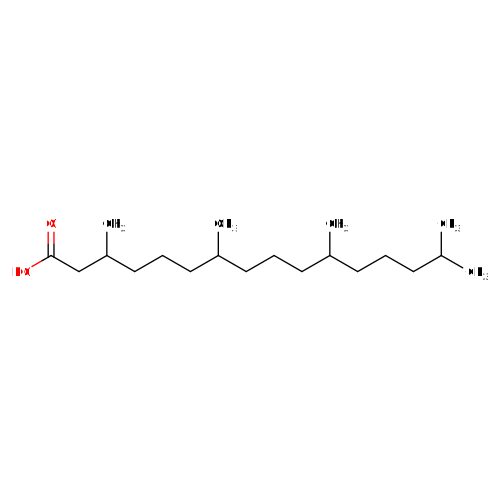
| Structure | CC(C)CCCC(C)CCCC(C)CCCC(C)CC(O)=O InChI=1S/C20H40O2/c1-16(2)9-6-10-17(3)11-7-12-18(4)13-8-14-19(5)15-20(21)22/h16-19H,6-15H2,1-5H3,(H,21,22) |
|---|
| Synonyms | | Value | Source |
|---|
| 3,7,11,15-Tetramethyl hexadecanoic acid | ChEBI | | 3,7,11,15-Tetramethyl-hexadecanoic acid | ChEBI | | 3,7,11,15-Tetramethyl-hexadecansaeure | ChEBI | | 3,7,11,15-Tetramethylhexadecanoic acid | Kegg | | 3,7,11,15-Tetramethyl hexadecanoate | Generator | | 3,7,11,15-Tetramethyl-hexadecanoate | Generator | | 3,7,11,15-Tetramethylhexadecanoate | Generator | | Phytanate | Generator | | 3,7,11,15-Tetramethylhexadecoanoate | HMDB | | 3,7,11,15-Tetramethylhexadecoanoic acid | HMDB | | Phytanoate | HMDB | | Phytanoic acid | HMDB | | Acid, phytanic | HMDB |
|
|---|
| Chemical Formula | C20H40O2 |
|---|
| Average Mass | 312.5304 Da |
|---|
| Monoisotopic Mass | 312.30283 Da |
|---|
| IUPAC Name | 3,7,11,15-tetramethylhexadecanoic acid |
|---|
| Traditional Name | phytanic acid |
|---|
| CAS Registry Number | Not Available |
|---|
| SMILES | CC(C)CCCC(C)CCCC(C)CCCC(C)CC(O)=O |
|---|
| InChI Identifier | InChI=1S/C20H40O2/c1-16(2)9-6-10-17(3)11-7-12-18(4)13-8-14-19(5)15-20(21)22/h16-19H,6-15H2,1-5H3,(H,21,22) |
|---|
| InChI Key | RLCKHJSFHOZMDR-UHFFFAOYSA-N |
|---|
| Experimental Spectra |
|---|
|
| Not Available | | Predicted Spectra |
|---|
|
| | Spectrum Type | Description | Depositor ID | Depositor Organization | Depositor | Deposition Date | View |
|---|
| 1D NMR | 13C NMR Spectrum (1D, 25 MHz, D2O, predicted) | Wishart Lab | Wishart Lab | David Wishart | 2021-06-20 | View Spectrum | | 1D NMR | 1H NMR Spectrum (1D, 100 MHz, D2O, predicted) | Wishart Lab | Wishart Lab | David Wishart | 2021-06-20 | View Spectrum | | 1D NMR | 13C NMR Spectrum (1D, 252 MHz, D2O, predicted) | Wishart Lab | Wishart Lab | David Wishart | 2021-06-20 | View Spectrum | | 1D NMR | 1H NMR Spectrum (1D, 1000 MHz, D2O, predicted) | Wishart Lab | Wishart Lab | David Wishart | 2021-06-20 | View Spectrum | | 1D NMR | 13C NMR Spectrum (1D, 50 MHz, D2O, predicted) | Wishart Lab | Wishart Lab | David Wishart | 2021-06-20 | View Spectrum | | 1D NMR | 1H NMR Spectrum (1D, 200 MHz, D2O, predicted) | Wishart Lab | Wishart Lab | David Wishart | 2021-06-20 | View Spectrum | | 1D NMR | 13C NMR Spectrum (1D, 75 MHz, D2O, predicted) | Wishart Lab | Wishart Lab | David Wishart | 2021-06-20 | View Spectrum | | 1D NMR | 1H NMR Spectrum (1D, 300 MHz, D2O, predicted) | Wishart Lab | Wishart Lab | David Wishart | 2021-06-20 | View Spectrum | | 1D NMR | 13C NMR Spectrum (1D, 101 MHz, D2O, predicted) | Wishart Lab | Wishart Lab | David Wishart | 2021-06-20 | View Spectrum | | 1D NMR | 1H NMR Spectrum (1D, 400 MHz, D2O, predicted) | Wishart Lab | Wishart Lab | David Wishart | 2021-06-20 | View Spectrum | | 1D NMR | 13C NMR Spectrum (1D, 126 MHz, D2O, predicted) | Wishart Lab | Wishart Lab | David Wishart | 2021-06-20 | View Spectrum | | 1D NMR | 1H NMR Spectrum (1D, 500 MHz, D2O, predicted) | Wishart Lab | Wishart Lab | David Wishart | 2021-06-20 | View Spectrum | | 1D NMR | 13C NMR Spectrum (1D, 151 MHz, D2O, predicted) | Wishart Lab | Wishart Lab | David Wishart | 2021-06-20 | View Spectrum | | 1D NMR | 1H NMR Spectrum (1D, 600 MHz, D2O, predicted) | Wishart Lab | Wishart Lab | David Wishart | 2021-06-20 | View Spectrum | | 1D NMR | 13C NMR Spectrum (1D, 176 MHz, D2O, predicted) | Wishart Lab | Wishart Lab | David Wishart | 2021-06-20 | View Spectrum | | 1D NMR | 1H NMR Spectrum (1D, 700 MHz, D2O, predicted) | Wishart Lab | Wishart Lab | David Wishart | 2021-06-20 | View Spectrum | | 1D NMR | 13C NMR Spectrum (1D, 201 MHz, D2O, predicted) | Wishart Lab | Wishart Lab | David Wishart | 2021-06-20 | View Spectrum | | 1D NMR | 1H NMR Spectrum (1D, 800 MHz, D2O, predicted) | Wishart Lab | Wishart Lab | David Wishart | 2021-06-20 | View Spectrum | | 1D NMR | 13C NMR Spectrum (1D, 226 MHz, D2O, predicted) | Wishart Lab | Wishart Lab | David Wishart | 2021-06-20 | View Spectrum | | 1D NMR | 1H NMR Spectrum (1D, 900 MHz, D2O, predicted) | Wishart Lab | Wishart Lab | David Wishart | 2021-06-20 | View Spectrum |
| | Chemical Shift Submissions |
|---|
|
| Not Available | | Species |
|---|
| Species of Origin | |
|---|
| Chemical Taxonomy |
|---|
| Description | Belongs to the class of organic compounds known as acyclic diterpenoids. These are diterpenoids (compounds made of four consecutive isoprene units) that do not contain a cycle. |
|---|
| Kingdom | Organic compounds |
|---|
| Super Class | Lipids and lipid-like molecules |
|---|
| Class | Prenol lipids |
|---|
| Sub Class | Diterpenoids |
|---|
| Direct Parent | Acyclic diterpenoids |
|---|
| Alternative Parents | |
|---|
| Substituents | - Acyclic diterpenoid
- Long-chain fatty acid
- Methyl-branched fatty acid
- Branched fatty acid
- Fatty acyl
- Fatty acid
- Monocarboxylic acid or derivatives
- Carboxylic acid
- Carboxylic acid derivative
- Organic oxygen compound
- Organic oxide
- Hydrocarbon derivative
- Organooxygen compound
- Carbonyl group
- Aliphatic acyclic compound
|
|---|
| Molecular Framework | Aliphatic acyclic compounds |
|---|
| External Descriptors | |
|---|
| Physical Properties |
|---|
| State | Not Available |
|---|
| Experimental Properties | | Property | Value | Reference |
|---|
| Melting Point | Not Available | Not Available | | Boiling Point | Not Available | Not Available | | Water Solubility | Not Available | Not Available | | LogP | Not Available | Not Available |
|
|---|
| Predicted Properties | |
|---|