| Record Information |
|---|
| Version | 2.0 |
|---|
| Created at | 2022-04-29 06:11:26 UTC |
|---|
| Updated at | 2022-04-29 06:11:26 UTC |
|---|
| NP-MRD ID | NP0085710 |
|---|
| Secondary Accession Numbers | None |
|---|
| Natural Product Identification |
|---|
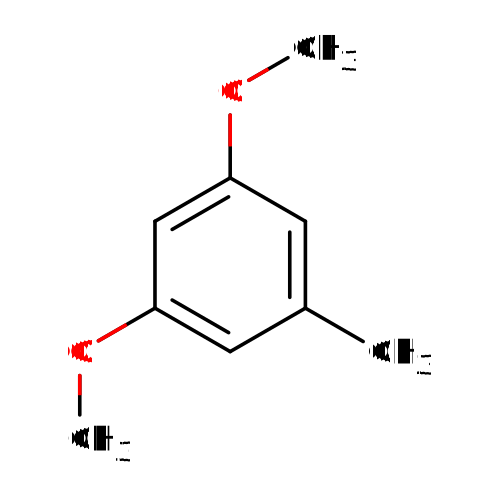
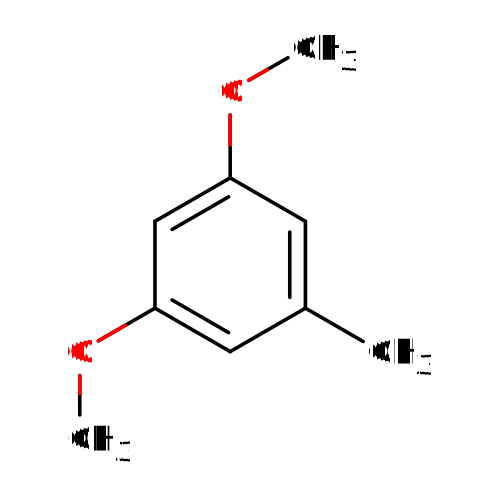
| Common Name | 3,5-Dimethoxytoluene |
|---|
| Description | 3,5-Dimethoxytoluene, also known as DMT or orcinol dimethyl ether, belongs to the class of organic compounds known as dimethoxybenzenes. These are organic aromatic compounds containing a monocyclic benzene moiety carrying exactly two methoxy groups. 3,5-Dimethoxytoluene is an extremely weak basic (essentially neutral) compound (based on its pKa). 3,5-Dimethoxytoluene is found in Ligusticum jeholense and Solanum peruvianum. 3,5-Dimethoxytoluene was first documented in 2002 (PMID: 12123815). These are organic compounds contaiing a methoxybenzene or a derivative thereof (PMID: 12177504) (PMID: 16361520) (PMID: 18413608) (PMID: 23973758). |
|---|
| Structure | [H]C1=C(OC([H])([H])[H])C([H])=C(C([H])=C1OC([H])([H])[H])C([H])([H])[H] InChI=1S/C9H12O2/c1-7-4-8(10-2)6-9(5-7)11-3/h4-6H,1-3H3 |
|---|
| Synonyms | | Value | Source |
|---|
| 1,5-Dimethoxy-3-methylbenzene | ChEBI | | 5-Methylresorcinol dimethyl ether | ChEBI | | DMT | ChEBI | | Orcinol dimethyl ether | ChEBI |
|
|---|
| Chemical Formula | C9H12O2 |
|---|
| Average Mass | 152.1904 Da |
|---|
| Monoisotopic Mass | 152.08373 Da |
|---|
| IUPAC Name | 1,3-dimethoxy-5-methylbenzene |
|---|
| Traditional Name | 1,3-dimethoxy-5-methylbenzene |
|---|
| CAS Registry Number | Not Available |
|---|
| SMILES | [H]C1=C(OC([H])([H])[H])C([H])=C(C([H])=C1OC([H])([H])[H])C([H])([H])[H] |
|---|
| InChI Identifier | InChI=1S/C9H12O2/c1-7-4-8(10-2)6-9(5-7)11-3/h4-6H,1-3H3 |
|---|
| InChI Key | RIZBLVRXRWHLFA-UHFFFAOYSA-N |
|---|
| Experimental Spectra |
|---|
|
| Not Available | | Predicted Spectra |
|---|
|
| | Spectrum Type | Description | Depositor ID | Depositor Organization | Depositor | Deposition Date | View |
|---|
| 1D NMR | 13C NMR Spectrum (1D, 25 MHz, D2O, predicted) | Wishart Lab | Wishart Lab | David Wishart | 2021-06-20 | View Spectrum | | 1D NMR | 1H NMR Spectrum (1D, 100 MHz, D2O, predicted) | Wishart Lab | Wishart Lab | David Wishart | 2021-06-20 | View Spectrum | | 1D NMR | 13C NMR Spectrum (1D, 252 MHz, D2O, predicted) | Wishart Lab | Wishart Lab | David Wishart | 2021-06-20 | View Spectrum | | 1D NMR | 1H NMR Spectrum (1D, 1000 MHz, D2O, predicted) | Wishart Lab | Wishart Lab | David Wishart | 2021-06-20 | View Spectrum | | 1D NMR | 13C NMR Spectrum (1D, 50 MHz, D2O, predicted) | Wishart Lab | Wishart Lab | David Wishart | 2021-06-20 | View Spectrum | | 1D NMR | 1H NMR Spectrum (1D, 200 MHz, D2O, predicted) | Wishart Lab | Wishart Lab | David Wishart | 2021-06-20 | View Spectrum | | 1D NMR | 13C NMR Spectrum (1D, 75 MHz, D2O, predicted) | Wishart Lab | Wishart Lab | David Wishart | 2021-06-20 | View Spectrum | | 1D NMR | 1H NMR Spectrum (1D, 300 MHz, D2O, predicted) | Wishart Lab | Wishart Lab | David Wishart | 2021-06-20 | View Spectrum | | 1D NMR | 13C NMR Spectrum (1D, 101 MHz, D2O, predicted) | Wishart Lab | Wishart Lab | David Wishart | 2021-06-20 | View Spectrum | | 1D NMR | 1H NMR Spectrum (1D, 400 MHz, D2O, predicted) | Wishart Lab | Wishart Lab | David Wishart | 2021-06-20 | View Spectrum | | 1D NMR | 13C NMR Spectrum (1D, 126 MHz, D2O, predicted) | Wishart Lab | Wishart Lab | David Wishart | 2021-06-20 | View Spectrum | | 1D NMR | 1H NMR Spectrum (1D, 500 MHz, D2O, predicted) | Wishart Lab | Wishart Lab | David Wishart | 2021-06-20 | View Spectrum | | 1D NMR | 13C NMR Spectrum (1D, 151 MHz, D2O, predicted) | Wishart Lab | Wishart Lab | David Wishart | 2021-06-20 | View Spectrum | | 1D NMR | 1H NMR Spectrum (1D, 600 MHz, D2O, predicted) | Wishart Lab | Wishart Lab | David Wishart | 2021-06-20 | View Spectrum | | 1D NMR | 13C NMR Spectrum (1D, 176 MHz, D2O, predicted) | Wishart Lab | Wishart Lab | David Wishart | 2021-06-20 | View Spectrum | | 1D NMR | 1H NMR Spectrum (1D, 700 MHz, D2O, predicted) | Wishart Lab | Wishart Lab | David Wishart | 2021-06-20 | View Spectrum | | 1D NMR | 13C NMR Spectrum (1D, 201 MHz, D2O, predicted) | Wishart Lab | Wishart Lab | David Wishart | 2021-06-20 | View Spectrum | | 1D NMR | 1H NMR Spectrum (1D, 800 MHz, D2O, predicted) | Wishart Lab | Wishart Lab | David Wishart | 2021-06-20 | View Spectrum | | 1D NMR | 13C NMR Spectrum (1D, 226 MHz, D2O, predicted) | Wishart Lab | Wishart Lab | David Wishart | 2021-06-20 | View Spectrum | | 1D NMR | 1H NMR Spectrum (1D, 900 MHz, D2O, predicted) | Wishart Lab | Wishart Lab | David Wishart | 2021-06-20 | View Spectrum |
| | Chemical Shift Submissions |
|---|
|
| Not Available | | Species |
|---|
| Species of Origin | |
|---|
| Chemical Taxonomy |
|---|
| Description | Belongs to the class of organic compounds known as dimethoxybenzenes. These are organic aromatic compounds containing a monocyclic benzene moiety carrying exactly two methoxy groups. |
|---|
| Kingdom | Organic compounds |
|---|
| Super Class | Benzenoids |
|---|
| Class | Benzene and substituted derivatives |
|---|
| Sub Class | Methoxybenzenes |
|---|
| Direct Parent | Dimethoxybenzenes |
|---|
| Alternative Parents | |
|---|
| Substituents | - M-dimethoxybenzene
- Dimethoxybenzene
- Phenoxy compound
- Phenol ether
- Anisole
- Toluene
- Alkyl aryl ether
- Ether
- Organic oxygen compound
- Hydrocarbon derivative
- Organooxygen compound
- Aromatic homomonocyclic compound
|
|---|
| Molecular Framework | Aromatic homomonocyclic compounds |
|---|
| External Descriptors | |
|---|
| Physical Properties |
|---|
| State | Not Available |
|---|
| Experimental Properties | | Property | Value | Reference |
|---|
| Melting Point | Not Available | Not Available | | Boiling Point | Not Available | Not Available | | Water Solubility | Not Available | Not Available | | LogP | Not Available | Not Available |
|
|---|
| Predicted Properties | |
|---|
| General References | - Scalliet G, Journot N, Jullien F, Baudino S, Magnard JL, Channeliere S, Vergne P, Dumas C, Bendahmane M, Cock JM, Hugueney P: Biosynthesis of the major scent components 3,5-dimethoxytoluene and 1,3,5-trimethoxybenzene by novel rose O-methyltransferases. FEBS Lett. 2002 Jul 17;523(1-3):113-8. doi: 10.1016/s0014-5793(02)02956-3. [PubMed:12123815 ]
- Lavid N, Wang J, Shalit M, Guterman I, Bar E, Beuerle T, Menda N, Shafir S, Zamir D, Adam Z, Vainstein A, Weiss D, Pichersky E, Lewinsohn E: O-methyltransferases involved in the biosynthesis of volatile phenolic derivatives in rose petals. Plant Physiol. 2002 Aug;129(4):1899-907. doi: 10.1104/pp.005330. [PubMed:12177504 ]
- Scalliet G, Lionnet C, Le Bechec M, Dutron L, Magnard JL, Baudino S, Bergougnoux V, Jullien F, Chambrier P, Vergne P, Dumas C, Cock JM, Hugueney P: Role of petal-specific orcinol O-methyltransferases in the evolution of rose scent. Plant Physiol. 2006 Jan;140(1):18-29. doi: 10.1104/pp.105.070961. Epub 2005 Dec 16. [PubMed:16361520 ]
- Scalliet G, Piola F, Douady CJ, Rety S, Raymond O, Baudino S, Bordji K, Bendahmane M, Dumas C, Cock JM, Hugueney P: Scent evolution in Chinese roses. Proc Natl Acad Sci U S A. 2008 Apr 15;105(15):5927-32. doi: 10.1073/pnas.0711551105. Epub 2008 Apr 14. [PubMed:18413608 ]
- Li C, Xu F, Cao C, Shang MY, Zhang CY, Yu J, Liu GX, Wang X, Cai SQ: Comparative analysis of two species of Asari Radix et Rhizoma by electronic nose, headspace GC-MS and chemometrics. J Pharm Biomed Anal. 2013 Nov;85:231-8. doi: 10.1016/j.jpba.2013.07.034. Epub 2013 Aug 7. [PubMed:23973758 ]
|
|---|