| Record Information |
|---|
| Version | 2.0 |
|---|
| Created at | 2022-04-29 05:59:28 UTC |
|---|
| Updated at | 2022-04-29 05:59:28 UTC |
|---|
| NP-MRD ID | NP0085477 |
|---|
| Secondary Accession Numbers | None |
|---|
| Natural Product Identification |
|---|
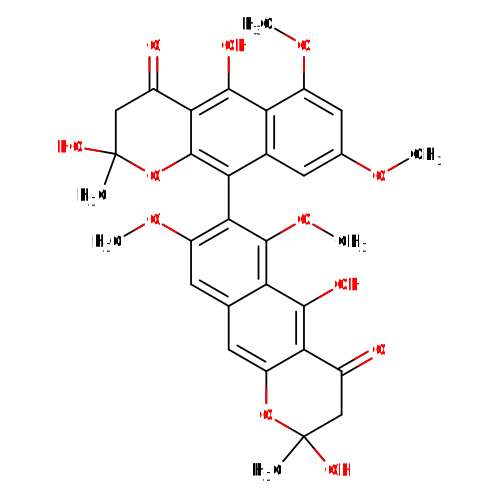
| Common Name | Aurasperone B |
|---|
| Description | Aurasperone B belongs to the class of organic compounds known as naphthopyranones. Naphthopyranones are compounds containing a naphthopyran skeleton where a ring carbon bears a carboxylic acid group. Naphthtopyran is made up of the pyran ring fused to a naphthalene ring system. Aurasperone B is an extremely weak basic (essentially neutral) compound (based on its pKa). Aurasperone B is found in Alternaria alternata, Aspergillus awamori, Aspergillus fonsecaeus and Aspergillus niger. Aurasperone B was first documented in 2005 (PMID: 16076634). A dimeric naphthopyran with formula C32H30O12, isolated from several Aspergillus species (PMID: 21892239) (PMID: 20003296) (PMID: 15803385) (PMID: 21652743). |
|---|
| Structure | COC1=CC2=C(C(O)=C3C(=O)CC(C)(O)OC3=C2C2=C(OC)C=C3C=C4OC(C)(O)CC(=O)C4=C(O)C3=C2OC)C(OC)=C1 InChI=1S/C32H30O12/c1-31(37)11-16(33)24-20(43-31)8-13-7-18(40-4)26(29(42-6)21(13)27(24)35)23-15-9-14(39-3)10-19(41-5)22(15)28(36)25-17(34)12-32(2,38)44-30(23)25/h7-10,35-38H,11-12H2,1-6H3 |
|---|
| Synonyms | Not Available |
|---|
| Chemical Formula | C32H30O12 |
|---|
| Average Mass | 606.5734 Da |
|---|
| Monoisotopic Mass | 606.17373 Da |
|---|
| IUPAC Name | 10-{2,5-dihydroxy-6,8-dimethoxy-2-methyl-4-oxo-2H,3H,4H-naphtho[2,3-b]pyran-7-yl}-2,5-dihydroxy-6,8-dimethoxy-2-methyl-2H,3H,4H-naphtho[2,3-b]pyran-4-one |
|---|
| Traditional Name | 10-{2,5-dihydroxy-6,8-dimethoxy-2-methyl-4-oxo-3H-naphtho[2,3-b]pyran-7-yl}-2,5-dihydroxy-6,8-dimethoxy-2-methyl-3H-naphtho[2,3-b]pyran-4-one |
|---|
| CAS Registry Number | Not Available |
|---|
| SMILES | COC1=CC2=C(C(O)=C3C(=O)CC(C)(O)OC3=C2C2=C(OC)C=C3C=C4OC(C)(O)CC(=O)C4=C(O)C3=C2OC)C(OC)=C1 |
|---|
| InChI Identifier | InChI=1S/C32H30O12/c1-31(37)11-16(33)24-20(43-31)8-13-7-18(40-4)26(29(42-6)21(13)27(24)35)23-15-9-14(39-3)10-19(41-5)22(15)28(36)25-17(34)12-32(2,38)44-30(23)25/h7-10,35-38H,11-12H2,1-6H3 |
|---|
| InChI Key | VIFQAHKDYKZMMS-UHFFFAOYSA-N |
|---|
| Experimental Spectra |
|---|
|
| Not Available | | Predicted Spectra |
|---|
|
| | Spectrum Type | Description | Depositor ID | Depositor Organization | Depositor | Deposition Date | View |
|---|
| 1D NMR | 13C NMR Spectrum (1D, 25 MHz, D2O, predicted) | Wishart Lab | Wishart Lab | David Wishart | 2021-06-20 | View Spectrum | | 1D NMR | 1H NMR Spectrum (1D, 100 MHz, D2O, predicted) | Wishart Lab | Wishart Lab | David Wishart | 2021-06-20 | View Spectrum | | 1D NMR | 13C NMR Spectrum (1D, 252 MHz, D2O, predicted) | Wishart Lab | Wishart Lab | David Wishart | 2021-06-20 | View Spectrum | | 1D NMR | 1H NMR Spectrum (1D, 1000 MHz, D2O, predicted) | Wishart Lab | Wishart Lab | David Wishart | 2021-06-20 | View Spectrum | | 1D NMR | 13C NMR Spectrum (1D, 50 MHz, D2O, predicted) | Wishart Lab | Wishart Lab | David Wishart | 2021-06-20 | View Spectrum | | 1D NMR | 1H NMR Spectrum (1D, 200 MHz, D2O, predicted) | Wishart Lab | Wishart Lab | David Wishart | 2021-06-20 | View Spectrum | | 1D NMR | 13C NMR Spectrum (1D, 75 MHz, D2O, predicted) | Wishart Lab | Wishart Lab | David Wishart | 2021-06-20 | View Spectrum | | 1D NMR | 1H NMR Spectrum (1D, 300 MHz, D2O, predicted) | Wishart Lab | Wishart Lab | David Wishart | 2021-06-20 | View Spectrum | | 1D NMR | 13C NMR Spectrum (1D, 101 MHz, D2O, predicted) | Wishart Lab | Wishart Lab | David Wishart | 2021-06-20 | View Spectrum | | 1D NMR | 1H NMR Spectrum (1D, 400 MHz, D2O, predicted) | Wishart Lab | Wishart Lab | David Wishart | 2021-06-20 | View Spectrum | | 1D NMR | 13C NMR Spectrum (1D, 126 MHz, D2O, predicted) | Wishart Lab | Wishart Lab | David Wishart | 2021-06-20 | View Spectrum | | 1D NMR | 1H NMR Spectrum (1D, 500 MHz, D2O, predicted) | Wishart Lab | Wishart Lab | David Wishart | 2021-06-20 | View Spectrum | | 1D NMR | 13C NMR Spectrum (1D, 151 MHz, D2O, predicted) | Wishart Lab | Wishart Lab | David Wishart | 2021-06-20 | View Spectrum | | 1D NMR | 1H NMR Spectrum (1D, 600 MHz, D2O, predicted) | Wishart Lab | Wishart Lab | David Wishart | 2021-06-20 | View Spectrum | | 1D NMR | 13C NMR Spectrum (1D, 176 MHz, D2O, predicted) | Wishart Lab | Wishart Lab | David Wishart | 2021-06-20 | View Spectrum | | 1D NMR | 1H NMR Spectrum (1D, 700 MHz, D2O, predicted) | Wishart Lab | Wishart Lab | David Wishart | 2021-06-20 | View Spectrum | | 1D NMR | 13C NMR Spectrum (1D, 201 MHz, D2O, predicted) | Wishart Lab | Wishart Lab | David Wishart | 2021-06-20 | View Spectrum | | 1D NMR | 1H NMR Spectrum (1D, 800 MHz, D2O, predicted) | Wishart Lab | Wishart Lab | David Wishart | 2021-06-20 | View Spectrum | | 1D NMR | 13C NMR Spectrum (1D, 226 MHz, D2O, predicted) | Wishart Lab | Wishart Lab | David Wishart | 2021-06-20 | View Spectrum | | 1D NMR | 1H NMR Spectrum (1D, 900 MHz, D2O, predicted) | Wishart Lab | Wishart Lab | David Wishart | 2021-06-20 | View Spectrum |
| | Chemical Shift Submissions |
|---|
|
| Not Available | | Species |
|---|
| Species of Origin | |
|---|
| Chemical Taxonomy |
|---|
| Description | Belongs to the class of organic compounds known as naphthopyranones. Naphthopyranones are compounds containing a naphthopyran skeleton where a ring carbon bears a carboxylic acid group. Naphthtopyran is made up of the pyran ring fused to a naphthalene ring system. |
|---|
| Kingdom | Organic compounds |
|---|
| Super Class | Organoheterocyclic compounds |
|---|
| Class | Naphthopyrans |
|---|
| Sub Class | Naphthopyranones |
|---|
| Direct Parent | Naphthopyranones |
|---|
| Alternative Parents | |
|---|
| Substituents | - Benzochromone
- Naphthopyranone
- Chromone
- 1-naphthol
- Chromane
- Benzopyran
- Naphthalene
- 1-benzopyran
- Anisole
- Aryl alkyl ketone
- Aryl ketone
- Pyranone
- Alkyl aryl ether
- 1-hydroxy-4-unsubstituted benzenoid
- Pyran
- Benzenoid
- Vinylogous acid
- Ketone
- Hemiacetal
- Oxacycle
- Ether
- Organooxygen compound
- Hydrocarbon derivative
- Organic oxide
- Organic oxygen compound
- Aromatic heteropolycyclic compound
|
|---|
| Molecular Framework | Aromatic heteropolycyclic compounds |
|---|
| External Descriptors | Not Available |
|---|
| Physical Properties |
|---|
| State | Not Available |
|---|
| Experimental Properties | | Property | Value | Reference |
|---|
| Melting Point | Not Available | Not Available | | Boiling Point | Not Available | Not Available | | Water Solubility | Not Available | Not Available | | LogP | Not Available | Not Available |
|
|---|
| Predicted Properties | |
|---|
| General References | - Bouras N, Mathieu F, Coppel Y, Lebrihi A: Aurasperone F--a new member of the naphtho-gamma-pyrone class isolated from a cultured microfungus, Aspergillus niger C-433. Nat Prod Res. 2005 Oct;19(7):653-9. doi: 10.1080/14786410412331286955. [PubMed:16076634 ]
- Varga J, Frisvad JC, Kocsube S, Brankovics B, Toth B, Szigeti G, Samson RA: New and revisited species in Aspergillus section Nigri. Stud Mycol. 2011 Jun 30;69(1):1-17. doi: 10.3114/sim.2011.69.01. [PubMed:21892239 ]
- Sorensen LM, Lametsch R, Andersen MR, Nielsen PV, Frisvad JC: Proteome analysis of Aspergillus niger: lactate added in starch-containing medium can increase production of the mycotoxin fumonisin B2 by modifying acetyl-CoA metabolism. BMC Microbiol. 2009 Dec 10;9:255. doi: 10.1186/1471-2180-9-255. [PubMed:20003296 ]
- de Vries RP, Frisvad JC, van de Vondervoort PJ, Burgers K, Kuijpers AF, Samson RA, Visser J: Aspergillus vadensis, a new species of the group of black Aspergilli. Antonie Van Leeuwenhoek. 2005 Apr;87(3):195-203. doi: 10.1007/s10482-004-3194-y. [PubMed:15803385 ]
- Jorgensen TR, Nielsen KF, Arentshorst M, Park J, van den Hondel CA, Frisvad JC, Ram AF: Submerged conidiation and product formation by Aspergillus niger at low specific growth rates are affected in aerial developmental mutants. Appl Environ Microbiol. 2011 Aug;77(15):5270-7. doi: 10.1128/AEM.00118-11. Epub 2011 Jun 7. [PubMed:21652743 ]
|
|---|