| Record Information |
|---|
| Version | 2.0 |
|---|
| Created at | 2022-04-29 05:45:22 UTC |
|---|
| Updated at | 2022-04-29 05:45:22 UTC |
|---|
| NP-MRD ID | NP0085148 |
|---|
| Secondary Accession Numbers | None |
|---|
| Natural Product Identification |
|---|
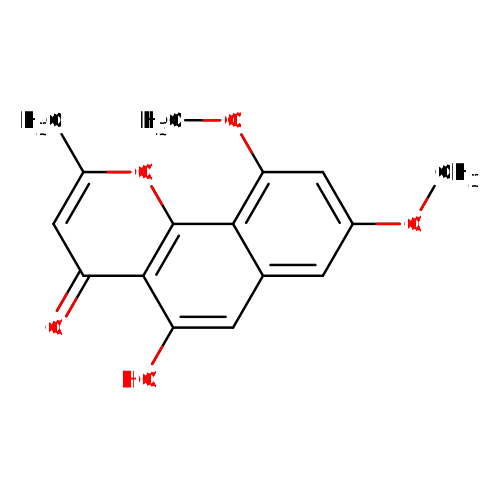
| Common Name | Asperxanthone |
|---|
| Description | Asperxanthone, also known as TMC 256C2, belongs to the class of organic compounds known as naphthopyranones. Naphthopyranones are compounds containing a naphthopyran skeleton where a ring carbon bears a carboxylic acid group. Naphthtopyran is made up of the pyran ring fused to a naphthalene ring system. Asperxanthone is an extremely weak basic (essentially neutral) compound (based on its pKa). Outside of the human body, Asperxanthone has been detected, but not quantified in, fruits and nuts. Asperxanthone is found in Aspergillus niger. Asperxanthone was first documented in 1984 (PMID: 6548104). This could make asperxanthone a potential biomarker for the consumption of these foods (PMID: 18205129) (PMID: 25809933) (PMID: 26669099) (PMID: 21652743) (PMID: 18823067) (PMID: 19160525). |
|---|
| Structure | COC1=CC(OC)=C2C(C=C(O)C3=C2OC(C)=CC3=O)=C1 InChI=1S/C16H14O5/c1-8-4-11(17)15-12(18)6-9-5-10(19-2)7-13(20-3)14(9)16(15)21-8/h4-7,18H,1-3H3 |
|---|
| Synonyms | | Value | Source |
|---|
| Antibiotic TMC 256c2 | ChEBI | | Asperxanthon | ChEBI | | TMC 256c2 | ChEBI | | 5-Hydroxy-8,10-dimethoxy-2-methyl-4H-naphtho[1,2-b]pyran-4-one, 9ci | HMDB | | Flavasperone | HMDB | | Asperxanthone | ChEBI |
|
|---|
| Chemical Formula | C16H14O5 |
|---|
| Average Mass | 286.2794 Da |
|---|
| Monoisotopic Mass | 286.08412 Da |
|---|
| IUPAC Name | 5-hydroxy-8,10-dimethoxy-2-methyl-4H-benzo[h]chromen-4-one |
|---|
| Traditional Name | 5-hydroxy-8,10-dimethoxy-2-methylbenzo[h]chromen-4-one |
|---|
| CAS Registry Number | Not Available |
|---|
| SMILES | COC1=CC(OC)=C2C(C=C(O)C3=C2OC(C)=CC3=O)=C1 |
|---|
| InChI Identifier | InChI=1S/C16H14O5/c1-8-4-11(17)15-12(18)6-9-5-10(19-2)7-13(20-3)14(9)16(15)21-8/h4-7,18H,1-3H3 |
|---|
| InChI Key | ARXPDHLVDOYIPX-UHFFFAOYSA-N |
|---|
| Experimental Spectra |
|---|
|
| Not Available | | Predicted Spectra |
|---|
|
| | Spectrum Type | Description | Depositor ID | Depositor Organization | Depositor | Deposition Date | View |
|---|
| 1D NMR | 13C NMR Spectrum (1D, 25 MHz, D2O, predicted) | Wishart Lab | Wishart Lab | David Wishart | 2021-06-20 | View Spectrum | | 1D NMR | 1H NMR Spectrum (1D, 100 MHz, D2O, predicted) | Wishart Lab | Wishart Lab | David Wishart | 2021-06-20 | View Spectrum | | 1D NMR | 13C NMR Spectrum (1D, 252 MHz, D2O, predicted) | Wishart Lab | Wishart Lab | David Wishart | 2021-06-20 | View Spectrum | | 1D NMR | 1H NMR Spectrum (1D, 1000 MHz, D2O, predicted) | Wishart Lab | Wishart Lab | David Wishart | 2021-06-20 | View Spectrum | | 1D NMR | 13C NMR Spectrum (1D, 50 MHz, D2O, predicted) | Wishart Lab | Wishart Lab | David Wishart | 2021-06-20 | View Spectrum | | 1D NMR | 1H NMR Spectrum (1D, 200 MHz, D2O, predicted) | Wishart Lab | Wishart Lab | David Wishart | 2021-06-20 | View Spectrum | | 1D NMR | 13C NMR Spectrum (1D, 75 MHz, D2O, predicted) | Wishart Lab | Wishart Lab | David Wishart | 2021-06-20 | View Spectrum | | 1D NMR | 1H NMR Spectrum (1D, 300 MHz, D2O, predicted) | Wishart Lab | Wishart Lab | David Wishart | 2021-06-20 | View Spectrum | | 1D NMR | 13C NMR Spectrum (1D, 101 MHz, D2O, predicted) | Wishart Lab | Wishart Lab | David Wishart | 2021-06-20 | View Spectrum | | 1D NMR | 1H NMR Spectrum (1D, 400 MHz, D2O, predicted) | Wishart Lab | Wishart Lab | David Wishart | 2021-06-20 | View Spectrum | | 1D NMR | 13C NMR Spectrum (1D, 126 MHz, D2O, predicted) | Wishart Lab | Wishart Lab | David Wishart | 2021-06-20 | View Spectrum | | 1D NMR | 1H NMR Spectrum (1D, 500 MHz, D2O, predicted) | Wishart Lab | Wishart Lab | David Wishart | 2021-06-20 | View Spectrum | | 1D NMR | 13C NMR Spectrum (1D, 151 MHz, D2O, predicted) | Wishart Lab | Wishart Lab | David Wishart | 2021-06-20 | View Spectrum | | 1D NMR | 1H NMR Spectrum (1D, 600 MHz, D2O, predicted) | Wishart Lab | Wishart Lab | David Wishart | 2021-06-20 | View Spectrum | | 1D NMR | 13C NMR Spectrum (1D, 176 MHz, D2O, predicted) | Wishart Lab | Wishart Lab | David Wishart | 2021-06-20 | View Spectrum | | 1D NMR | 1H NMR Spectrum (1D, 700 MHz, D2O, predicted) | Wishart Lab | Wishart Lab | David Wishart | 2021-06-20 | View Spectrum | | 1D NMR | 13C NMR Spectrum (1D, 201 MHz, D2O, predicted) | Wishart Lab | Wishart Lab | David Wishart | 2021-06-20 | View Spectrum | | 1D NMR | 1H NMR Spectrum (1D, 800 MHz, D2O, predicted) | Wishart Lab | Wishart Lab | David Wishart | 2021-06-20 | View Spectrum | | 1D NMR | 13C NMR Spectrum (1D, 226 MHz, D2O, predicted) | Wishart Lab | Wishart Lab | David Wishart | 2021-06-20 | View Spectrum | | 1D NMR | 1H NMR Spectrum (1D, 900 MHz, D2O, predicted) | Wishart Lab | Wishart Lab | David Wishart | 2021-06-20 | View Spectrum |
| | Chemical Shift Submissions |
|---|
|
| Not Available | | Species |
|---|
| Species of Origin | |
|---|
| Chemical Taxonomy |
|---|
| Description | Belongs to the class of organic compounds known as naphthopyranones. Naphthopyranones are compounds containing a naphthopyran skeleton where a ring carbon bears a carboxylic acid group. Naphthtopyran is made up of the pyran ring fused to a naphthalene ring system. |
|---|
| Kingdom | Organic compounds |
|---|
| Super Class | Organoheterocyclic compounds |
|---|
| Class | Naphthopyrans |
|---|
| Sub Class | Naphthopyranones |
|---|
| Direct Parent | Naphthopyranones |
|---|
| Alternative Parents | |
|---|
| Substituents | - Naphthopyranone
- Chromone
- 2-naphthol
- Benzopyran
- 1-benzopyran
- Naphthalene
- Anisole
- 1-hydroxy-2-unsubstituted benzenoid
- Alkyl aryl ether
- Pyranone
- Benzenoid
- Pyran
- Heteroaromatic compound
- Vinylogous acid
- Oxacycle
- Ether
- Organic oxygen compound
- Hydrocarbon derivative
- Organic oxide
- Organooxygen compound
- Aromatic heteropolycyclic compound
|
|---|
| Molecular Framework | Aromatic heteropolycyclic compounds |
|---|
| External Descriptors | Not Available |
|---|
| Physical Properties |
|---|
| State | Not Available |
|---|
| Experimental Properties | | Property | Value | Reference |
|---|
| Melting Point | Not Available | Not Available | | Boiling Point | Not Available | Not Available | | Water Solubility | Not Available | Not Available | | LogP | Not Available | Not Available |
|
|---|
| Predicted Properties | |
|---|
| General References | - Zhang Y, Ling S, Fang Y, Zhu T, Gu Q, Zhu WM: Isolation, Structure elucidation, and antimycobacterial properties of dimeric naphtho-gamma-pyrones from the marine-derived fungus Aspergillus carbonarius. Chem Biodivers. 2008 Jan;5(1):93-100. doi: 10.1002/cbdv.200890017. [PubMed:18205129 ]
- Siriwardane AM, Kumar NS, Jayasinghe L, Fujimoto Y: Chemical investigation of metabolites produced by an endophytic Aspergillus sp. isolated from Limonia acidissima. Nat Prod Res. 2015;29(14):1384-7. doi: 10.1080/14786419.2015.1025230. Epub 2015 Mar 26. [PubMed:25809933 ]
- Bandara HM, Kumar NS, Jayasinghe L, Masubuti H, Fujimoto Y: A 3-Vinyl Cephem Derivative, a Useful Intermediate in the Synthesis of Cepham Antibiotics, from Aspergillus awamori Associated with Banana Fruit. Nat Prod Commun. 2015 Oct;10(10):1663-6. [PubMed:26669099 ]
- Jorgensen TR, Nielsen KF, Arentshorst M, Park J, van den Hondel CA, Frisvad JC, Ram AF: Submerged conidiation and product formation by Aspergillus niger at low specific growth rates are affected in aerial developmental mutants. Appl Environ Microbiol. 2011 Aug;77(15):5270-7. doi: 10.1128/AEM.00118-11. Epub 2011 Jun 7. [PubMed:21652743 ]
- Wu ZJ, Ouyang MA, Tan QW: New asperxanthone and asperbiphenyl from the marine fungus Aspergillus sp. Pest Manag Sci. 2009 Jan;65(1):60-5. doi: 10.1002/ps.1645. [PubMed:18823067 ]
- Sakai K, Ohte S, Ohshiro T, Matsuda D, Masuma R, Rudel LL, Tomoda H: Selective inhibition of acyl-CoA:cholesterol acyltransferase 2 isozyme by flavasperone and sterigmatocystin from Aspergillus species. J Antibiot (Tokyo). 2008 Sep;61(9):568-72. doi: 10.1038/ja.2008.76. [PubMed:19160525 ]
- Ehrlich KC, DeLucca AJ 2nd, Ciegler A: Naphtho-gamma-pyrone production by Aspergillus niger isolated from stored cottonseed. Appl Environ Microbiol. 1984 Jul;48(1):1-4. doi: 10.1128/aem.48.1.1-4.1984. [PubMed:6548104 ]
|
|---|