| Record Information |
|---|
| Version | 2.0 |
|---|
| Created at | 2022-04-29 04:43:28 UTC |
|---|
| Updated at | 2022-04-29 04:43:28 UTC |
|---|
| NP-MRD ID | NP0083787 |
|---|
| Secondary Accession Numbers | None |
|---|
| Natural Product Identification |
|---|
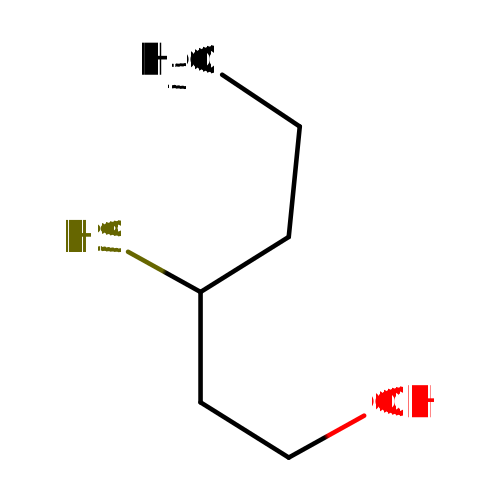
| Common Name | 3-Sulfanylhexan-1-ol |
|---|
| Description | 3-Mercapto-1-hexanol, also known as 3-sulfanyl-1-hexanol or fema 3850, belongs to the class of organic compounds known as alkylthiols. These are organic compounds containing the thiol functional group linked to an alkyl chain. Thus, 3-mercapto-1-hexanol is considered to be a fatty alcohol lipid molecule. 3-Mercapto-1-hexanol is a very hydrophobic molecule, practically insoluble (in water), and relatively neutral. 3-Mercapto-1-hexanol is a sulfur tasting compound. Outside of the human body, 3-Mercapto-1-hexanol has been detected, but not quantified in, fruits. This could make 3-mercapto-1-hexanol a potential biomarker for the consumption of these foods. 3-Sulfanylhexan-1-ol is found in Humulus lupulus , Passiflora edulis and Vitis vinifera. 3-Sulfanylhexan-1-ol was first documented in 2003 (PMID: 12769536). An alkanethiol that is hexane substituted at positions 1 and 3 by hydroxy and sulfanyl groups respectively (PMID: 21332202) (PMID: 21854044) (PMID: 22663147) (PMID: 22868118). |
|---|
| Structure | InChI=1S/C6H14OS/c1-2-3-6(8)4-5-7/h6-8H,2-5H2,1H3 |
|---|
| Synonyms | | Value | Source |
|---|
| 3-Mercaptohexan-1-ol | ChEBI | | 3-Sulfanyl-1-hexanol | ChEBI | | 3-Sulphanylhexan-1-ol | ChEBI | | 3-Sulphanyl-1-hexanol | Generator | | 3-Sulfanylhexan-1-ol | Generator | | 3-Mercapto hexan-1-ol | HMDB | | 3-Mercaptohexanol | HMDB | | FEMA 3850 | HMDB | | 3-Mercapto-1-hexanol | ChEBI |
|
|---|
| Chemical Formula | C6H14OS |
|---|
| Average Mass | 134.2400 Da |
|---|
| Monoisotopic Mass | 134.07654 Da |
|---|
| IUPAC Name | 3-sulfanylhexan-1-ol |
|---|
| Traditional Name | 3-sulfanylhexan-1-ol |
|---|
| CAS Registry Number | Not Available |
|---|
| SMILES | CCCC(S)CCO |
|---|
| InChI Identifier | InChI=1S/C6H14OS/c1-2-3-6(8)4-5-7/h6-8H,2-5H2,1H3 |
|---|
| InChI Key | TYZFMFVWHZKYSE-UHFFFAOYSA-N |
|---|
| Experimental Spectra |
|---|
|
| Not Available | | Predicted Spectra |
|---|
|
| | Spectrum Type | Description | Depositor ID | Depositor Organization | Depositor | Deposition Date | View |
|---|
| 1D NMR | 13C NMR Spectrum (1D, 25 MHz, D2O, predicted) | Wishart Lab | Wishart Lab | David Wishart | 2021-06-20 | View Spectrum | | 1D NMR | 1H NMR Spectrum (1D, 100 MHz, D2O, predicted) | Wishart Lab | Wishart Lab | David Wishart | 2021-06-20 | View Spectrum | | 1D NMR | 13C NMR Spectrum (1D, 252 MHz, D2O, predicted) | Wishart Lab | Wishart Lab | David Wishart | 2021-06-20 | View Spectrum | | 1D NMR | 1H NMR Spectrum (1D, 1000 MHz, D2O, predicted) | Wishart Lab | Wishart Lab | David Wishart | 2021-06-20 | View Spectrum | | 1D NMR | 13C NMR Spectrum (1D, 50 MHz, D2O, predicted) | Wishart Lab | Wishart Lab | David Wishart | 2021-06-20 | View Spectrum | | 1D NMR | 1H NMR Spectrum (1D, 200 MHz, D2O, predicted) | Wishart Lab | Wishart Lab | David Wishart | 2021-06-20 | View Spectrum | | 1D NMR | 13C NMR Spectrum (1D, 75 MHz, D2O, predicted) | Wishart Lab | Wishart Lab | David Wishart | 2021-06-20 | View Spectrum | | 1D NMR | 1H NMR Spectrum (1D, 300 MHz, D2O, predicted) | Wishart Lab | Wishart Lab | David Wishart | 2021-06-20 | View Spectrum | | 1D NMR | 13C NMR Spectrum (1D, 101 MHz, D2O, predicted) | Wishart Lab | Wishart Lab | David Wishart | 2021-06-20 | View Spectrum | | 1D NMR | 1H NMR Spectrum (1D, 400 MHz, D2O, predicted) | Wishart Lab | Wishart Lab | David Wishart | 2021-06-20 | View Spectrum | | 1D NMR | 13C NMR Spectrum (1D, 126 MHz, D2O, predicted) | Wishart Lab | Wishart Lab | David Wishart | 2021-06-20 | View Spectrum | | 1D NMR | 1H NMR Spectrum (1D, 500 MHz, D2O, predicted) | Wishart Lab | Wishart Lab | David Wishart | 2021-06-20 | View Spectrum | | 1D NMR | 13C NMR Spectrum (1D, 151 MHz, D2O, predicted) | Wishart Lab | Wishart Lab | David Wishart | 2021-06-20 | View Spectrum | | 1D NMR | 1H NMR Spectrum (1D, 600 MHz, D2O, predicted) | Wishart Lab | Wishart Lab | David Wishart | 2021-06-20 | View Spectrum | | 1D NMR | 13C NMR Spectrum (1D, 176 MHz, D2O, predicted) | Wishart Lab | Wishart Lab | David Wishart | 2021-06-20 | View Spectrum | | 1D NMR | 1H NMR Spectrum (1D, 700 MHz, D2O, predicted) | Wishart Lab | Wishart Lab | David Wishart | 2021-06-20 | View Spectrum | | 1D NMR | 13C NMR Spectrum (1D, 201 MHz, D2O, predicted) | Wishart Lab | Wishart Lab | David Wishart | 2021-06-20 | View Spectrum | | 1D NMR | 1H NMR Spectrum (1D, 800 MHz, D2O, predicted) | Wishart Lab | Wishart Lab | David Wishart | 2021-06-20 | View Spectrum | | 1D NMR | 13C NMR Spectrum (1D, 226 MHz, D2O, predicted) | Wishart Lab | Wishart Lab | David Wishart | 2021-06-20 | View Spectrum | | 1D NMR | 1H NMR Spectrum (1D, 900 MHz, D2O, predicted) | Wishart Lab | Wishart Lab | David Wishart | 2021-06-20 | View Spectrum |
| | Chemical Shift Submissions |
|---|
|
| Not Available | | Species |
|---|
| Species of Origin | |
|---|
| Chemical Taxonomy |
|---|
| Description | Belongs to the class of organic compounds known as alkylthiols. These are organic compounds containing the thiol functional group linked to an alkyl chain. |
|---|
| Kingdom | Organic compounds |
|---|
| Super Class | Organosulfur compounds |
|---|
| Class | Thiols |
|---|
| Sub Class | Alkylthiols |
|---|
| Direct Parent | Alkylthiols |
|---|
| Alternative Parents | |
|---|
| Substituents | - Alkylthiol
- Organic oxygen compound
- Hydrocarbon derivative
- Primary alcohol
- Organooxygen compound
- Alcohol
- Aliphatic acyclic compound
|
|---|
| Molecular Framework | Aliphatic acyclic compounds |
|---|
| External Descriptors | |
|---|
| Physical Properties |
|---|
| State | Not Available |
|---|
| Experimental Properties | | Property | Value | Reference |
|---|
| Melting Point | Not Available | Not Available | | Boiling Point | Not Available | Not Available | | Water Solubility | Not Available | Not Available | | LogP | Not Available | Not Available |
|
|---|
| Predicted Properties | |
|---|
| General References | - Vermeulen C, Guyot-Declerck C, Collin S: Combinatorial synthesis and sensorial properties of mercapto primary alcohols and analogues. J Agric Food Chem. 2003 Jun 4;51(12):3623-8. doi: 10.1021/jf0212340. [PubMed:12769536 ]
- Ugliano M, Kwiatkowski M, Vidal S, Capone D, Siebert T, Dieval JB, Aagaard O, Waters EJ: Evolution of 3-mercaptohexanol, hydrogen sulfide, and methyl mercaptan during bottle storage of Sauvignon blanc wines. Effect of glutathione, copper, oxygen exposure, and closure-derived oxygen. J Agric Food Chem. 2011 Mar 23;59(6):2564-72. doi: 10.1021/jf1043585. Epub 2011 Feb 18. [PubMed:21332202 ]
- Allen T, Herbst-Johnstone M, Girault M, Butler P, Logan G, Jouanneau S, Nicolau L, Kilmartin PA: Influence of grape-harvesting steps on varietal thiol aromas in Sauvignon blanc wines. J Agric Food Chem. 2011 Oct 12;59(19):10641-50. doi: 10.1021/jf2018676. Epub 2011 Sep 8. [PubMed:21854044 ]
- Benkwitz F, Nicolau L, Lund C, Beresford M, Wohlers M, Kilmartin PA: Evaluation of key odorants in sauvignon blanc wines using three different methodologies. J Agric Food Chem. 2012 Jun 27;60(25):6293-302. doi: 10.1021/jf300914n. Epub 2012 Jun 18. [PubMed:22663147 ]
- Makhotkina O, Kilmartin PA: Hydrolysis and formation of volatile esters in New Zealand Sauvignon blanc wine. Food Chem. 2012 Nov 15;135(2):486-93. doi: 10.1016/j.foodchem.2012.05.034. Epub 2012 May 11. [PubMed:22868118 ]
|
|---|