| Record Information |
|---|
| Version | 2.0 |
|---|
| Created at | 2022-04-29 04:29:17 UTC |
|---|
| Updated at | 2022-04-29 04:29:17 UTC |
|---|
| NP-MRD ID | NP0083443 |
|---|
| Secondary Accession Numbers | None |
|---|
| Natural Product Identification |
|---|
| Common Name | 3-Methyl sulfolane |
|---|
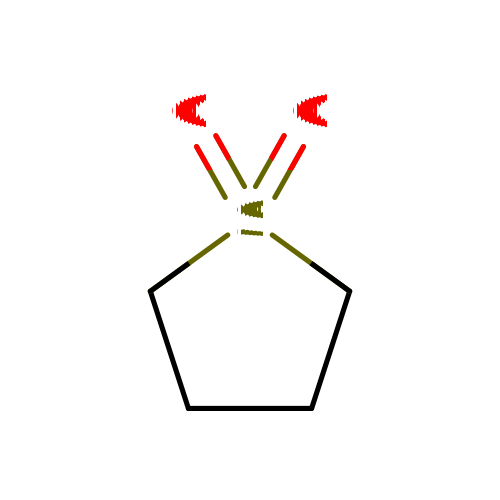
| Description | Sulfolane, also known as 1,1-dioxothiolan or (CH2)4SO2, belongs to the class of organic compounds known as thiolanes. These are organic compounds containing thiolane, a five-member saturated ring containing four carbon atoms and a sulfur atom. The sulfur-oxygen double bond is polar, conferring good solubility in water, while the four carbon ring provides non-polar stability. Sulfolane is possibly neutral. This reaction produces tetramethylene sulfoxide, which can then be further oxidized. This was then hydrogenated using Raney nickel as a catalyst to give sulfolane. Because sulfolane is one of the most efficient industrial solvents for purifying aromatics, the process operates at a relatively low solvent-to-feed ratio, making sulfolane relatively cost effective compared to similar-purpose solvents. 3-Methyl sulfolane is found in Homo sapiens (Urine). 3-Methyl sulfolane was first documented in 1985 (PMID: 4071560). It is a colorless liquid commonly used in the chemical industry as a solvent for extractive distillation and chemical reactions (PMID: 11878596) (PMID: 22219044) (PMID: 22918536) (PMID: 22936336) (PMID: 3709502). |
|---|
| Structure | InChI=1S/C4H8O2S/c5-7(6)3-1-2-4-7/h1-4H2 |
|---|
| Synonyms | | Value | Source |
|---|
| (CH2)4SO2 | ChEBI | | 1,1-Dioxidetetrahydrothiofuran | ChEBI | | 1,1-Dioxidetetrahydrothiophene | ChEBI | | 1,1-Dioxothiolan | ChEBI | | 2,3,4,5-Tetrahydrothiophene-1,1-dioxide | ChEBI | | Cyclic tetramethylene sulfone | ChEBI | | Cyclotetramethylene sulfone | ChEBI | | Dioxothiolan | ChEBI | | Sulfolan | ChEBI | | Tetrahydrothiophene 1-dioxide | ChEBI | | Tetramethylene sulfone | ChEBI | | Thiacyclopentane dioxide | ChEBI | | Thiolane-1,1-dioxide | ChEBI | | Thiophan sulfone | ChEBI | | Thiophane dioxide | ChEBI | | Cyclic tetramethylene sulphone | Generator | | Cyclotetramethylene sulphone | Generator | | Sulpholan | Generator | | Tetramethylene sulphone | Generator | | Thiophan sulphone | Generator | | Sulpholane | Generator |
|
|---|
| Chemical Formula | C4H8O2S |
|---|
| Average Mass | 120.1700 Da |
|---|
| Monoisotopic Mass | 120.02450 Da |
|---|
| IUPAC Name | 1λ⁶-thiolane-1,1-dione |
|---|
| Traditional Name | sulfolane |
|---|
| CAS Registry Number | Not Available |
|---|
| SMILES | O=S1(=O)CCCC1 |
|---|
| InChI Identifier | InChI=1S/C4H8O2S/c5-7(6)3-1-2-4-7/h1-4H2 |
|---|
| InChI Key | HXJUTPCZVOIRIF-UHFFFAOYSA-N |
|---|
| Experimental Spectra |
|---|
|
| Not Available | | Predicted Spectra |
|---|
|
| | Spectrum Type | Description | Depositor ID | Depositor Organization | Depositor | Deposition Date | View |
|---|
| 1D NMR | 13C NMR Spectrum (1D, 25 MHz, D2O, predicted) | Wishart Lab | Wishart Lab | David Wishart | 2021-06-20 | View Spectrum | | 1D NMR | 1H NMR Spectrum (1D, 100 MHz, D2O, predicted) | Wishart Lab | Wishart Lab | David Wishart | 2021-06-20 | View Spectrum | | 1D NMR | 13C NMR Spectrum (1D, 252 MHz, D2O, predicted) | Wishart Lab | Wishart Lab | David Wishart | 2021-06-20 | View Spectrum | | 1D NMR | 1H NMR Spectrum (1D, 1000 MHz, D2O, predicted) | Wishart Lab | Wishart Lab | David Wishart | 2021-06-20 | View Spectrum | | 1D NMR | 13C NMR Spectrum (1D, 50 MHz, D2O, predicted) | Wishart Lab | Wishart Lab | David Wishart | 2021-06-20 | View Spectrum | | 1D NMR | 1H NMR Spectrum (1D, 200 MHz, D2O, predicted) | Wishart Lab | Wishart Lab | David Wishart | 2021-06-20 | View Spectrum | | 1D NMR | 13C NMR Spectrum (1D, 75 MHz, D2O, predicted) | Wishart Lab | Wishart Lab | David Wishart | 2021-06-20 | View Spectrum | | 1D NMR | 1H NMR Spectrum (1D, 300 MHz, D2O, predicted) | Wishart Lab | Wishart Lab | David Wishart | 2021-06-20 | View Spectrum | | 1D NMR | 13C NMR Spectrum (1D, 101 MHz, D2O, predicted) | Wishart Lab | Wishart Lab | David Wishart | 2021-06-20 | View Spectrum | | 1D NMR | 1H NMR Spectrum (1D, 400 MHz, D2O, predicted) | Wishart Lab | Wishart Lab | David Wishart | 2021-06-20 | View Spectrum | | 1D NMR | 13C NMR Spectrum (1D, 126 MHz, D2O, predicted) | Wishart Lab | Wishart Lab | David Wishart | 2021-06-20 | View Spectrum | | 1D NMR | 1H NMR Spectrum (1D, 500 MHz, D2O, predicted) | Wishart Lab | Wishart Lab | David Wishart | 2021-06-20 | View Spectrum | | 1D NMR | 13C NMR Spectrum (1D, 151 MHz, D2O, predicted) | Wishart Lab | Wishart Lab | David Wishart | 2021-06-20 | View Spectrum | | 1D NMR | 1H NMR Spectrum (1D, 600 MHz, D2O, predicted) | Wishart Lab | Wishart Lab | David Wishart | 2021-06-20 | View Spectrum | | 1D NMR | 13C NMR Spectrum (1D, 176 MHz, D2O, predicted) | Wishart Lab | Wishart Lab | David Wishart | 2021-06-20 | View Spectrum | | 1D NMR | 1H NMR Spectrum (1D, 700 MHz, D2O, predicted) | Wishart Lab | Wishart Lab | David Wishart | 2021-06-20 | View Spectrum | | 1D NMR | 13C NMR Spectrum (1D, 201 MHz, D2O, predicted) | Wishart Lab | Wishart Lab | David Wishart | 2021-06-20 | View Spectrum | | 1D NMR | 1H NMR Spectrum (1D, 800 MHz, D2O, predicted) | Wishart Lab | Wishart Lab | David Wishart | 2021-06-20 | View Spectrum | | 1D NMR | 13C NMR Spectrum (1D, 226 MHz, D2O, predicted) | Wishart Lab | Wishart Lab | David Wishart | 2021-06-20 | View Spectrum | | 1D NMR | 1H NMR Spectrum (1D, 900 MHz, D2O, predicted) | Wishart Lab | Wishart Lab | David Wishart | 2021-06-20 | View Spectrum |
| | Chemical Shift Submissions |
|---|
|
| Not Available | | Species |
|---|
| Species of Origin | | Species Name | Source | Reference |
|---|
| Homo sapiens (Urine) | Animalia | |
|
|---|
| Chemical Taxonomy |
|---|
| Description | Belongs to the class of organic compounds known as thiolanes. These are organic compounds containing thiolane, a five-member saturated ring containing four carbon atoms and a sulfur atom. |
|---|
| Kingdom | Organic compounds |
|---|
| Super Class | Organoheterocyclic compounds |
|---|
| Class | Thiolanes |
|---|
| Sub Class | Not Available |
|---|
| Direct Parent | Thiolanes |
|---|
| Alternative Parents | |
|---|
| Substituents | - Thiolane
- Sulfone
- Organic oxygen compound
- Organic oxide
- Hydrocarbon derivative
- Aliphatic heteromonocyclic compound
|
|---|
| Molecular Framework | Aliphatic heteromonocyclic compounds |
|---|
| External Descriptors | |
|---|
| Physical Properties |
|---|
| State | Not Available |
|---|
| Experimental Properties | | Property | Value | Reference |
|---|
| Melting Point | Not Available | Not Available | | Boiling Point | Not Available | Not Available | | Water Solubility | Not Available | Not Available | | LogP | Not Available | Not Available |
|
|---|
| Predicted Properties | |
|---|
| General References | - Headley JV, Fedorak PM, Dickson LC: A review of analytical methods for the determination of sulfolane and alkanolamines in environmental studies. J AOAC Int. 2002 Jan-Feb;85(1):154-62. [PubMed:11878596 ]
- Douglass KA, Venter AR: Investigating the role of adducts in protein supercharging with sulfolane. J Am Soc Mass Spectrom. 2012 Mar;23(3):489-97. doi: 10.1007/s13361-011-0319-1. Epub 2012 Jan 5. [PubMed:22219044 ]
- Versace F, Uppugunduri CR, Krajinovic M, Theoret Y, Gumy-Pause F, Mangin P, Staub C, Ansari M: A novel method for quantification of sulfolane (a metabolite of busulfan) in plasma by gas chromatography-tandem mass spectrometry. Anal Bioanal Chem. 2012 Oct;404(6-7):1831-8. doi: 10.1007/s00216-012-6330-y. Epub 2012 Aug 24. [PubMed:22918536 ]
- Thompson CM, Gaylor DW, Tachovsky JA, Perry C, Carakostas MC, Haws LC: Development of a chronic noncancer oral reference dose and drinking water screening level for sulfolane using benchmark dose modeling. J Appl Toxicol. 2013 Dec;33(12):1395-406. doi: 10.1002/jat.2799. Epub 2012 Aug 31. [PubMed:22936336 ]
- Gordon CJ, Long MD, Fehlner KS, Dyer RS: Sulfolane-induced hypothermia enhances survivability in mice. Environ Res. 1986 Jun;40(1):92-7. doi: 10.1016/s0013-9351(86)80084-6. [PubMed:3709502 ]
- Ruppert PH, Dyer RS: Acute behavioral toxicity of sulfolane: influence of hypothermia. Toxicol Lett. 1985 Nov;28(2-3):111-6. doi: 10.1016/0378-4274(85)90018-9. [PubMed:4071560 ]
|
|---|