| Record Information |
|---|
| Version | 2.0 |
|---|
| Created at | 2022-04-29 04:24:24 UTC |
|---|
| Updated at | 2022-04-29 04:24:24 UTC |
|---|
| NP-MRD ID | NP0083365 |
|---|
| Secondary Accession Numbers | None |
|---|
| Natural Product Identification |
|---|
| Common Name | N-Methylserotonin |
|---|
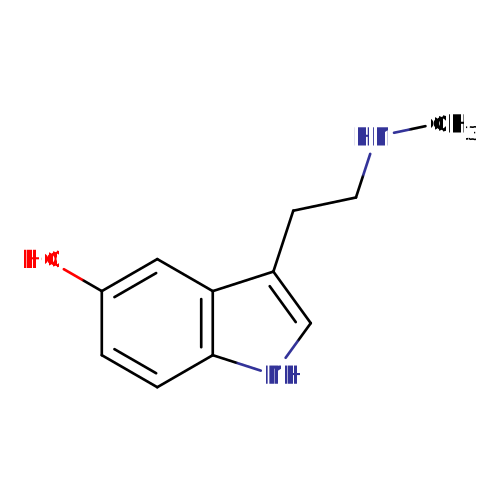
| Description | N-Methylserotonin, also known as lopac-m-1514, belongs to the class of organic compounds known as serotonins. Serotonins are compounds containing a serotonin moiety, which consists of an indole that bears an aminoethyl a position 2 and a hydroxyl group at position 5. Chemically, it is a derivative of serotonin in which a methyl group resides at its alkyl amine. N-Methylserotonin is a very strong basic compound (based on its pKa). N-methylserotonin and S-adenosylhomocysteine can be biosynthesized from serotonin and S-adenosylmethionine through the action of the enzyme indolethylamine N-methyltransferase. These include the plants, Actaea racemosa (black cohosh) and Zanthoxylum piperitum, the Green and Golden Bell Frog, Litoria aurea, and Amanita mushrooms. The compound binds to several serotonin receptors, including the 5-HT7 and 5-HT1A receptors, with high affinity (IC50 ≤ 2 nM) and selectivity, and displays agonist activity; besides its direct interaction with the serotonin receptors, N-methylserotonin also acts as a selective serotonin reuptake inhibitor. N-Methylserotonin is not scheduled at the federal level in the United States, but could be considered an analog (of bufotenin), in which case, sales or possession intended for human consumption could be prosecuted under the Federal Analog Act. In humans, N-methylserotonin is involved in tryptophan metabolism. Outside of the human body, N-Methylserotonin has been detected, but not quantified in, citrus. This could make N-methylserotonin a potential biomarker for the consumption of these foods. N-Methylserotonin is a tryptamine alkaloid. Florida N-Methylserotonin is a Schedule I controlled substance in the state of Florida making it illegal to buy, sell, or possess in Florida. N-Methylserotonin is found in Amanita citrina, Bufo bufo, Citrus unshiu , Homo sapiens and Phyllodium pulchellum. N-Methylserotonin was first documented in 1995 (PMID: 8747157). It is also called Nω-methylserotonin (Nω-methyl-5-hydroxytryptamine) to distinguish it from tryptamine-derived compounds in which a methyl group is bonded to the nitrogen atom of the indole group (PMID: 11201232) (PMID: 19649617). |
|---|
| Structure | InChI=1S/C11H14N2O/c1-12-5-4-8-7-13-11-3-2-9(14)6-10(8)11/h2-3,6-7,12-14H,4-5H2,1H3 |
|---|
| Synonyms | | Value | Source |
|---|
| N-Methylserotonin oxalate salt | HMDB | | 3-(2-(Methylamino)ethyl)-1H-indol-5-ol | HMDB | | 3-[2-(Methylamino)ethyl]-1H-indol-5-ol | HMDB | | Lopac-m-1514 | HMDB |
|
|---|
| Chemical Formula | C11H14N2O |
|---|
| Average Mass | 190.2417 Da |
|---|
| Monoisotopic Mass | 190.11061 Da |
|---|
| IUPAC Name | 3-[2-(methylamino)ethyl]-1H-indol-5-ol |
|---|
| Traditional Name | N-methylserotonin |
|---|
| CAS Registry Number | Not Available |
|---|
| SMILES | CNCCC1=CNC2=C1C=C(O)C=C2 |
|---|
| InChI Identifier | InChI=1S/C11H14N2O/c1-12-5-4-8-7-13-11-3-2-9(14)6-10(8)11/h2-3,6-7,12-14H,4-5H2,1H3 |
|---|
| InChI Key | ASUSBMNYRHGZIG-UHFFFAOYSA-N |
|---|
| Experimental Spectra |
|---|
|
| Not Available | | Predicted Spectra |
|---|
|
| | Spectrum Type | Description | Depositor ID | Depositor Organization | Depositor | Deposition Date | View |
|---|
| 1D NMR | 13C NMR Spectrum (1D, 25 MHz, D2O, predicted) | Wishart Lab | Wishart Lab | David Wishart | 2021-06-20 | View Spectrum | | 1D NMR | 1H NMR Spectrum (1D, 100 MHz, D2O, predicted) | Wishart Lab | Wishart Lab | David Wishart | 2021-06-20 | View Spectrum | | 1D NMR | 13C NMR Spectrum (1D, 252 MHz, D2O, predicted) | Wishart Lab | Wishart Lab | David Wishart | 2021-06-20 | View Spectrum | | 1D NMR | 1H NMR Spectrum (1D, 1000 MHz, D2O, predicted) | Wishart Lab | Wishart Lab | David Wishart | 2021-06-20 | View Spectrum | | 1D NMR | 13C NMR Spectrum (1D, 50 MHz, D2O, predicted) | Wishart Lab | Wishart Lab | David Wishart | 2021-06-20 | View Spectrum | | 1D NMR | 1H NMR Spectrum (1D, 200 MHz, D2O, predicted) | Wishart Lab | Wishart Lab | David Wishart | 2021-06-20 | View Spectrum | | 1D NMR | 13C NMR Spectrum (1D, 75 MHz, D2O, predicted) | Wishart Lab | Wishart Lab | David Wishart | 2021-06-20 | View Spectrum | | 1D NMR | 1H NMR Spectrum (1D, 300 MHz, D2O, predicted) | Wishart Lab | Wishart Lab | David Wishart | 2021-06-20 | View Spectrum | | 1D NMR | 13C NMR Spectrum (1D, 101 MHz, D2O, predicted) | Wishart Lab | Wishart Lab | David Wishart | 2021-06-20 | View Spectrum | | 1D NMR | 1H NMR Spectrum (1D, 400 MHz, D2O, predicted) | Wishart Lab | Wishart Lab | David Wishart | 2021-06-20 | View Spectrum | | 1D NMR | 13C NMR Spectrum (1D, 126 MHz, D2O, predicted) | Wishart Lab | Wishart Lab | David Wishart | 2021-06-20 | View Spectrum | | 1D NMR | 1H NMR Spectrum (1D, 500 MHz, D2O, predicted) | Wishart Lab | Wishart Lab | David Wishart | 2021-06-20 | View Spectrum | | 1D NMR | 13C NMR Spectrum (1D, 151 MHz, D2O, predicted) | Wishart Lab | Wishart Lab | David Wishart | 2021-06-20 | View Spectrum | | 1D NMR | 1H NMR Spectrum (1D, 600 MHz, D2O, predicted) | Wishart Lab | Wishart Lab | David Wishart | 2021-06-20 | View Spectrum | | 1D NMR | 13C NMR Spectrum (1D, 176 MHz, D2O, predicted) | Wishart Lab | Wishart Lab | David Wishart | 2021-06-20 | View Spectrum | | 1D NMR | 1H NMR Spectrum (1D, 700 MHz, D2O, predicted) | Wishart Lab | Wishart Lab | David Wishart | 2021-06-20 | View Spectrum | | 1D NMR | 13C NMR Spectrum (1D, 201 MHz, D2O, predicted) | Wishart Lab | Wishart Lab | David Wishart | 2021-06-20 | View Spectrum | | 1D NMR | 1H NMR Spectrum (1D, 800 MHz, D2O, predicted) | Wishart Lab | Wishart Lab | David Wishart | 2021-06-20 | View Spectrum | | 1D NMR | 13C NMR Spectrum (1D, 226 MHz, D2O, predicted) | Wishart Lab | Wishart Lab | David Wishart | 2021-06-20 | View Spectrum | | 1D NMR | 1H NMR Spectrum (1D, 900 MHz, D2O, predicted) | Wishart Lab | Wishart Lab | David Wishart | 2021-06-20 | View Spectrum |
| | Chemical Shift Submissions |
|---|
|
| Not Available | | Species |
|---|
| Species of Origin | |
|---|
| Chemical Taxonomy |
|---|
| Description | Belongs to the class of organic compounds known as serotonins. Serotonins are compounds containing a serotonin moiety, which consists of an indole that bears an aminoethyl a position 2 and a hydroxyl group at position 5. |
|---|
| Kingdom | Organic compounds |
|---|
| Super Class | Organoheterocyclic compounds |
|---|
| Class | Indoles and derivatives |
|---|
| Sub Class | Tryptamines and derivatives |
|---|
| Direct Parent | Serotonins |
|---|
| Alternative Parents | |
|---|
| Substituents | - Serotonin
- Hydroxyindole
- 3-alkylindole
- Indole
- 1-hydroxy-2-unsubstituted benzenoid
- Aralkylamine
- Benzenoid
- Substituted pyrrole
- Pyrrole
- Heteroaromatic compound
- Secondary aliphatic amine
- Secondary amine
- Azacycle
- Amine
- Hydrocarbon derivative
- Organopnictogen compound
- Organooxygen compound
- Organonitrogen compound
- Organic oxygen compound
- Organic nitrogen compound
- Aromatic heteropolycyclic compound
|
|---|
| Molecular Framework | Aromatic heteropolycyclic compounds |
|---|
| External Descriptors | |
|---|
| Physical Properties |
|---|
| State | Not Available |
|---|
| Experimental Properties | | Property | Value | Reference |
|---|
| Melting Point | Not Available | Not Available | | Boiling Point | Not Available | Not Available | | Water Solubility | Not Available | Not Available | | LogP | Not Available | Not Available |
|
|---|
| Predicted Properties | |
|---|
| General References | - Takeda N, Ikeda R, Ohba K, Kondo M: Bufotenine reconsidered as a diagnostic indicator of psychiatric disorders. Neuroreport. 1995 Nov 27;6(17):2378-80. doi: 10.1097/00001756-199511270-00024. [PubMed:8747157 ]
- Somei M, Yamada F, Kurauchi T, Nagahama Y, Hasegawa M, Yamada K, Teranishi S, Sato H, Kaneko C: The chemistry of indoles. CIII. Simple syntheses of serotonin, N-methylserotonin, bufotenine, 5-methoxy-N-methyltryptamine, bufobutanoic acid, N-(indol-3-yl)methyl-5-methoxy-N-methyltryptamine, and lespedamine based on 1-hydroxyindole chemistry. Chem Pharm Bull (Tokyo). 2001 Jan;49(1):87-96. doi: 10.1248/cpb.49.87. [PubMed:11201232 ]
- Patkar AA, Rozen S, Mannelli P, Matson W, Pae CU, Krishnan KR, Kaddurah-Daouk R: Alterations in tryptophan and purine metabolism in cocaine addiction: a metabolomic study. Psychopharmacology (Berl). 2009 Oct;206(3):479-89. doi: 10.1007/s00213-009-1625-1. Epub 2009 Aug 1. [PubMed:19649617 ]
|
|---|