| Record Information |
|---|
| Version | 2.0 |
|---|
| Created at | 2022-04-29 02:44:14 UTC |
|---|
| Updated at | 2022-04-29 02:44:14 UTC |
|---|
| NP-MRD ID | NP0081682 |
|---|
| Secondary Accession Numbers | None |
|---|
| Natural Product Identification |
|---|
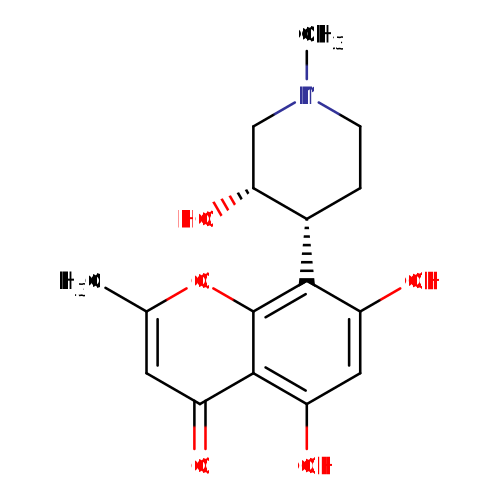
| Common Name | Rohitukine |
|---|
| Description | Rohitukine belongs to the class of organic compounds known as phenylpiperidines. Phenylpiperidines are compounds containing a phenylpiperidine skeleton, which consists of a piperidine bound to a phenyl group. Rohitukine is a secondary metabolite. Secondary metabolites are metabolically or physiologically non-essential metabolites that may serve a role as defense or signalling molecules. In some cases they are simply molecules that arise from the incomplete metabolism of other secondary metabolites. Rohitukine is found in Dysoxylum acutangulum , Dysoxylum binectariferum, Dysoxylum gotadhora, Schumanniophyton magnificum and Schumanniophyton problematicum. Rohitukine was first documented in 2019 (PMID: 31513869). Based on a literature review a small amount of articles have been published on rohitukine (PMID: 34324743) (PMID: 33773222) (PMID: 32858336) (PMID: 32165175). |
|---|
| Structure | CN1CC[C@@H]([C@H](O)C1)C1=C2OC(C)=CC(=O)C2=C(O)C=C1O InChI=1S/C16H19NO5/c1-8-5-10(18)15-12(20)6-11(19)14(16(15)22-8)9-3-4-17(2)7-13(9)21/h5-6,9,13,19-21H,3-4,7H2,1-2H3/t9-,13+/m0/s1 |
|---|
| Synonyms | | Value | Source |
|---|
| 5,7-Dihydroxy-8-[(3S,4R)-3-hydroxy-1-methylpiperidin-4-yl]-2-methyl-4H-1-benzopyran-4-one | ChEBI | | 5,7-Dihydroxy-2-methyl-8-(4-(3-hydroxy-1-methyl)-piperidinyl)-4H-1-benzopyran-4-one | MeSH |
|
|---|
| Chemical Formula | C16H19NO5 |
|---|
| Average Mass | 305.3300 Da |
|---|
| Monoisotopic Mass | 305.12632 Da |
|---|
| IUPAC Name | 5,7-dihydroxy-8-[(3S,4R)-3-hydroxy-1-methylpiperidin-4-yl]-2-methyl-4H-chromen-4-one |
|---|
| Traditional Name | rohitukine |
|---|
| CAS Registry Number | Not Available |
|---|
| SMILES | CN1CC[C@@H]([C@H](O)C1)C1=C2OC(C)=CC(=O)C2=C(O)C=C1O |
|---|
| InChI Identifier | InChI=1S/C16H19NO5/c1-8-5-10(18)15-12(20)6-11(19)14(16(15)22-8)9-3-4-17(2)7-13(9)21/h5-6,9,13,19-21H,3-4,7H2,1-2H3/t9-,13+/m0/s1 |
|---|
| InChI Key | MOCVYVBNJQIVOV-TVQRCGJNSA-N |
|---|
| Experimental Spectra |
|---|
|
| Not Available | | Predicted Spectra |
|---|
|
| | Spectrum Type | Description | Depositor ID | Depositor Organization | Depositor | Deposition Date | View |
|---|
| 1D NMR | 13C NMR Spectrum (1D, 25 MHz, D2O, predicted) | Wishart Lab | Wishart Lab | David Wishart | 2021-06-20 | View Spectrum | | 1D NMR | 1H NMR Spectrum (1D, 100 MHz, D2O, predicted) | Wishart Lab | Wishart Lab | David Wishart | 2021-06-20 | View Spectrum | | 1D NMR | 13C NMR Spectrum (1D, 252 MHz, D2O, predicted) | Wishart Lab | Wishart Lab | David Wishart | 2021-06-20 | View Spectrum | | 1D NMR | 1H NMR Spectrum (1D, 1000 MHz, D2O, predicted) | Wishart Lab | Wishart Lab | David Wishart | 2021-06-20 | View Spectrum | | 1D NMR | 13C NMR Spectrum (1D, 50 MHz, D2O, predicted) | Wishart Lab | Wishart Lab | David Wishart | 2021-06-20 | View Spectrum | | 1D NMR | 1H NMR Spectrum (1D, 200 MHz, D2O, predicted) | Wishart Lab | Wishart Lab | David Wishart | 2021-06-20 | View Spectrum | | 1D NMR | 13C NMR Spectrum (1D, 75 MHz, D2O, predicted) | Wishart Lab | Wishart Lab | David Wishart | 2021-06-20 | View Spectrum | | 1D NMR | 1H NMR Spectrum (1D, 300 MHz, D2O, predicted) | Wishart Lab | Wishart Lab | David Wishart | 2021-06-20 | View Spectrum | | 1D NMR | 13C NMR Spectrum (1D, 101 MHz, D2O, predicted) | Wishart Lab | Wishart Lab | David Wishart | 2021-06-20 | View Spectrum | | 1D NMR | 1H NMR Spectrum (1D, 400 MHz, D2O, predicted) | Wishart Lab | Wishart Lab | David Wishart | 2021-06-20 | View Spectrum | | 1D NMR | 13C NMR Spectrum (1D, 126 MHz, D2O, predicted) | Wishart Lab | Wishart Lab | David Wishart | 2021-06-20 | View Spectrum | | 1D NMR | 1H NMR Spectrum (1D, 500 MHz, D2O, predicted) | Wishart Lab | Wishart Lab | David Wishart | 2021-06-20 | View Spectrum | | 1D NMR | 13C NMR Spectrum (1D, 151 MHz, D2O, predicted) | Wishart Lab | Wishart Lab | David Wishart | 2021-06-20 | View Spectrum | | 1D NMR | 1H NMR Spectrum (1D, 600 MHz, D2O, predicted) | Wishart Lab | Wishart Lab | David Wishart | 2021-06-20 | View Spectrum | | 1D NMR | 13C NMR Spectrum (1D, 176 MHz, D2O, predicted) | Wishart Lab | Wishart Lab | David Wishart | 2021-06-20 | View Spectrum | | 1D NMR | 1H NMR Spectrum (1D, 700 MHz, D2O, predicted) | Wishart Lab | Wishart Lab | David Wishart | 2021-06-20 | View Spectrum | | 1D NMR | 13C NMR Spectrum (1D, 201 MHz, D2O, predicted) | Wishart Lab | Wishart Lab | David Wishart | 2021-06-20 | View Spectrum | | 1D NMR | 1H NMR Spectrum (1D, 800 MHz, D2O, predicted) | Wishart Lab | Wishart Lab | David Wishart | 2021-06-20 | View Spectrum | | 1D NMR | 13C NMR Spectrum (1D, 226 MHz, D2O, predicted) | Wishart Lab | Wishart Lab | David Wishart | 2021-06-20 | View Spectrum | | 1D NMR | 1H NMR Spectrum (1D, 900 MHz, D2O, predicted) | Wishart Lab | Wishart Lab | David Wishart | 2021-06-20 | View Spectrum |
| | Chemical Shift Submissions |
|---|
|
| Not Available | | Species |
|---|
| Species of Origin | |
|---|
| Chemical Taxonomy |
|---|
| Description | Belongs to the class of organic compounds known as phenylpiperidines. Phenylpiperidines are compounds containing a phenylpiperidine skeleton, which consists of a piperidine bound to a phenyl group. |
|---|
| Kingdom | Organic compounds |
|---|
| Super Class | Organoheterocyclic compounds |
|---|
| Class | Piperidines |
|---|
| Sub Class | Phenylpiperidines |
|---|
| Direct Parent | Phenylpiperidines |
|---|
| Alternative Parents | |
|---|
| Substituents | - Phenylpiperidine
- Chromone
- Benzopyran
- 1-benzopyran
- 1-hydroxy-2-unsubstituted benzenoid
- Phenol
- Pyranone
- Aralkylamine
- Benzenoid
- Pyran
- Heteroaromatic compound
- Vinylogous acid
- 1,2-aminoalcohol
- Tertiary aliphatic amine
- Tertiary amine
- Secondary alcohol
- Oxacycle
- Azacycle
- Hydrocarbon derivative
- Organooxygen compound
- Organonitrogen compound
- Organic oxide
- Organic oxygen compound
- Amine
- Organic nitrogen compound
- Alcohol
- Aromatic heteropolycyclic compound
|
|---|
| Molecular Framework | Aromatic heteropolycyclic compounds |
|---|
| External Descriptors | Not Available |
|---|
| Physical Properties |
|---|
| State | Not Available |
|---|
| Experimental Properties | | Property | Value | Reference |
|---|
| Melting Point | Not Available | Not Available | | Boiling Point | Not Available | Not Available | | Water Solubility | Not Available | Not Available | | LogP | Not Available | Not Available |
|
|---|
| Predicted Properties | |
|---|
| General References | - Mintoo M, Khan S, Wani A, Malik S, Bhurta D, Bharate S, Malik F, Mondhe D: A rohitukine derivative IIIM-290 induces p53 dependent mitochondrial apoptosis in acute lymphoblastic leukemia cells. Mol Carcinog. 2021 Oct;60(10):671-683. doi: 10.1002/mc.23332. Epub 2021 Jul 29. [PubMed:34324743 ]
- Balaramnavar VM, Srivastava R, Varshney S, Kumar S, Rawat AK, Chandasana H, Chhonker YS, Bhatta RS, Srivastava AK, Gaikwad AN, Lakshmi V, Saxena AK: Synthesis, biological evaluation, and molecular docking study of some new rohitukine analogs as protein tyrosine phosphatase 1B inhibitors. Bioorg Chem. 2021 May;110:104829. doi: 10.1016/j.bioorg.2021.104829. Epub 2021 Mar 15. [PubMed:33773222 ]
- Ray B, Mehrotra R: Nucleic acid binding mechanism of flavone derivative, riviciclib: Structural analysis to unveil anticancer potential. J Photochem Photobiol B. 2020 Oct;211:111990. doi: 10.1016/j.jphotobiol.2020.111990. Epub 2020 Aug 11. [PubMed:32858336 ]
- Kumar V, Bharate SS, Bhurta D, Gupta M, Gandhi SG, Singh D, Jaglan S, Kumar A, Vishwakarma RA, Bharate SB: Evaluation of rohitukine-enriched fraction of Dysoxylum binectariferum Hook.f. (leaves) as anti-arthritic phytopharmaceutical candidate: Chemical standardization, in-vivo validation, formulation development and oral pharmacokinetics. J Ethnopharmacol. 2020 May 23;254:112758. doi: 10.1016/j.jep.2020.112758. Epub 2020 Mar 9. [PubMed:32165175 ]
- Kumar V, Mintoo MJ, Mondhe DM, Bharate SB, Vishwakarma RA, Bharate SS: Binary and ternary solid dispersions of an anticancer preclinical lead, IIIM-290: In vitro and in vivo studies. Int J Pharm. 2019 Oct 30;570:118683. doi: 10.1016/j.ijpharm.2019.118683. Epub 2019 Sep 9. [PubMed:31513869 ]
|
|---|