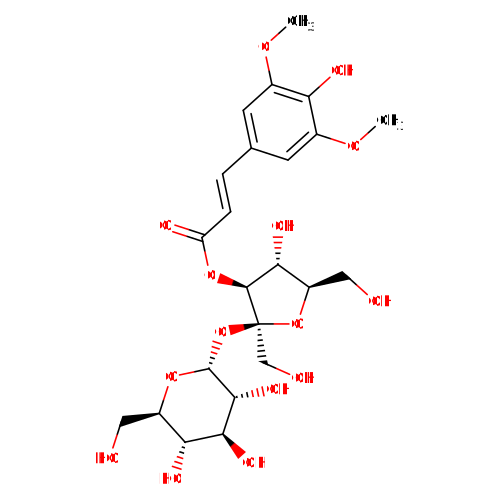
| Record Information |
|---|
| Version | 2.0 |
|---|
| Created at | 2022-04-28 23:49:09 UTC |
|---|
| Updated at | 2022-04-28 23:49:09 UTC |
|---|
| NP-MRD ID | NP0078748 |
|---|
| Secondary Accession Numbers | None |
|---|
| Natural Product Identification |
|---|
| Common Name | Sibiricose A6 |
|---|
| Description | Sibiricose A6 belongs to the class of organic compounds known as coumaric acids and derivatives. These are aromatic compounds containing Aromatic compounds containing a cinnamic acid moiety (or a derivative thereof) hydroxylated at the C2 (ortho-), C3 (meta-), or C4 (para-) carbon atom of the benzene ring. Sibiricose A6 is found in Polygala arillata, Polygala karensium, Polygala sibirica , Polygala tricornis and Raphanus sativus. Sibiricose A6 was first documented in 2004 (PMID: 15506285). Based on a literature review a significant number of articles have been published on Sibiricose A6 (PMID: 29017076) (PMID: 28342292) (PMID: 29261155) (PMID: 32956609) (PMID: 31354847) (PMID: 30340065). |
|---|
| Structure | COC1=CC(\C=C\C(=O)O[C@H]2[C@H](O)[C@@H](CO)O[C@@]2(CO)O[C@H]2O[C@H](CO)[C@@H](O)[C@H](O)[C@H]2O)=CC(OC)=C1O InChI=1S/C23H32O15/c1-33-11-5-10(6-12(34-2)16(11)28)3-4-15(27)36-21-18(30)14(8-25)37-23(21,9-26)38-22-20(32)19(31)17(29)13(7-24)35-22/h3-6,13-14,17-22,24-26,28-32H,7-9H2,1-2H3/b4-3+/t13-,14-,17-,18-,19+,20-,21+,22-,23+/m1/s1 |
|---|
| Synonyms | | Value | Source |
|---|
| 3'-Sinapoyl sucrose | MeSH | | 3'-Sinapoylsucrose | MeSH |
|
|---|
| Chemical Formula | C23H32O15 |
|---|
| Average Mass | 548.4940 Da |
|---|
| Monoisotopic Mass | 548.17412 Da |
|---|
| IUPAC Name | (2S,3S,4R,5R)-4-hydroxy-2,5-bis(hydroxymethyl)-2-{[(2R,3R,4S,5S,6R)-3,4,5-trihydroxy-6-(hydroxymethyl)oxan-2-yl]oxy}oxolan-3-yl (2E)-3-(4-hydroxy-3,5-dimethoxyphenyl)prop-2-enoate |
|---|
| Traditional Name | (2S,3S,4R,5R)-4-hydroxy-2,5-bis(hydroxymethyl)-2-{[(2R,3R,4S,5S,6R)-3,4,5-trihydroxy-6-(hydroxymethyl)oxan-2-yl]oxy}oxolan-3-yl (2E)-3-(4-hydroxy-3,5-dimethoxyphenyl)prop-2-enoate |
|---|
| CAS Registry Number | Not Available |
|---|
| SMILES | COC1=CC(\C=C\C(=O)O[C@H]2[C@H](O)[C@@H](CO)O[C@@]2(CO)O[C@H]2O[C@H](CO)[C@@H](O)[C@H](O)[C@H]2O)=CC(OC)=C1O |
|---|
| InChI Identifier | InChI=1S/C23H32O15/c1-33-11-5-10(6-12(34-2)16(11)28)3-4-15(27)36-21-18(30)14(8-25)37-23(21,9-26)38-22-20(32)19(31)17(29)13(7-24)35-22/h3-6,13-14,17-22,24-26,28-32H,7-9H2,1-2H3/b4-3+/t13-,14-,17-,18-,19+,20-,21+,22-,23+/m1/s1 |
|---|
| InChI Key | WTCVROXOIQEIRC-IBVGEFGBSA-N |
|---|
| Experimental Spectra |
|---|
|
| Not Available | | Predicted Spectra |
|---|
|
| | Spectrum Type | Description | Depositor ID | Depositor Organization | Depositor | Deposition Date | View |
|---|
| 1D NMR | 13C NMR Spectrum (1D, 25 MHz, D2O, predicted) | Wishart Lab | Wishart Lab | David Wishart | 2021-06-20 | View Spectrum | | 1D NMR | 1H NMR Spectrum (1D, 100 MHz, D2O, predicted) | Wishart Lab | Wishart Lab | David Wishart | 2021-06-20 | View Spectrum | | 1D NMR | 13C NMR Spectrum (1D, 252 MHz, D2O, predicted) | Wishart Lab | Wishart Lab | David Wishart | 2021-06-20 | View Spectrum | | 1D NMR | 1H NMR Spectrum (1D, 1000 MHz, D2O, predicted) | Wishart Lab | Wishart Lab | David Wishart | 2021-06-20 | View Spectrum | | 1D NMR | 13C NMR Spectrum (1D, 50 MHz, D2O, predicted) | Wishart Lab | Wishart Lab | David Wishart | 2021-06-20 | View Spectrum | | 1D NMR | 1H NMR Spectrum (1D, 200 MHz, D2O, predicted) | Wishart Lab | Wishart Lab | David Wishart | 2021-06-20 | View Spectrum | | 1D NMR | 13C NMR Spectrum (1D, 75 MHz, D2O, predicted) | Wishart Lab | Wishart Lab | David Wishart | 2021-06-20 | View Spectrum | | 1D NMR | 1H NMR Spectrum (1D, 300 MHz, D2O, predicted) | Wishart Lab | Wishart Lab | David Wishart | 2021-06-20 | View Spectrum | | 1D NMR | 13C NMR Spectrum (1D, 101 MHz, D2O, predicted) | Wishart Lab | Wishart Lab | David Wishart | 2021-06-20 | View Spectrum | | 1D NMR | 1H NMR Spectrum (1D, 400 MHz, D2O, predicted) | Wishart Lab | Wishart Lab | David Wishart | 2021-06-20 | View Spectrum | | 1D NMR | 13C NMR Spectrum (1D, 126 MHz, D2O, predicted) | Wishart Lab | Wishart Lab | David Wishart | 2021-06-20 | View Spectrum | | 1D NMR | 1H NMR Spectrum (1D, 500 MHz, D2O, predicted) | Wishart Lab | Wishart Lab | David Wishart | 2021-06-20 | View Spectrum | | 1D NMR | 13C NMR Spectrum (1D, 151 MHz, D2O, predicted) | Wishart Lab | Wishart Lab | David Wishart | 2021-06-20 | View Spectrum | | 1D NMR | 1H NMR Spectrum (1D, 600 MHz, D2O, predicted) | Wishart Lab | Wishart Lab | David Wishart | 2021-06-20 | View Spectrum | | 1D NMR | 13C NMR Spectrum (1D, 176 MHz, D2O, predicted) | Wishart Lab | Wishart Lab | David Wishart | 2021-06-20 | View Spectrum | | 1D NMR | 1H NMR Spectrum (1D, 700 MHz, D2O, predicted) | Wishart Lab | Wishart Lab | David Wishart | 2021-06-20 | View Spectrum | | 1D NMR | 13C NMR Spectrum (1D, 201 MHz, D2O, predicted) | Wishart Lab | Wishart Lab | David Wishart | 2021-06-20 | View Spectrum | | 1D NMR | 1H NMR Spectrum (1D, 800 MHz, D2O, predicted) | Wishart Lab | Wishart Lab | David Wishart | 2021-06-20 | View Spectrum | | 1D NMR | 13C NMR Spectrum (1D, 226 MHz, D2O, predicted) | Wishart Lab | Wishart Lab | David Wishart | 2021-06-20 | View Spectrum | | 1D NMR | 1H NMR Spectrum (1D, 900 MHz, D2O, predicted) | Wishart Lab | Wishart Lab | David Wishart | 2021-06-20 | View Spectrum |
| | Chemical Shift Submissions |
|---|
|
| Not Available | | Species |
|---|
| Species of Origin | |
|---|
| Chemical Taxonomy |
|---|
| Description | Belongs to the class of organic compounds known as coumaric acids and derivatives. These are aromatic compounds containing Aromatic compounds containing a cinnamic acid moiety (or a derivative thereof) hydroxylated at the C2 (ortho-), C3 (meta-), or C4 (para-) carbon atom of the benzene ring. |
|---|
| Kingdom | Organic compounds |
|---|
| Super Class | Phenylpropanoids and polyketides |
|---|
| Class | Cinnamic acids and derivatives |
|---|
| Sub Class | Hydroxycinnamic acids and derivatives |
|---|
| Direct Parent | Coumaric acids and derivatives |
|---|
| Alternative Parents | |
|---|
| Substituents | - Coumaric acid or derivatives
- Cinnamic acid ester
- C-glycosyl compound
- Disaccharide
- Glycosyl compound
- O-glycosyl compound
- Methoxyphenol
- M-dimethoxybenzene
- Dimethoxybenzene
- Anisole
- Phenoxy compound
- Phenol ether
- Styrene
- Methoxybenzene
- Ketal
- Fatty acid ester
- Alkyl aryl ether
- Phenol
- Monocyclic benzene moiety
- Fatty acyl
- Benzenoid
- Oxane
- Alpha,beta-unsaturated carboxylic ester
- Enoate ester
- Oxolane
- Carboxylic acid ester
- Secondary alcohol
- Carboxylic acid derivative
- Oxacycle
- Monocarboxylic acid or derivatives
- Acetal
- Ether
- Organoheterocyclic compound
- Polyol
- Primary alcohol
- Carbonyl group
- Alcohol
- Organic oxygen compound
- Organic oxide
- Hydrocarbon derivative
- Organooxygen compound
- Aromatic heteromonocyclic compound
|
|---|
| Molecular Framework | Aromatic heteromonocyclic compounds |
|---|
| External Descriptors | Not Available |
|---|
| Physical Properties |
|---|
| State | Not Available |
|---|
| Experimental Properties | | Property | Value | Reference |
|---|
| Melting Point | Not Available | Not Available | | Boiling Point | Not Available | Not Available | | Water Solubility | Not Available | Not Available | | LogP | Not Available | Not Available |
|
|---|
| Predicted Properties | |
|---|
| General References | - Yang C, Yin X, Dong X, Zhang X, You L, Wang W, Wang J, Chen Q, Ni J: Determination of the phytochemical composition of Jingning fang and the in vivo pharmacokinetics of its metabolites in rat plasma by UPLC-MS/MS. J Chromatogr B Analyt Technol Biomed Life Sci. 2017 Nov 1;1067:71-88. doi: 10.1016/j.jchromb.2017.09.019. Epub 2017 Sep 21. [PubMed:29017076 ]
- Wang X, Zhang Y, Niu H, Geng Y, Wang B, Yang X, Yan P, Li Q, Bi K: Ultra-fast liquid chromatography with tandem mass spectrometry determination of eight bioactive components of Kai-Xin-San in rat plasma and its application to a comparative pharmacokinetic study in normal and Alzheimer's disease rats. J Sep Sci. 2017 May;40(10):2131-2140. doi: 10.1002/jssc.201601343. Epub 2017 Apr 19. [PubMed:28342292 ]
- Xu R, Mao F, Zhao Y, Wang W, Fan L, Gao X, Zhao J, Tian H: UPLC Quantitative Analysis of Multi-Components by Single Marker and Quality Evaluation of Polygala tenuifolia Wild. Extracts. Molecules. 2017 Dec 20;22(12). pii: molecules22122276. doi: 10.3390/molecules22122276. [PubMed:29261155 ]
- Zhao X, Xu B, Wu P, Zhao P, Guo C, Cui Y, Zhang Y, Zhang X, Li H: UHPLC-MS/MS method for pharmacokinetic and bioavailability determination of five bioactive components in raw and various processed products of Polygala tenuifolia in rat plasma. Pharm Biol. 2020 Dec;58(1):969-978. doi: 10.1080/13880209.2020.1818790. [PubMed:32956609 ]
- Ba Y, Wang M, Zhang K, Chen Q, Wang J, Lv H, Jiang Y, Shi R: Intestinal Absorption Profile of Three Polygala Oligosaccharide Esters in Polygalae Radix and the Effects of Other Components in Polygalae Radix on Their Absorption. Evid Based Complement Alternat Med. 2019 Jul 2;2019:1379531. doi: 10.1155/2019/1379531. eCollection 2019. [PubMed:31354847 ]
- Xu B, Qu C, Zheng W, Xi Y, Zhao X, Li H, Liu J, Zhang X: UHPLC-MS/MS method for simultaneous determination of Radix Polygalae glycolipids and organic acids in rat plasma and application in a pharmacokinetic study. J Chromatogr B Analyt Technol Biomed Life Sci. 2018 Nov 15;1100-1101:165-173. doi: 10.1016/j.jchromb.2018.09.037. Epub 2018 Oct 2. [PubMed:30340065 ]
- Shi Q, Chen J, Zhou Q, Lei H, Luan L, Liu X, Wu Y: Indirect identification of antioxidants in Polygalae Radix through their reaction with 2,2-diphenyl-1-picrylhydrazyl and subsequent HPLC-ESI-Q-TOF-MS/MS. Talanta. 2015 Nov 1;144:830-5. doi: 10.1016/j.talanta.2015.07.032. Epub 2015 Jul 11. [PubMed:26452897 ]
- Tu HH, Liu P, Mu L, Liao HB, Xie TT, Ma LH, Liu YM: [Study on antidepressant components of sucrose ester from Polygala tenuifolia]. Zhongguo Zhong Yao Za Zhi. 2008 Jun;33(11):1278-80. [PubMed:18831206 ]
- Yong J, Tu PF: [Studies on the chemical constituents in root bark of Polygala tenuifolia (II)]. Zhongguo Zhong Yao Za Zhi. 2004 Aug;29(8):751-3. [PubMed:15506285 ]
|
|---|