| Record Information |
|---|
| Version | 2.0 |
|---|
| Created at | 2022-04-28 23:25:25 UTC |
|---|
| Updated at | 2022-04-28 23:25:26 UTC |
|---|
| NP-MRD ID | NP0078323 |
|---|
| Secondary Accession Numbers | None |
|---|
| Natural Product Identification |
|---|
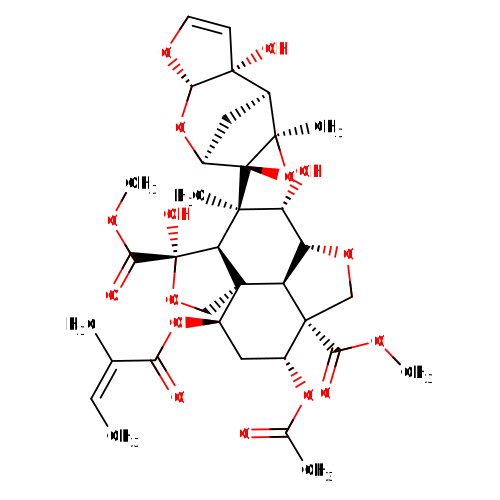
| Common Name | Azadirachtin B |
|---|
| Description | Azadirachtin B belongs to the class of organic compounds known as limonoids. These are highly oxygenated, modified terpenoids with a prototypical structure either containing or derived from a precursor with a 4,4,8-trimethyl-17-furanylsteroid skeleton. All naturally occurring citrus limonoids contain a furan ring attached to the D-ring, at C-17, as well as oxygen containing functional groups at C-3, C-4, C-7, C-16 and C-17. Azadirachtin B is found in Azadirachta indica and Zadirachta excelsa. Azadirachtin B was first documented in 2003 (PMID: 12822931). Based on a literature review a significant number of articles have been published on azadirachtin B (PMID: 16752388) (PMID: 16038546) (PMID: 29312880) (PMID: 27317644) (PMID: 19844073) (PMID: 17428489). |
|---|
| Structure | COC(=O)[C@@]1(O)OC[C@@]23[C@H]4[C@@H](OC[C@@]4([C@@H](C[C@H]2OC(=O)C(\C)=C\C)OC(C)=O)C(=O)OC)[C@@H](O)[C@](C)([C@H]13)[C@]12O[C@@]1(C)[C@H]1C[C@@H]2O[C@@H]2OC=C[C@]12O InChI=1S/C35H44O16/c1-8-15(2)24(38)49-18-12-19(48-16(3)36)32(26(39)43-6)13-46-21-22(32)31(18)14-47-34(42,27(40)44-7)25(31)29(4,23(21)37)35-20-11-17(30(35,5)51-35)33(41)9-10-45-28(33)50-20/h8-10,17-23,25,28,37,41-42H,11-14H2,1-7H3/b15-8+/t17-,18-,19-,20+,21-,22-,23-,25+,28+,29-,30+,31+,32+,33+,34+,35+/m1/s1 |
|---|
| Synonyms | Not Available |
|---|
| Chemical Formula | C35H44O16 |
|---|
| Average Mass | 720.7210 Da |
|---|
| Monoisotopic Mass | 720.26294 Da |
|---|
| IUPAC Name | 4,11-dimethyl (1S,4S,5R,6S,7S,8R,11S,12R,14R,15R)-12-(acetyloxy)-4,7-dihydroxy-6-[(1S,2S,6S,8S,9R,11S)-2-hydroxy-11-methyl-5,7,10-trioxatetracyclo[6.3.1.0^{2,6}.0^{9,11}]dodec-3-en-9-yl]-6-methyl-14-{[(2E)-2-methylbut-2-enoyl]oxy}-3,9-dioxatetracyclo[6.6.1.0^{1,5}.0^{11,15}]pentadecane-4,11-dicarboxylate |
|---|
| Traditional Name | 4,11-dimethyl (1S,4S,5R,6S,7S,8R,11S,12R,14R,15R)-12-(acetyloxy)-4,7-dihydroxy-6-[(1S,2S,6S,8S,9R,11S)-2-hydroxy-11-methyl-5,7,10-trioxatetracyclo[6.3.1.0^{2,6}.0^{9,11}]dodec-3-en-9-yl]-6-methyl-14-{[(2E)-2-methylbut-2-enoyl]oxy}-3,9-dioxatetracyclo[6.6.1.0^{1,5}.0^{11,15}]pentadecane-4,11-dicarboxylate |
|---|
| CAS Registry Number | Not Available |
|---|
| SMILES | COC(=O)[C@@]1(O)OC[C@@]23[C@H]4[C@@H](OC[C@@]4([C@@H](C[C@H]2OC(=O)C(\C)=C\C)OC(C)=O)C(=O)OC)[C@@H](O)[C@](C)([C@H]13)[C@]12O[C@@]1(C)[C@H]1C[C@@H]2O[C@@H]2OC=C[C@]12O |
|---|
| InChI Identifier | InChI=1S/C35H44O16/c1-8-15(2)24(38)49-18-12-19(48-16(3)36)32(26(39)43-6)13-46-21-22(32)31(18)14-47-34(42,27(40)44-7)25(31)29(4,23(21)37)35-20-11-17(30(35,5)51-35)33(41)9-10-45-28(33)50-20/h8-10,17-23,25,28,37,41-42H,11-14H2,1-7H3/b15-8+/t17-,18-,19-,20+,21-,22-,23-,25+,28+,29-,30+,31+,32+,33+,34+,35+/m1/s1 |
|---|
| InChI Key | FTNJWQUOZFUQQJ-UZTPERQESA-N |
|---|
| Experimental Spectra |
|---|
|
| Not Available | | Predicted Spectra |
|---|
|
| | Spectrum Type | Description | Depositor ID | Depositor Organization | Depositor | Deposition Date | View |
|---|
| 1D NMR | 13C NMR Spectrum (1D, 25 MHz, D2O, predicted) | Wishart Lab | Wishart Lab | David Wishart | 2021-06-20 | View Spectrum | | 1D NMR | 1H NMR Spectrum (1D, 100 MHz, D2O, predicted) | Wishart Lab | Wishart Lab | David Wishart | 2021-06-20 | View Spectrum | | 1D NMR | 13C NMR Spectrum (1D, 252 MHz, D2O, predicted) | Wishart Lab | Wishart Lab | David Wishart | 2021-06-20 | View Spectrum | | 1D NMR | 1H NMR Spectrum (1D, 1000 MHz, D2O, predicted) | Wishart Lab | Wishart Lab | David Wishart | 2021-06-20 | View Spectrum | | 1D NMR | 13C NMR Spectrum (1D, 50 MHz, D2O, predicted) | Wishart Lab | Wishart Lab | David Wishart | 2021-06-20 | View Spectrum | | 1D NMR | 1H NMR Spectrum (1D, 200 MHz, D2O, predicted) | Wishart Lab | Wishart Lab | David Wishart | 2021-06-20 | View Spectrum | | 1D NMR | 13C NMR Spectrum (1D, 75 MHz, D2O, predicted) | Wishart Lab | Wishart Lab | David Wishart | 2021-06-20 | View Spectrum | | 1D NMR | 1H NMR Spectrum (1D, 300 MHz, D2O, predicted) | Wishart Lab | Wishart Lab | David Wishart | 2021-06-20 | View Spectrum | | 1D NMR | 13C NMR Spectrum (1D, 101 MHz, D2O, predicted) | Wishart Lab | Wishart Lab | David Wishart | 2021-06-20 | View Spectrum | | 1D NMR | 1H NMR Spectrum (1D, 400 MHz, D2O, predicted) | Wishart Lab | Wishart Lab | David Wishart | 2021-06-20 | View Spectrum | | 1D NMR | 13C NMR Spectrum (1D, 126 MHz, D2O, predicted) | Wishart Lab | Wishart Lab | David Wishart | 2021-06-20 | View Spectrum | | 1D NMR | 1H NMR Spectrum (1D, 500 MHz, D2O, predicted) | Wishart Lab | Wishart Lab | David Wishart | 2021-06-20 | View Spectrum | | 1D NMR | 13C NMR Spectrum (1D, 151 MHz, D2O, predicted) | Wishart Lab | Wishart Lab | David Wishart | 2021-06-20 | View Spectrum | | 1D NMR | 1H NMR Spectrum (1D, 600 MHz, D2O, predicted) | Wishart Lab | Wishart Lab | David Wishart | 2021-06-20 | View Spectrum | | 1D NMR | 13C NMR Spectrum (1D, 176 MHz, D2O, predicted) | Wishart Lab | Wishart Lab | David Wishart | 2021-06-20 | View Spectrum | | 1D NMR | 1H NMR Spectrum (1D, 700 MHz, D2O, predicted) | Wishart Lab | Wishart Lab | David Wishart | 2021-06-20 | View Spectrum | | 1D NMR | 13C NMR Spectrum (1D, 201 MHz, D2O, predicted) | Wishart Lab | Wishart Lab | David Wishart | 2021-06-20 | View Spectrum | | 1D NMR | 1H NMR Spectrum (1D, 800 MHz, D2O, predicted) | Wishart Lab | Wishart Lab | David Wishart | 2021-06-20 | View Spectrum | | 1D NMR | 13C NMR Spectrum (1D, 226 MHz, D2O, predicted) | Wishart Lab | Wishart Lab | David Wishart | 2021-06-20 | View Spectrum | | 1D NMR | 1H NMR Spectrum (1D, 900 MHz, D2O, predicted) | Wishart Lab | Wishart Lab | David Wishart | 2021-06-20 | View Spectrum |
| | Chemical Shift Submissions |
|---|
|
| Not Available | | Species |
|---|
| Species of Origin | |
|---|
| Chemical Taxonomy |
|---|
| Description | Belongs to the class of organic compounds known as limonoids. These are highly oxygenated, modified terpenoids with a prototypical structure either containing or derived from a precursor with a 4,4,8-trimethyl-17-furanylsteroid skeleton. All naturally occurring citrus limonoids contain a furan ring attached to the D-ring, at C-17, as well as oxygen containing functional groups at C-3, C-4, C-7, C-16 and C-17. |
|---|
| Kingdom | Organic compounds |
|---|
| Super Class | Lipids and lipid-like molecules |
|---|
| Class | Prenol lipids |
|---|
| Sub Class | Triterpenoids |
|---|
| Direct Parent | Limonoids |
|---|
| Alternative Parents | |
|---|
| Substituents | - Limonoid skeleton
- Tetracarboxylic acid or derivatives
- Furopyran
- Fatty acid ester
- Oxepane
- Oxane
- Fatty acyl
- Pyran
- Cyclic alcohol
- Dihydrofuran
- Furan
- Alpha,beta-unsaturated carboxylic ester
- Tertiary alcohol
- Enoate ester
- Tetrahydrofuran
- Methyl ester
- Hemiacetal
- Carboxylic acid ester
- Secondary alcohol
- Dialkyl ether
- Acetal
- Carboxylic acid derivative
- Ether
- Oxirane
- Organoheterocyclic compound
- Oxacycle
- Organooxygen compound
- Alcohol
- Carbonyl group
- Organic oxygen compound
- Organic oxide
- Hydrocarbon derivative
- Aliphatic heteropolycyclic compound
|
|---|
| Molecular Framework | Aliphatic heteropolycyclic compounds |
|---|
| External Descriptors | |
|---|
| Physical Properties |
|---|
| State | Not Available |
|---|
| Experimental Properties | | Property | Value | Reference |
|---|
| Melting Point | Not Available | Not Available | | Boiling Point | Not Available | Not Available | | Water Solubility | Not Available | Not Available | | LogP | Not Available | Not Available |
|
|---|
| Predicted Properties | |
|---|
| General References | - Thoeming G, Draeger G, Poehling HM: Soil application of azadirachtin and 3-tigloyl-azadirachtol to control western flower thrips, Frankliniella occidentalis (Thysanoptera: Thripidae): translocation and persistence in bean plants. Pest Manag Sci. 2006 Aug;62(8):759-67. doi: 10.1002/ps.1239. [PubMed:16752388 ]
- Kanokmedhakul S, Kanokmedhakul K, Prajuabsuk T, Panichajakul S, Panyamee P, Prabpai S, Kongsaeree P: Azadirachtin derivatives from seed kernels of Azadirachta excelsa. J Nat Prod. 2005 Jul;68(7):1047-50. doi: 10.1021/np050064t. [PubMed:16038546 ]
- Sengupta P, Raman S, Chowdhury R, Lohitesh K, Saini H, Mukherjee S, Paul A: Evaluation of Apoptosis and Autophagy Inducing Potential of Berberis aristata, Azadirachta indica, and Their Synergistic Combinations in Parental and Resistant Human Osteosarcoma Cells. Front Oncol. 2017 Dec 11;7:296. doi: 10.3389/fonc.2017.00296. eCollection 2017. [PubMed:29312880 ]
- Kushwaha P, Khedgikar V, Haldar S, Gautam J, Mulani FA, Thulasiram HV, Trivedi R: Azadirachta indica triterpenoids promote osteoblast differentiation and mineralization in vitro and in vivo. Bioorg Med Chem Lett. 2016 Aug 1;26(15):3719-24. doi: 10.1016/j.bmcl.2016.05.076. Epub 2016 May 27. [PubMed:27317644 ]
- Akihisa T, Noto T, Takahashi A, Fujita Y, Banno N, Tokuda H, Koike K, Suzuki T, Yasukawa K, Kimura Y: Melanogenesis inhibitory, anti-inflammatory, and chemopreventive effects of limonoids from the seeds of Azadirachta indicia A. Juss. (neem). J Oleo Sci. 2009;58(11):581-94. doi: 10.5650/jos.58.581. [PubMed:19844073 ]
- Silva JC, Jham GN, Oliveira RD, Brown L: Purification of the seven tetranortriterpenoids in neem (Azadirachta indica) seed by counter-current chromatography sequentially followed by isocratic preparative reversed-phase high-performance liquid chromatography. J Chromatogr A. 2007 Jun 1;1151(1-2):203-10. doi: 10.1016/j.chroma.2007.03.086. Epub 2007 Mar 30. [PubMed:17428489 ]
- Caboni P, Sarais G, Angioni A, Garcia AJ, Lai F, Dedola F, Cabras P: Residues and persistence of neem formulations on strawberry after field treatment. J Agric Food Chem. 2006 Dec 27;54(26):10026-32. doi: 10.1021/jf062461v. [PubMed:17177537 ]
- Thompson DG, Chartrand DT, Kreutzweiser DP: Fate and effects of azadirachtin in aquatic mesocosms--1: fate in water and bottom sediments. Ecotoxicol Environ Saf. 2004 Oct;59(2):186-93. doi: 10.1016/j.ecoenv.2003.09.007. [PubMed:15327874 ]
- Sharma V, Walia S, Kumar J, Nair MG, Parmar BS: An efficient method for the purification and characterization of nematicidal azadirachtins A, B, and H, using MPLC and ESIMS. J Agric Food Chem. 2003 Jul 2;51(14):3966-72. doi: 10.1021/jf0342167. [PubMed:12822931 ]
|
|---|