| Record Information |
|---|
| Version | 2.0 |
|---|
| Created at | 2022-04-28 20:14:07 UTC |
|---|
| Updated at | 2022-04-28 20:14:08 UTC |
|---|
| NP-MRD ID | NP0074936 |
|---|
| Secondary Accession Numbers | None |
|---|
| Natural Product Identification |
|---|
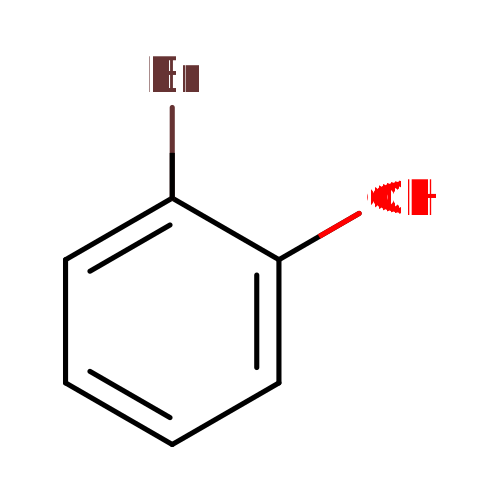
| Common Name | 2-Bromophenol |
|---|
| Description | 2-Bromophenol belongs to the class of organic compounds known as o-bromophenols. These are bromophenols carrying a iodine at the C2 position of the benzene ring. 2-Bromophenol is an extremely weak basic (essentially neutral) compound (based on its pKa). Monobromrophenols have three isomers because there is only one bromine atom that can occupy one of three ring positions on the phenol molecule; 2-bromophenol, for example, is the isomer that has a bromine atom in the ortho position. There are five basic types of bromophenols (mono- to pentabromophenol) and 19 different bromophenols in total when positional isomerism is taken into account. Bromophenols are produced by electrophilic halogenation of phenol with bromine. Pentabromophenol, by contrast, has only one isomer because all five available ring positions on the phenol are fully chlorinated. A bromophenol is any organobromide of phenol that contains one or more covalently bonded bromine atoms. 2-Bromophenol is found in Polysiphonia sphaerocarpa and Ulva lactuca. 2-Bromophenol was first documented in 2009 (PMID: 19488620). There is a total of 19 bromophenols, corresponding to the different ways in which bromine atoms can be attached to the five carbon atoms in the benzene ring of the phenol molecule, excluding the carbon atom to which the hydroxy group is attached (PMID: 23369690) (PMID: 23325557) (PMID: 23377268) (PMID: 23364683). |
|---|
| Structure | InChI=1S/C6H5BrO/c7-5-3-1-2-4-6(5)8/h1-4,8H |
|---|
| Synonyms | | Value | Source |
|---|
| O-Bromophenol | Kegg | | 2-Bromfenol | HMDB | | 2-Bromo-phenol | HMDB | | Bromo-phenol | HMDB | | Bromophenol | HMDB | | O-Bromo-phenol | HMDB | | Ortho-bromophenol | HMDB |
|
|---|
| Chemical Formula | C6H5BrO |
|---|
| Average Mass | 173.0070 Da |
|---|
| Monoisotopic Mass | 171.95238 Da |
|---|
| IUPAC Name | 2-bromophenol |
|---|
| Traditional Name | bromophenol |
|---|
| CAS Registry Number | Not Available |
|---|
| SMILES | OC1=CC=CC=C1Br |
|---|
| InChI Identifier | InChI=1S/C6H5BrO/c7-5-3-1-2-4-6(5)8/h1-4,8H |
|---|
| InChI Key | VADKRMSMGWJZCF-UHFFFAOYSA-N |
|---|
| Experimental Spectra |
|---|
|
| Not Available | | Predicted Spectra |
|---|
|
| | Spectrum Type | Description | Depositor ID | Depositor Organization | Depositor | Deposition Date | View |
|---|
| 1D NMR | 13C NMR Spectrum (1D, 25 MHz, D2O, predicted) | Wishart Lab | Wishart Lab | David Wishart | 2021-06-20 | View Spectrum | | 1D NMR | 1H NMR Spectrum (1D, 100 MHz, D2O, predicted) | Wishart Lab | Wishart Lab | David Wishart | 2021-06-20 | View Spectrum | | 1D NMR | 13C NMR Spectrum (1D, 252 MHz, D2O, predicted) | Wishart Lab | Wishart Lab | David Wishart | 2021-06-20 | View Spectrum | | 1D NMR | 1H NMR Spectrum (1D, 1000 MHz, D2O, predicted) | Wishart Lab | Wishart Lab | David Wishart | 2021-06-20 | View Spectrum | | 1D NMR | 13C NMR Spectrum (1D, 50 MHz, D2O, predicted) | Wishart Lab | Wishart Lab | David Wishart | 2021-06-20 | View Spectrum | | 1D NMR | 1H NMR Spectrum (1D, 200 MHz, D2O, predicted) | Wishart Lab | Wishart Lab | David Wishart | 2021-06-20 | View Spectrum | | 1D NMR | 13C NMR Spectrum (1D, 75 MHz, D2O, predicted) | Wishart Lab | Wishart Lab | David Wishart | 2021-06-20 | View Spectrum | | 1D NMR | 1H NMR Spectrum (1D, 300 MHz, D2O, predicted) | Wishart Lab | Wishart Lab | David Wishart | 2021-06-20 | View Spectrum | | 1D NMR | 13C NMR Spectrum (1D, 101 MHz, D2O, predicted) | Wishart Lab | Wishart Lab | David Wishart | 2021-06-20 | View Spectrum | | 1D NMR | 1H NMR Spectrum (1D, 400 MHz, D2O, predicted) | Wishart Lab | Wishart Lab | David Wishart | 2021-06-20 | View Spectrum | | 1D NMR | 13C NMR Spectrum (1D, 126 MHz, D2O, predicted) | Wishart Lab | Wishart Lab | David Wishart | 2021-06-20 | View Spectrum | | 1D NMR | 1H NMR Spectrum (1D, 500 MHz, D2O, predicted) | Wishart Lab | Wishart Lab | David Wishart | 2021-06-20 | View Spectrum | | 1D NMR | 13C NMR Spectrum (1D, 151 MHz, D2O, predicted) | Wishart Lab | Wishart Lab | David Wishart | 2021-06-20 | View Spectrum | | 1D NMR | 1H NMR Spectrum (1D, 600 MHz, D2O, predicted) | Wishart Lab | Wishart Lab | David Wishart | 2021-06-20 | View Spectrum | | 1D NMR | 13C NMR Spectrum (1D, 176 MHz, D2O, predicted) | Wishart Lab | Wishart Lab | David Wishart | 2021-06-20 | View Spectrum | | 1D NMR | 1H NMR Spectrum (1D, 700 MHz, D2O, predicted) | Wishart Lab | Wishart Lab | David Wishart | 2021-06-20 | View Spectrum | | 1D NMR | 13C NMR Spectrum (1D, 201 MHz, D2O, predicted) | Wishart Lab | Wishart Lab | David Wishart | 2021-06-20 | View Spectrum | | 1D NMR | 1H NMR Spectrum (1D, 800 MHz, D2O, predicted) | Wishart Lab | Wishart Lab | David Wishart | 2021-06-20 | View Spectrum | | 1D NMR | 13C NMR Spectrum (1D, 226 MHz, D2O, predicted) | Wishart Lab | Wishart Lab | David Wishart | 2021-06-20 | View Spectrum | | 1D NMR | 1H NMR Spectrum (1D, 900 MHz, D2O, predicted) | Wishart Lab | Wishart Lab | David Wishart | 2021-06-20 | View Spectrum |
| | Chemical Shift Submissions |
|---|
|
| Not Available | | Species |
|---|
| Species of Origin | | Species Name | Source | Reference |
|---|
| Polysiphonia sphaerocarpa | -- | | | Ulva lactuca | LOTUS Database | |
|
|---|
| Chemical Taxonomy |
|---|
| Description | Belongs to the class of organic compounds known as o-bromophenols. These are bromophenols carrying a iodine at the C2 position of the benzene ring. |
|---|
| Kingdom | Organic compounds |
|---|
| Super Class | Benzenoids |
|---|
| Class | Phenols |
|---|
| Sub Class | Halophenols |
|---|
| Direct Parent | O-bromophenols |
|---|
| Alternative Parents | |
|---|
| Substituents | - 2-bromophenol
- 1-hydroxy-4-unsubstituted benzenoid
- 1-hydroxy-2-unsubstituted benzenoid
- Halobenzene
- Bromobenzene
- Monocyclic benzene moiety
- Aryl halide
- Aryl bromide
- Organic oxygen compound
- Hydrocarbon derivative
- Organooxygen compound
- Organobromide
- Organohalogen compound
- Aromatic homomonocyclic compound
|
|---|
| Molecular Framework | Aromatic homomonocyclic compounds |
|---|
| External Descriptors | Not Available |
|---|
| Physical Properties |
|---|
| State | Not Available |
|---|
| Experimental Properties | | Property | Value | Reference |
|---|
| Melting Point | Not Available | Not Available | | Boiling Point | Not Available | Not Available | | Water Solubility | Not Available | Not Available | | LogP | Not Available | Not Available |
|
|---|
| Predicted Properties | |
|---|
| General References | - Oliveira AS, Silva VM, Veloso MC, Santos GV, Andrade JB: Bromophenol concentrations in fish from Salvador, BA, Brazil. An Acad Bras Cienc. 2009 Jun;81(2):165-72. [PubMed:19488620 ]
- Forootanfar H, Moezzi A, Aghaie-Khozani M, Mahmoudjanlou Y, Ameri A, Niknejad F, Faramarzi MA: Synthetic dye decolorization by three sources of fungal laccase. Iranian J Environ Health Sci Eng. 2012 Dec 15;9(1):27. doi: 10.1186/1735-2746-9-27. [PubMed:23369690 ]
- de Serrano V, Franzen S: Structural evidence for stabilization of inhibitor binding by a protein cavity in the dehaloperoxidase-hemoglobin from Amphitrite ornata. Biopolymers. 2012;98(1):27-35. doi: 10.1002/bip.21674. Epub 2011 May 17. [PubMed:23325557 ]
- Martinez NS, Machado JM, Perez-Saad H, Coro-Antich RM, Berlanga-Acosta JA, Salgueiro SR, Illera GG, Alba JS, del Barco DG: Global brain ischemia in Mongolian gerbils: assessing the level of anastomosis in the cerebral circle of Willis. Acta Neurobiol Exp (Wars). 2012;72(4):377-84. [PubMed:23377268 ]
- Shi D, Guo S, Jiang B, Guo C, Wang T, Zhang L, Li J: HPN, a synthetic analogue of bromophenol from red alga Rhodomela confervoides: synthesis and anti-diabetic effects in C57BL/KsJ-db/db mice. Mar Drugs. 2013 Jan 30;11(2):350-62. doi: 10.3390/md11020350. [PubMed:23364683 ]
|
|---|