| Record Information |
|---|
| Version | 2.0 |
|---|
| Created at | 2022-04-28 19:42:53 UTC |
|---|
| Updated at | 2022-04-28 19:42:54 UTC |
|---|
| NP-MRD ID | NP0074460 |
|---|
| Secondary Accession Numbers | None |
|---|
| Natural Product Identification |
|---|
| Common Name | Lauric acid, methyl ester |
|---|
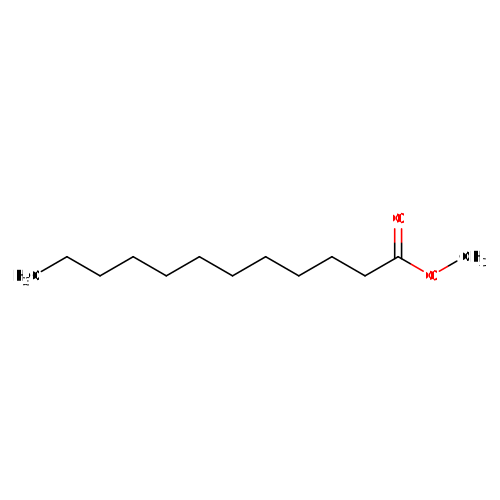
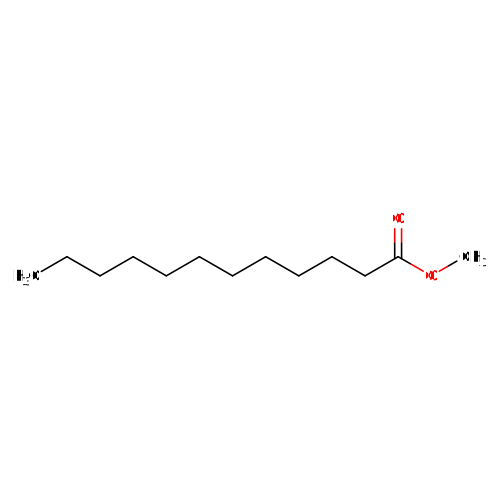
| Description | Methyl dodecanoate, also known as methyl laurinate or laate methyl ester, belongs to the class of organic compounds known as fatty acid methyl esters. Fatty acid methyl esters are compounds containing a fatty acid that is esterified with a methyl group. They have the general structure RC(=O)OR', where R=fatty aliphatic tail or organyl group and R'=methyl group. Methyl dodecanoate is a very hydrophobic molecule, practically insoluble (in water), and relatively neutral. Methyl dodecanoate is a coconut, creamy, and fat tasting compound. Outside of the human body, Methyl dodecanoate has been detected, but not quantified in, several different foods, such as fats and oils, milk and milk products, pomes, alcoholic beverages, and fruits. This could make methyl dodecanoate a potential biomarker for the consumption of these foods. Methyl dodecanoate is a potentially toxic compound. Lauric acid, methyl ester is found in Acyrthosiphon pisum, Astragalus membranaceus, Brassica juncea, Capsicum frutescens , Citrus iyo, Houttuynia cordata, Mandragora autumnalis , Pinus sibirica, Pueraria montana and Vitis labrusca . Lauric acid, methyl ester was first documented in 2015 (PMID: 25964351). Found in concord grape (Vitis labrusca), melon, pineapple, heated blackberry, red chilli (Capsicum frutescens) and other fruitsand is also present in cheeses, hop oil, white wine, spirits and other foodstuffs. |
|---|
| Structure | InChI=1S/C13H26O2/c1-3-4-5-6-7-8-9-10-11-12-13(14)15-2/h3-12H2,1-2H3 |
|---|
| Synonyms | | Value | Source |
|---|
| Lauric acid methyl ester | ChEBI | | Methyl dodecylate | ChEBI | | Methyl laurinate | ChEBI | | Methyl N-dodecanoate | ChEBI | | Laate methyl ester | Generator | | Laic acid methyl ester | Generator | | Methyl dodecylic acid | Generator | | Methyl laurinic acid | Generator | | Methyl N-dodecanoic acid | Generator | | Methyl dodecanoic acid | Generator | | Dodecanoic acid, methyl ester | HMDB | | FEMA 2715 | HMDB | | Lauric acid, methyl ester | HMDB | | Metholene 2296 | HMDB | | METHYL dodecanoATE, 99.8% | HMDB | | Methyl laurate | HMDB | | Stepan C40 | HMDB | | Uniphat a40 | HMDB | | Uniphat a40 in 511 | HMDB | | Lauric acid methyl ester, C14-labeled | MeSH |
|
|---|
| Chemical Formula | C13H26O2 |
|---|
| Average Mass | 214.3443 Da |
|---|
| Monoisotopic Mass | 214.19328 Da |
|---|
| IUPAC Name | methyl dodecanoate |
|---|
| Traditional Name | methyl laurate |
|---|
| CAS Registry Number | Not Available |
|---|
| SMILES | CCCCCCCCCCCC(=O)OC |
|---|
| InChI Identifier | InChI=1S/C13H26O2/c1-3-4-5-6-7-8-9-10-11-12-13(14)15-2/h3-12H2,1-2H3 |
|---|
| InChI Key | UQDUPQYQJKYHQI-UHFFFAOYSA-N |
|---|
| Experimental Spectra |
|---|
|
| Not Available | | Predicted Spectra |
|---|
|
| | Spectrum Type | Description | Depositor ID | Depositor Organization | Depositor | Deposition Date | View |
|---|
| 1D NMR | 13C NMR Spectrum (1D, 25 MHz, D2O, predicted) | Wishart Lab | Wishart Lab | David Wishart | 2021-06-20 | View Spectrum | | 1D NMR | 1H NMR Spectrum (1D, 100 MHz, D2O, predicted) | Wishart Lab | Wishart Lab | David Wishart | 2021-06-20 | View Spectrum | | 1D NMR | 13C NMR Spectrum (1D, 252 MHz, D2O, predicted) | Wishart Lab | Wishart Lab | David Wishart | 2021-06-20 | View Spectrum | | 1D NMR | 1H NMR Spectrum (1D, 1000 MHz, D2O, predicted) | Wishart Lab | Wishart Lab | David Wishart | 2021-06-20 | View Spectrum | | 1D NMR | 13C NMR Spectrum (1D, 50 MHz, D2O, predicted) | Wishart Lab | Wishart Lab | David Wishart | 2021-06-20 | View Spectrum | | 1D NMR | 1H NMR Spectrum (1D, 200 MHz, D2O, predicted) | Wishart Lab | Wishart Lab | David Wishart | 2021-06-20 | View Spectrum | | 1D NMR | 13C NMR Spectrum (1D, 75 MHz, D2O, predicted) | Wishart Lab | Wishart Lab | David Wishart | 2021-06-20 | View Spectrum | | 1D NMR | 1H NMR Spectrum (1D, 300 MHz, D2O, predicted) | Wishart Lab | Wishart Lab | David Wishart | 2021-06-20 | View Spectrum | | 1D NMR | 13C NMR Spectrum (1D, 101 MHz, D2O, predicted) | Wishart Lab | Wishart Lab | David Wishart | 2021-06-20 | View Spectrum | | 1D NMR | 1H NMR Spectrum (1D, 400 MHz, D2O, predicted) | Wishart Lab | Wishart Lab | David Wishart | 2021-06-20 | View Spectrum | | 1D NMR | 13C NMR Spectrum (1D, 126 MHz, D2O, predicted) | Wishart Lab | Wishart Lab | David Wishart | 2021-06-20 | View Spectrum | | 1D NMR | 1H NMR Spectrum (1D, 500 MHz, D2O, predicted) | Wishart Lab | Wishart Lab | David Wishart | 2021-06-20 | View Spectrum | | 1D NMR | 13C NMR Spectrum (1D, 151 MHz, D2O, predicted) | Wishart Lab | Wishart Lab | David Wishart | 2021-06-20 | View Spectrum | | 1D NMR | 1H NMR Spectrum (1D, 600 MHz, D2O, predicted) | Wishart Lab | Wishart Lab | David Wishart | 2021-06-20 | View Spectrum | | 1D NMR | 13C NMR Spectrum (1D, 176 MHz, D2O, predicted) | Wishart Lab | Wishart Lab | David Wishart | 2021-06-20 | View Spectrum | | 1D NMR | 1H NMR Spectrum (1D, 700 MHz, D2O, predicted) | Wishart Lab | Wishart Lab | David Wishart | 2021-06-20 | View Spectrum | | 1D NMR | 13C NMR Spectrum (1D, 201 MHz, D2O, predicted) | Wishart Lab | Wishart Lab | David Wishart | 2021-06-20 | View Spectrum | | 1D NMR | 1H NMR Spectrum (1D, 800 MHz, D2O, predicted) | Wishart Lab | Wishart Lab | David Wishart | 2021-06-20 | View Spectrum | | 1D NMR | 13C NMR Spectrum (1D, 226 MHz, D2O, predicted) | Wishart Lab | Wishart Lab | David Wishart | 2021-06-20 | View Spectrum | | 1D NMR | 1H NMR Spectrum (1D, 900 MHz, D2O, predicted) | Wishart Lab | Wishart Lab | David Wishart | 2021-06-20 | View Spectrum |
| | Chemical Shift Submissions |
|---|
|
| Not Available | | Species |
|---|
| Species of Origin | |
|---|
| Chemical Taxonomy |
|---|
| Description | Belongs to the class of organic compounds known as fatty acid methyl esters. Fatty acid methyl esters are compounds containing a fatty acid that is esterified with a methyl group. They have the general structure RC(=O)OR', where R=fatty aliphatic tail or organyl group and R'=methyl group. |
|---|
| Kingdom | Organic compounds |
|---|
| Super Class | Lipids and lipid-like molecules |
|---|
| Class | Fatty Acyls |
|---|
| Sub Class | Fatty acid esters |
|---|
| Direct Parent | Fatty acid methyl esters |
|---|
| Alternative Parents | |
|---|
| Substituents | - Fatty acid methyl ester
- Methyl ester
- Carboxylic acid ester
- Monocarboxylic acid or derivatives
- Carboxylic acid derivative
- Organic oxygen compound
- Organic oxide
- Hydrocarbon derivative
- Organooxygen compound
- Carbonyl group
- Aliphatic acyclic compound
|
|---|
| Molecular Framework | Aliphatic acyclic compounds |
|---|
| External Descriptors | |
|---|
| Physical Properties |
|---|
| State | Not Available |
|---|
| Experimental Properties | | Property | Value | Reference |
|---|
| Melting Point | Not Available | Not Available | | Boiling Point | Not Available | Not Available | | Water Solubility | Not Available | Not Available | | LogP | Not Available | Not Available |
|
|---|
| Predicted Properties | |
|---|