| Record Information |
|---|
| Version | 2.0 |
|---|
| Created at | 2022-04-28 18:56:02 UTC |
|---|
| Updated at | 2022-04-28 18:56:02 UTC |
|---|
| NP-MRD ID | NP0073711 |
|---|
| Secondary Accession Numbers | None |
|---|
| Natural Product Identification |
|---|
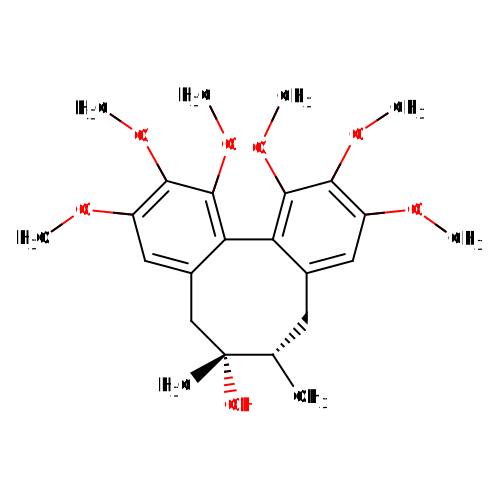
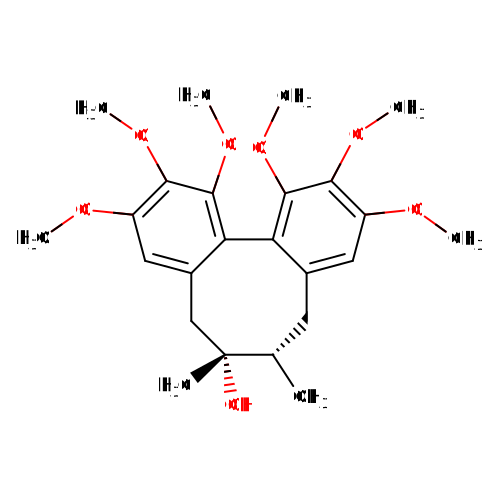
| Common Name | (+)-Schizandrin |
|---|
| Description | Schisandrin, also known as schizandrol a or wuweizisu a, belongs to the class of organic compounds known as hydrolyzable tannins. These are tannins with a structure characterized by either of the following models. In model 1, the structure contains galloyl units (in some cases, shikimic acid units) that are linked to diverse polyol carbohydrate-, catechin-, or triterpenoid units. In model 2, contains at least two galloyl units C-C coupled to each other, and do not contain a glycosidically linked catechin unit. (+)-Schizandrin is found in Incarvillea mairei, Kadsura angustifolia, Kadsura interior, Schisandra chinensis , Schisandra henryi, Schisandra lancifolia, Schisandra rubriflora, Schisandra sphenanthera and Trigonella foenum-graecum . (+)-Schizandrin was first documented in 2022 (PMID: 35408515). Based on a literature review a small amount of articles have been published on Schisandrin (PMID: 35419003) (PMID: 35405150) (PMID: 35384105) (PMID: 35367116). |
|---|
| Structure | COC1=CC2=C(C(OC)=C1OC)C1=C(C[C@](C)(O)[C@@H](C)C2)C=C(OC)C(OC)=C1OC InChI=1S/C24H32O7/c1-13-9-14-10-16(26-3)20(28-5)22(30-7)18(14)19-15(12-24(13,2)25)11-17(27-4)21(29-6)23(19)31-8/h10-11,13,25H,9,12H2,1-8H3/t13-,24-/m0/s1 |
|---|
| Synonyms | | Value | Source |
|---|
| Schizandrin | MeSH | | Schizandrol a | MeSH | | Wuweizisu a | MeSH |
|
|---|
| Chemical Formula | C24H32O7 |
|---|
| Average Mass | 432.5130 Da |
|---|
| Monoisotopic Mass | 432.21480 Da |
|---|
| IUPAC Name | (9S,10S)-3,4,5,14,15,16-hexamethoxy-9,10-dimethyltricyclo[10.4.0.0^{2,7}]hexadeca-1(12),2(7),3,5,13,15-hexaen-9-ol |
|---|
| Traditional Name | (9S,10S)-3,4,5,14,15,16-hexamethoxy-9,10-dimethyltricyclo[10.4.0.0^{2,7}]hexadeca-1(12),2(7),3,5,13,15-hexaen-9-ol |
|---|
| CAS Registry Number | Not Available |
|---|
| SMILES | COC1=CC2=C(C(OC)=C1OC)C1=C(C[C@](C)(O)[C@@H](C)C2)C=C(OC)C(OC)=C1OC |
|---|
| InChI Identifier | InChI=1S/C24H32O7/c1-13-9-14-10-16(26-3)20(28-5)22(30-7)18(14)19-15(12-24(13,2)25)11-17(27-4)21(29-6)23(19)31-8/h10-11,13,25H,9,12H2,1-8H3/t13-,24-/m0/s1 |
|---|
| InChI Key | YEFOAORQXAOVJQ-RZFZLAGVSA-N |
|---|
| Experimental Spectra |
|---|
|
| Not Available | | Predicted Spectra |
|---|
|
| | Spectrum Type | Description | Depositor ID | Depositor Organization | Depositor | Deposition Date | View |
|---|
| 1D NMR | 13C NMR Spectrum (1D, 25 MHz, D2O, predicted) | Wishart Lab | Wishart Lab | David Wishart | 2021-06-20 | View Spectrum | | 1D NMR | 1H NMR Spectrum (1D, 100 MHz, D2O, predicted) | Wishart Lab | Wishart Lab | David Wishart | 2021-06-20 | View Spectrum | | 1D NMR | 13C NMR Spectrum (1D, 252 MHz, D2O, predicted) | Wishart Lab | Wishart Lab | David Wishart | 2021-06-20 | View Spectrum | | 1D NMR | 1H NMR Spectrum (1D, 1000 MHz, D2O, predicted) | Wishart Lab | Wishart Lab | David Wishart | 2021-06-20 | View Spectrum | | 1D NMR | 13C NMR Spectrum (1D, 50 MHz, D2O, predicted) | Wishart Lab | Wishart Lab | David Wishart | 2021-06-20 | View Spectrum | | 1D NMR | 1H NMR Spectrum (1D, 200 MHz, D2O, predicted) | Wishart Lab | Wishart Lab | David Wishart | 2021-06-20 | View Spectrum | | 1D NMR | 13C NMR Spectrum (1D, 75 MHz, D2O, predicted) | Wishart Lab | Wishart Lab | David Wishart | 2021-06-20 | View Spectrum | | 1D NMR | 1H NMR Spectrum (1D, 300 MHz, D2O, predicted) | Wishart Lab | Wishart Lab | David Wishart | 2021-06-20 | View Spectrum | | 1D NMR | 13C NMR Spectrum (1D, 101 MHz, D2O, predicted) | Wishart Lab | Wishart Lab | David Wishart | 2021-06-20 | View Spectrum | | 1D NMR | 1H NMR Spectrum (1D, 400 MHz, D2O, predicted) | Wishart Lab | Wishart Lab | David Wishart | 2021-06-20 | View Spectrum | | 1D NMR | 13C NMR Spectrum (1D, 126 MHz, D2O, predicted) | Wishart Lab | Wishart Lab | David Wishart | 2021-06-20 | View Spectrum | | 1D NMR | 1H NMR Spectrum (1D, 500 MHz, D2O, predicted) | Wishart Lab | Wishart Lab | David Wishart | 2021-06-20 | View Spectrum | | 1D NMR | 13C NMR Spectrum (1D, 151 MHz, D2O, predicted) | Wishart Lab | Wishart Lab | David Wishart | 2021-06-20 | View Spectrum | | 1D NMR | 1H NMR Spectrum (1D, 600 MHz, D2O, predicted) | Wishart Lab | Wishart Lab | David Wishart | 2021-06-20 | View Spectrum | | 1D NMR | 13C NMR Spectrum (1D, 176 MHz, D2O, predicted) | Wishart Lab | Wishart Lab | David Wishart | 2021-06-20 | View Spectrum | | 1D NMR | 1H NMR Spectrum (1D, 700 MHz, D2O, predicted) | Wishart Lab | Wishart Lab | David Wishart | 2021-06-20 | View Spectrum | | 1D NMR | 13C NMR Spectrum (1D, 201 MHz, D2O, predicted) | Wishart Lab | Wishart Lab | David Wishart | 2021-06-20 | View Spectrum | | 1D NMR | 1H NMR Spectrum (1D, 800 MHz, D2O, predicted) | Wishart Lab | Wishart Lab | David Wishart | 2021-06-20 | View Spectrum | | 1D NMR | 13C NMR Spectrum (1D, 226 MHz, D2O, predicted) | Wishart Lab | Wishart Lab | David Wishart | 2021-06-20 | View Spectrum | | 1D NMR | 1H NMR Spectrum (1D, 900 MHz, D2O, predicted) | Wishart Lab | Wishart Lab | David Wishart | 2021-06-20 | View Spectrum |
| | Chemical Shift Submissions |
|---|
|
| Not Available | | Species |
|---|
| Species of Origin | |
|---|
| Chemical Taxonomy |
|---|
| Description | Belongs to the class of organic compounds known as hydrolyzable tannins. These are tannins with a structure characterized by either of the following models. In model 1, the structure contains galloyl units (in some cases, shikimic acid units) that are linked to diverse polyol carbohydrate-, catechin-, or triterpenoid units. In model 2, contains at least two galloyl units C-C coupled to each other, and do not contain a glycosidically linked catechin unit. |
|---|
| Kingdom | Organic compounds |
|---|
| Super Class | Phenylpropanoids and polyketides |
|---|
| Class | Tannins |
|---|
| Sub Class | Hydrolyzable tannins |
|---|
| Direct Parent | Hydrolyzable tannins |
|---|
| Alternative Parents | |
|---|
| Substituents | - Hydrolyzable tannin
- Dibenzocyclooctane lignan
- Anisole
- Alkyl aryl ether
- Benzenoid
- Tertiary alcohol
- Ether
- Organic oxygen compound
- Hydrocarbon derivative
- Organooxygen compound
- Alcohol
- Aromatic homopolycyclic compound
|
|---|
| Molecular Framework | Aromatic homopolycyclic compounds |
|---|
| External Descriptors | Not Available |
|---|
| Physical Properties |
|---|
| State | Not Available |
|---|
| Experimental Properties | | Property | Value | Reference |
|---|
| Melting Point | Not Available | Not Available | | Boiling Point | Not Available | Not Available | | Water Solubility | Not Available | Not Available | | LogP | Not Available | Not Available |
|
|---|
| Predicted Properties | |
|---|
| General References | - Sobstyl E, Szopa A, Dziurka M, Ekiert H, Nikolaichuk H, Choma IM: Schisandra rubriflora Fruit and Leaves as Promising New Materials of High Biological Potential: Lignan Profiling and Effect-Directed Analysis. Molecules. 2022 Mar 25;27(7). pii: molecules27072116. doi: 10.3390/molecules27072116. [PubMed:35408515 ]
- Tan S, Zheng Z, Liu T, Yao X, Yu M, Ji Y: Schisandrin B Induced ROS-Mediated Autophagy and Th1/Th2 Imbalance via Selenoproteins in Hepa1-6 Cells. Front Immunol. 2022 Mar 28;13:857069. doi: 10.3389/fimmu.2022.857069. eCollection 2022. [PubMed:35419003 ]
- Yan LS, Zhang SF, Luo G, Cheng BC, Zhang C, Wang YW, Qiu XY, Zhou XH, Wang QG, Song XL, Pan SY, Zhang Y: Schisandrin B mitigates hepatic steatosis and promotes fatty acid oxidation by inducing autophagy through AMPK/mTOR signaling pathway. Metabolism. 2022 Jun;131:155200. doi: 10.1016/j.metabol.2022.155200. Epub 2022 Apr 8. [PubMed:35405150 ]
- Fu K, Zhou H, Wang C, Gong L, Ma C, Zhang Y, Li Y: A review: Pharmacology and pharmacokinetics of Schisandrin A. Phytother Res. 2022 Jun;36(6):2375-2393. doi: 10.1002/ptr.7456. Epub 2022 Apr 5. [PubMed:35384105 ]
- Xu X, Rajamanicham V, Xu S, Liu Z, Yan T, Liang G, Guo G, Zhou H, Wang Y: Corrigendum to "Schisandrin A inhibits triple negative breast cancer cells by regulating Wnt/ER stress signaling pathway" [Biomed. Pharmacother. 115 (2019) 108922]. Biomed Pharmacother. 2022 May;149:112865. doi: 10.1016/j.biopha.2022.112865. Epub 2022 Mar 30. [PubMed:35367116 ]
|
|---|