| Record Information |
|---|
| Version | 2.0 |
|---|
| Created at | 2022-04-28 16:51:50 UTC |
|---|
| Updated at | 2022-04-28 16:51:50 UTC |
|---|
| NP-MRD ID | NP0071485 |
|---|
| Secondary Accession Numbers | None |
|---|
| Natural Product Identification |
|---|
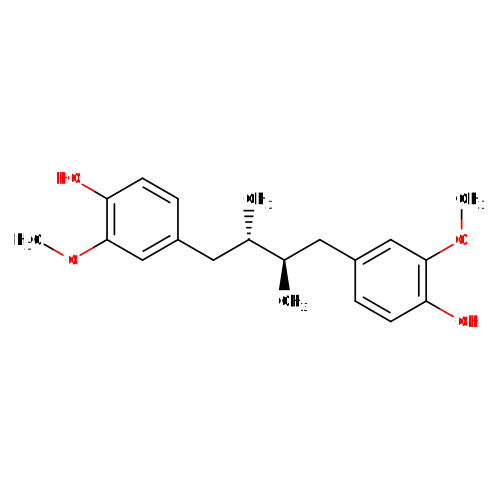
| Common Name | meso-Dihydroguaiaretic acid |
|---|
| Description | Meso-dihydroguaiaretic acid, also known as dihydroguaiaretate, belongs to the class of organic compounds known as dibenzylbutane lignans. These are lignan compounds containing a 2,3-dibenzylbutane moiety. Meso-dihydroguaiaretic acid is a secondary metabolite. Secondary metabolites are metabolically or physiologically non-essential metabolites that may serve a role as defense or signalling molecules. In some cases they are simply molecules that arise from the incomplete metabolism of other secondary metabolites. meso-Dihydroguaiaretic acid is found in Cinnamomum philippinense, Kadsura angustifolia, Kadsura heteroclita, Larrea tridentata, Leucas aspera , Machilus robusta, Machilus thunbergii , Machilus wangchiana, Myristica fragrans, Saururus chinensis, Schisandra lancifolia, Schisandra propinqua, Schisandra propinqua var.propinqua, Schisandra rubriflora and Schisandra rubriflora Rehd.et Wils.. meso-Dihydroguaiaretic acid was first documented in 2020 (PMID: 33206347). Based on a literature review a small amount of articles have been published on meso-dihydroguaiaretic acid (PMID: 35052627) (PMID: 34443392) (PMID: 34315376) (PMID: 33756201). |
|---|
| Structure | COC1=C(O)C=CC(C[C@H](C)[C@H](C)CC2=CC(OC)=C(O)C=C2)=C1 InChI=1S/C20H26O4/c1-13(9-15-5-7-17(21)19(11-15)23-3)14(2)10-16-6-8-18(22)20(12-16)24-4/h5-8,11-14,21-22H,9-10H2,1-4H3/t13-,14+ |
|---|
| Synonyms | | Value | Source |
|---|
| 4,4'-Dihydroxy-3,3'-dimethoxylignan | ChEBI | | Dihydroguaiaretic acid | ChEBI | | Dihydroguaiaretate | Generator | | Meso-dihydroguaiaretate | Generator | | Dihydroguaiaretic acid, (r*,s*)-isomer | MeSH |
|
|---|
| Chemical Formula | C20H26O4 |
|---|
| Average Mass | 330.4240 Da |
|---|
| Monoisotopic Mass | 330.18311 Da |
|---|
| IUPAC Name | 4-[(2R,3S)-3-[(4-hydroxy-3-methoxyphenyl)methyl]-2-methylbutyl]-2-methoxyphenol |
|---|
| Traditional Name | 4-[(2R,3S)-3-[(4-hydroxy-3-methoxyphenyl)methyl]-2-methylbutyl]-2-methoxyphenol |
|---|
| CAS Registry Number | Not Available |
|---|
| SMILES | COC1=C(O)C=CC(C[C@H](C)[C@H](C)CC2=CC(OC)=C(O)C=C2)=C1 |
|---|
| InChI Identifier | InChI=1S/C20H26O4/c1-13(9-15-5-7-17(21)19(11-15)23-3)14(2)10-16-6-8-18(22)20(12-16)24-4/h5-8,11-14,21-22H,9-10H2,1-4H3/t13-,14+ |
|---|
| InChI Key | ADFOLUXMYYCTRR-OKILXGFUSA-N |
|---|
| Experimental Spectra |
|---|
|
| Not Available | | Predicted Spectra |
|---|
|
| | Spectrum Type | Description | Depositor ID | Depositor Organization | Depositor | Deposition Date | View |
|---|
| 1D NMR | 13C NMR Spectrum (1D, 25 MHz, D2O, predicted) | Wishart Lab | Wishart Lab | David Wishart | 2021-06-20 | View Spectrum | | 1D NMR | 1H NMR Spectrum (1D, 100 MHz, D2O, predicted) | Wishart Lab | Wishart Lab | David Wishart | 2021-06-20 | View Spectrum | | 1D NMR | 13C NMR Spectrum (1D, 252 MHz, D2O, predicted) | Wishart Lab | Wishart Lab | David Wishart | 2021-06-20 | View Spectrum | | 1D NMR | 1H NMR Spectrum (1D, 1000 MHz, D2O, predicted) | Wishart Lab | Wishart Lab | David Wishart | 2021-06-20 | View Spectrum | | 1D NMR | 13C NMR Spectrum (1D, 50 MHz, D2O, predicted) | Wishart Lab | Wishart Lab | David Wishart | 2021-06-20 | View Spectrum | | 1D NMR | 1H NMR Spectrum (1D, 200 MHz, D2O, predicted) | Wishart Lab | Wishart Lab | David Wishart | 2021-06-20 | View Spectrum | | 1D NMR | 13C NMR Spectrum (1D, 75 MHz, D2O, predicted) | Wishart Lab | Wishart Lab | David Wishart | 2021-06-20 | View Spectrum | | 1D NMR | 1H NMR Spectrum (1D, 300 MHz, D2O, predicted) | Wishart Lab | Wishart Lab | David Wishart | 2021-06-20 | View Spectrum | | 1D NMR | 13C NMR Spectrum (1D, 101 MHz, D2O, predicted) | Wishart Lab | Wishart Lab | David Wishart | 2021-06-20 | View Spectrum | | 1D NMR | 1H NMR Spectrum (1D, 400 MHz, D2O, predicted) | Wishart Lab | Wishart Lab | David Wishart | 2021-06-20 | View Spectrum | | 1D NMR | 13C NMR Spectrum (1D, 126 MHz, D2O, predicted) | Wishart Lab | Wishart Lab | David Wishart | 2021-06-20 | View Spectrum | | 1D NMR | 1H NMR Spectrum (1D, 500 MHz, D2O, predicted) | Wishart Lab | Wishart Lab | David Wishart | 2021-06-20 | View Spectrum | | 1D NMR | 13C NMR Spectrum (1D, 151 MHz, D2O, predicted) | Wishart Lab | Wishart Lab | David Wishart | 2021-06-20 | View Spectrum | | 1D NMR | 1H NMR Spectrum (1D, 600 MHz, D2O, predicted) | Wishart Lab | Wishart Lab | David Wishart | 2021-06-20 | View Spectrum | | 1D NMR | 13C NMR Spectrum (1D, 176 MHz, D2O, predicted) | Wishart Lab | Wishart Lab | David Wishart | 2021-06-20 | View Spectrum | | 1D NMR | 1H NMR Spectrum (1D, 700 MHz, D2O, predicted) | Wishart Lab | Wishart Lab | David Wishart | 2021-06-20 | View Spectrum | | 1D NMR | 13C NMR Spectrum (1D, 201 MHz, D2O, predicted) | Wishart Lab | Wishart Lab | David Wishart | 2021-06-20 | View Spectrum | | 1D NMR | 1H NMR Spectrum (1D, 800 MHz, D2O, predicted) | Wishart Lab | Wishart Lab | David Wishart | 2021-06-20 | View Spectrum | | 1D NMR | 13C NMR Spectrum (1D, 226 MHz, D2O, predicted) | Wishart Lab | Wishart Lab | David Wishart | 2021-06-20 | View Spectrum | | 1D NMR | 1H NMR Spectrum (1D, 900 MHz, D2O, predicted) | Wishart Lab | Wishart Lab | David Wishart | 2021-06-20 | View Spectrum |
| | Chemical Shift Submissions |
|---|
|
| Not Available | | Species |
|---|
| Species of Origin | |
|---|
| Chemical Taxonomy |
|---|
| Description | Belongs to the class of organic compounds known as dibenzylbutane lignans. These are lignan compounds containing a 2,3-dibenzylbutane moiety. |
|---|
| Kingdom | Organic compounds |
|---|
| Super Class | Lignans, neolignans and related compounds |
|---|
| Class | Dibenzylbutane lignans |
|---|
| Sub Class | Not Available |
|---|
| Direct Parent | Dibenzylbutane lignans |
|---|
| Alternative Parents | |
|---|
| Substituents | - Dibenzylbutane lignan skeleton
- Methoxyphenol
- Phenylpropane
- Anisole
- Phenoxy compound
- Phenol ether
- Methoxybenzene
- Phenol
- 1-hydroxy-2-unsubstituted benzenoid
- Alkyl aryl ether
- Benzenoid
- Monocyclic benzene moiety
- Ether
- Organooxygen compound
- Organic oxygen compound
- Hydrocarbon derivative
- Aromatic homomonocyclic compound
|
|---|
| Molecular Framework | Aromatic homomonocyclic compounds |
|---|
| External Descriptors | |
|---|
| Physical Properties |
|---|
| State | Not Available |
|---|
| Experimental Properties | | Property | Value | Reference |
|---|
| Melting Point | Not Available | Not Available | | Boiling Point | Not Available | Not Available | | Water Solubility | Not Available | Not Available | | LogP | Not Available | Not Available |
|
|---|
| Predicted Properties | |
|---|
| General References | - Lee YT, Chen YL, Wu YH, Chen IS, Chang HS, Wang YH, Chang SH, Wu YH, Kao TI, Yu HP, Hwang TL: Meso-Dihydroguaiaretic Acid Ameliorates Acute Respiratory Distress Syndrome through Inhibiting Neutrophilic Inflammation and Scavenging Free Radical. Antioxidants (Basel). 2022 Jan 6;11(1). pii: antiox11010123. doi: 10.3390/antiox11010123. [PubMed:35052627 ]
- Shin H, Han YK, Byun Y, Jeon YH, Lee KY: Lignans from Machilus thunbergii as Thymic Stromal Lymphopoietin Inhibitors. Molecules. 2021 Aug 8;26(16). pii: molecules26164804. doi: 10.3390/molecules26164804. [PubMed:34443392 ]
- Reyes-Melo KY, Galvan-Rodrigo AA, Martinez-Olivo IE, Nunez-Mojica G, Avalos-Alanis FG, Garcia A, Del Rayo Camacho-Corona M: Larrea tridentata and its Biological Activities. Curr Top Med Chem. 2021;21(26):2352-2364. doi: 10.2174/1568026621666210727170908. [PubMed:34315376 ]
- Tian F, Lee SY, Woo SY, Choi HY, Park SB, Chun HS: Effect of plant-based compounds on the antifungal and antiaflatoxigenic efficiency of strobilurins against Aspergillus flavus. J Hazard Mater. 2021 Aug 5;415:125663. doi: 10.1016/j.jhazmat.2021.125663. Epub 2021 Mar 15. [PubMed:33756201 ]
- Ha MT, Vu NK, Tran TH, Kim JA, Woo MH, Min BS: Phytochemical and pharmacological properties of Myristica fragrans Houtt.: an updated review. Arch Pharm Res. 2020 Nov;43(11):1067-1092. doi: 10.1007/s12272-020-01285-4. Epub 2020 Nov 18. [PubMed:33206347 ]
|
|---|