| Record Information |
|---|
| Version | 2.0 |
|---|
| Created at | 2022-04-28 15:14:41 UTC |
|---|
| Updated at | 2022-04-28 15:14:41 UTC |
|---|
| NP-MRD ID | NP0069947 |
|---|
| Secondary Accession Numbers | None |
|---|
| Natural Product Identification |
|---|
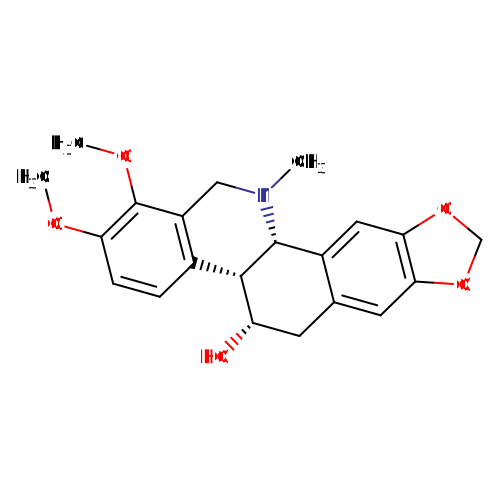
| Common Name | (+)-Homochelidonine |
|---|
| Description | Homochelidonine belongs to the class of organic compounds known as hexahydrobenzophenanthridine alkaloids. These are alkaloids containing a hexahydrobenzophenanthridine skeleton, which is a tetracyclic compound containing a benzene fused to a hexahydrophenanthridine moiety. (+)-Homochelidonine is found in Chelidonium majus and Eschscholzia californica. (+)-Homochelidonine was first documented in 2008 (PMID: 18200643). Based on a literature review a small amount of articles have been published on Homochelidonine (PMID: 29527613) (PMID: 26969379) (PMID: 23676491) (PMID: 21213973). |
|---|
| Structure | COC1=C(OC)C2=C(C=C1)[C@H]1[C@@H](O)CC3=CC4=C(OCO4)C=C3[C@H]1N(C)C2 InChI=1S/C21H23NO5/c1-22-9-14-12(4-5-16(24-2)21(14)25-3)19-15(23)6-11-7-17-18(27-10-26-17)8-13(11)20(19)22/h4-5,7-8,15,19-20,23H,6,9-10H2,1-3H3/t15-,19-,20+/m0/s1 |
|---|
| Synonyms | | Value | Source |
|---|
| (+/-)-homochelidonine | Kegg | | Norchelidonine | MeSH |
|
|---|
| Chemical Formula | C21H23NO5 |
|---|
| Average Mass | 369.4170 Da |
|---|
| Monoisotopic Mass | 369.15762 Da |
|---|
| IUPAC Name | (1S,12S,13R)-17,18-dimethoxy-21-methyl-5,7-dioxa-21-azapentacyclo[11.8.0.0^{2,10}.0^{4,8}.0^{14,19}]henicosa-2,4(8),9,14(19),15,17-hexaen-12-ol |
|---|
| Traditional Name | (1S,12S,13R)-17,18-dimethoxy-21-methyl-5,7-dioxa-21-azapentacyclo[11.8.0.0^{2,10}.0^{4,8}.0^{14,19}]henicosa-2,4(8),9,14(19),15,17-hexaen-12-ol |
|---|
| CAS Registry Number | Not Available |
|---|
| SMILES | COC1=C(OC)C2=C(C=C1)[C@H]1[C@@H](O)CC3=CC4=C(OCO4)C=C3[C@H]1N(C)C2 |
|---|
| InChI Identifier | InChI=1S/C21H23NO5/c1-22-9-14-12(4-5-16(24-2)21(14)25-3)19-15(23)6-11-7-17-18(27-10-26-17)8-13(11)20(19)22/h4-5,7-8,15,19-20,23H,6,9-10H2,1-3H3/t15-,19-,20+/m0/s1 |
|---|
| InChI Key | MADYLZJCRKUBIK-RYGJVYDSSA-N |
|---|
| Experimental Spectra |
|---|
|
| Not Available | | Predicted Spectra |
|---|
|
| | Spectrum Type | Description | Depositor ID | Depositor Organization | Depositor | Deposition Date | View |
|---|
| 1D NMR | 13C NMR Spectrum (1D, 25 MHz, D2O, predicted) | Wishart Lab | Wishart Lab | David Wishart | 2021-06-20 | View Spectrum | | 1D NMR | 1H NMR Spectrum (1D, 100 MHz, D2O, predicted) | Wishart Lab | Wishart Lab | David Wishart | 2021-06-20 | View Spectrum | | 1D NMR | 13C NMR Spectrum (1D, 252 MHz, D2O, predicted) | Wishart Lab | Wishart Lab | David Wishart | 2021-06-20 | View Spectrum | | 1D NMR | 1H NMR Spectrum (1D, 1000 MHz, D2O, predicted) | Wishart Lab | Wishart Lab | David Wishart | 2021-06-20 | View Spectrum | | 1D NMR | 13C NMR Spectrum (1D, 50 MHz, D2O, predicted) | Wishart Lab | Wishart Lab | David Wishart | 2021-06-20 | View Spectrum | | 1D NMR | 1H NMR Spectrum (1D, 200 MHz, D2O, predicted) | Wishart Lab | Wishart Lab | David Wishart | 2021-06-20 | View Spectrum | | 1D NMR | 13C NMR Spectrum (1D, 75 MHz, D2O, predicted) | Wishart Lab | Wishart Lab | David Wishart | 2021-06-20 | View Spectrum | | 1D NMR | 1H NMR Spectrum (1D, 300 MHz, D2O, predicted) | Wishart Lab | Wishart Lab | David Wishart | 2021-06-20 | View Spectrum | | 1D NMR | 13C NMR Spectrum (1D, 101 MHz, D2O, predicted) | Wishart Lab | Wishart Lab | David Wishart | 2021-06-20 | View Spectrum | | 1D NMR | 1H NMR Spectrum (1D, 400 MHz, D2O, predicted) | Wishart Lab | Wishart Lab | David Wishart | 2021-06-20 | View Spectrum | | 1D NMR | 13C NMR Spectrum (1D, 126 MHz, D2O, predicted) | Wishart Lab | Wishart Lab | David Wishart | 2021-06-20 | View Spectrum | | 1D NMR | 1H NMR Spectrum (1D, 500 MHz, D2O, predicted) | Wishart Lab | Wishart Lab | David Wishart | 2021-06-20 | View Spectrum | | 1D NMR | 13C NMR Spectrum (1D, 151 MHz, D2O, predicted) | Wishart Lab | Wishart Lab | David Wishart | 2021-06-20 | View Spectrum | | 1D NMR | 1H NMR Spectrum (1D, 600 MHz, D2O, predicted) | Wishart Lab | Wishart Lab | David Wishart | 2021-06-20 | View Spectrum | | 1D NMR | 13C NMR Spectrum (1D, 176 MHz, D2O, predicted) | Wishart Lab | Wishart Lab | David Wishart | 2021-06-20 | View Spectrum | | 1D NMR | 1H NMR Spectrum (1D, 700 MHz, D2O, predicted) | Wishart Lab | Wishart Lab | David Wishart | 2021-06-20 | View Spectrum | | 1D NMR | 13C NMR Spectrum (1D, 201 MHz, D2O, predicted) | Wishart Lab | Wishart Lab | David Wishart | 2021-06-20 | View Spectrum | | 1D NMR | 1H NMR Spectrum (1D, 800 MHz, D2O, predicted) | Wishart Lab | Wishart Lab | David Wishart | 2021-06-20 | View Spectrum | | 1D NMR | 13C NMR Spectrum (1D, 226 MHz, D2O, predicted) | Wishart Lab | Wishart Lab | David Wishart | 2021-06-20 | View Spectrum | | 1D NMR | 1H NMR Spectrum (1D, 900 MHz, D2O, predicted) | Wishart Lab | Wishart Lab | David Wishart | 2021-06-20 | View Spectrum |
| | Chemical Shift Submissions |
|---|
|
| Not Available | | Species |
|---|
| Species of Origin | |
|---|
| Chemical Taxonomy |
|---|
| Description | Belongs to the class of organic compounds known as hexahydrobenzophenanthridine alkaloids. These are alkaloids containing a hexahydrobenzophenanthridine skeleton, which is a tetracyclic compound containing a benzene fused to a hexahydrophenanthridine moiety. |
|---|
| Kingdom | Organic compounds |
|---|
| Super Class | Alkaloids and derivatives |
|---|
| Class | Benzophenanthridine alkaloids |
|---|
| Sub Class | Hexahydrobenzophenanthridine alkaloids |
|---|
| Direct Parent | Hexahydrobenzophenanthridine alkaloids |
|---|
| Alternative Parents | |
|---|
| Substituents | - Hexahydrobenzophenanthridine alkaloid skeleton
- Benzoquinoline
- Phenanthridine
- Quinoline
- Tetrahydroisoquinoline
- Tetralin
- Benzodioxole
- Anisole
- Alkyl aryl ether
- Aralkylamine
- Benzenoid
- Tertiary amine
- Secondary alcohol
- Tertiary aliphatic amine
- Organoheterocyclic compound
- Azacycle
- Oxacycle
- Acetal
- Ether
- Alcohol
- Hydrocarbon derivative
- Organopnictogen compound
- Organic oxygen compound
- Organic nitrogen compound
- Amine
- Organonitrogen compound
- Organooxygen compound
- Aromatic heteropolycyclic compound
|
|---|
| Molecular Framework | Aromatic heteropolycyclic compounds |
|---|
| External Descriptors | |
|---|
| Physical Properties |
|---|
| State | Not Available |
|---|
| Experimental Properties | | Property | Value | Reference |
|---|
| Melting Point | Not Available | Not Available | | Boiling Point | Not Available | Not Available | | Water Solubility | Not Available | Not Available | | LogP | Not Available | Not Available |
|
|---|
| Predicted Properties | |
|---|
| General References | - Fleming MJ, McManus HA, Rudolph A, Chan WH, Ruiz J, Dockendorff C, Lautens M: Concise enantioselective total syntheses of (+)-homochelidonine, (+)-chelamidine, (+)-chelidonine, (+)-chelamine and (+)-norchelidonine by a Pd II-catalyzed ring-opening strategy. Chemistry. 2008;14(7):2112-24. doi: 10.1002/chem.200701775. [PubMed:18200643 ]
- Li RQ, He Y, Ding Y, Ang CK, Tian JS, Loh TP: Formal synthesis of chelamidine alkaloids and their derivatives. Chem Commun (Camb). 2018 Mar 28;54(25):3150-3153. doi: 10.1039/c7cc09875h. Epub 2018 Mar 12. [PubMed:29527613 ]
- Havelek R, Seifrtova M, Kralovec K, Krocova E, Tejkalova V, Novotny I, Cahlikova L, Safratova M, Opletal L, Bilkova Z, Vavrova J, Rezacova M: Comparative cytotoxicity of chelidonine and homochelidonine, the dimethoxy analogues isolated from Chelidonium majus L. (Papaveraceae), against human leukemic and lung carcinoma cells. Phytomedicine. 2016 Mar 15;23(3):253-66. doi: 10.1016/j.phymed.2016.01.001. Epub 2016 Jan 22. [PubMed:26969379 ]
- Bozhadze AD, Vachnadze VIu, Dzhokhadze MS, Berashvili DT, Bakuridze AD: [Study on the separation process of pharmacological active total alkaloids from Chelidonium majus L. growing in Georgia]. Georgian Med News. 2013 Apr;(217):61-5. [PubMed:23676491 ]
- Cahlikova L, Opletal L, Kurfurst M, Macakova K, Kulhankova A, Hostalkova A: Acetylcholinesterase and butyrylcholinesterase inhibitory compounds from Chelidonium majus (Papaveraceae). Nat Prod Commun. 2010 Nov;5(11):1751-4. [PubMed:21213973 ]
|
|---|