| Record Information |
|---|
| Version | 2.0 |
|---|
| Created at | 2022-04-28 14:43:25 UTC |
|---|
| Updated at | 2022-04-28 14:43:25 UTC |
|---|
| NP-MRD ID | NP0069371 |
|---|
| Secondary Accession Numbers | None |
|---|
| Natural Product Identification |
|---|
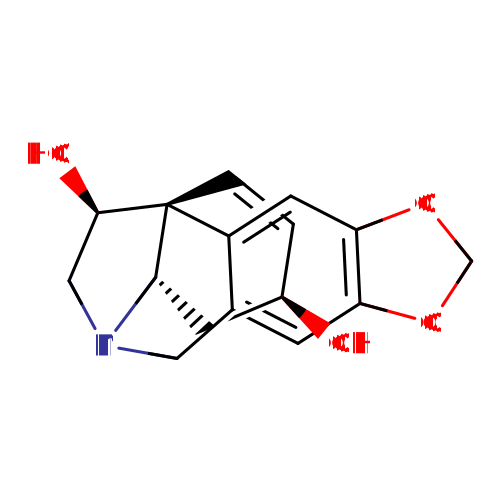
| Common Name | (+)-11-Hydroxyvittatine |
|---|
| Description | 11-Hydroxyvittatine belongs to the class of organic compounds known as crinine- and haemanthamine-type amaryllidaceae alkaloids. These are amaryllidaceae alkaloids compounds with a structure based on the crinine or haemanthamine backbone. Both backbones have a common 5,10b-ethano bridge moiety in their frameworks, which is a very significant taxonomic feature, and the configurations of the 5,10b-ethano bridge are opposite to each other. (+)-11-Hydroxyvittatine is found in Amaryllis belladonna, Galanthus elewesii, Galanthus elwesii, Galanthus plicatus, Hippeastrum papilio, Hippeastrum puniceum, Pancratium canariense, Pancratium maritimum, Pancratium sickenbergeri and Sternbergia lutea. (+)-11-Hydroxyvittatine was first documented in 2003 (PMID: 14598220). Based on a literature review a significant number of articles have been published on 11-Hydroxyvittatine (PMID: 22260001) (PMID: 35448871) (PMID: 30963375) (PMID: 16309304) (PMID: 15587597) (PMID: 30657047). |
|---|
| Structure | O[C@@H]1CN2CC3=CC4=C(OCO4)C=C3[C@]11C=C[C@@H](O)C[C@H]21 InChI=1S/C16H17NO4/c18-10-1-2-16-11-5-13-12(20-8-21-13)3-9(11)6-17(7-15(16)19)14(16)4-10/h1-3,5,10,14-15,18-19H,4,6-8H2/t10-,14+,15-,16+/m1/s1 |
|---|
| Synonyms | Not Available |
|---|
| Chemical Formula | C16H17NO4 |
|---|
| Average Mass | 287.3150 Da |
|---|
| Monoisotopic Mass | 287.11576 Da |
|---|
| IUPAC Name | (1S,13S,15S,18S)-5,7-dioxa-12-azapentacyclo[10.5.2.0^{1,13}.0^{2,10}.0^{4,8}]nonadeca-2,4(8),9,16-tetraene-15,18-diol |
|---|
| Traditional Name | (1S,13S,15S,18S)-5,7-dioxa-12-azapentacyclo[10.5.2.0^{1,13}.0^{2,10}.0^{4,8}]nonadeca-2,4(8),9,16-tetraene-15,18-diol |
|---|
| CAS Registry Number | Not Available |
|---|
| SMILES | O[C@@H]1CN2CC3=CC4=C(OCO4)C=C3[C@]11C=C[C@@H](O)C[C@H]21 |
|---|
| InChI Identifier | InChI=1S/C16H17NO4/c18-10-1-2-16-11-5-13-12(20-8-21-13)3-9(11)6-17(7-15(16)19)14(16)4-10/h1-3,5,10,14-15,18-19H,4,6-8H2/t10-,14+,15-,16+/m1/s1 |
|---|
| InChI Key | KWAOMPWGIIXDPH-NWLYGAKOSA-N |
|---|
| Experimental Spectra |
|---|
|
| Not Available | | Predicted Spectra |
|---|
|
| | Spectrum Type | Description | Depositor ID | Depositor Organization | Depositor | Deposition Date | View |
|---|
| 1D NMR | 13C NMR Spectrum (1D, 25 MHz, D2O, predicted) | Wishart Lab | Wishart Lab | David Wishart | 2021-06-20 | View Spectrum | | 1D NMR | 1H NMR Spectrum (1D, 100 MHz, D2O, predicted) | Wishart Lab | Wishart Lab | David Wishart | 2021-06-20 | View Spectrum | | 1D NMR | 13C NMR Spectrum (1D, 252 MHz, D2O, predicted) | Wishart Lab | Wishart Lab | David Wishart | 2021-06-20 | View Spectrum | | 1D NMR | 1H NMR Spectrum (1D, 1000 MHz, D2O, predicted) | Wishart Lab | Wishart Lab | David Wishart | 2021-06-20 | View Spectrum | | 1D NMR | 13C NMR Spectrum (1D, 50 MHz, D2O, predicted) | Wishart Lab | Wishart Lab | David Wishart | 2021-06-20 | View Spectrum | | 1D NMR | 1H NMR Spectrum (1D, 200 MHz, D2O, predicted) | Wishart Lab | Wishart Lab | David Wishart | 2021-06-20 | View Spectrum | | 1D NMR | 13C NMR Spectrum (1D, 75 MHz, D2O, predicted) | Wishart Lab | Wishart Lab | David Wishart | 2021-06-20 | View Spectrum | | 1D NMR | 1H NMR Spectrum (1D, 300 MHz, D2O, predicted) | Wishart Lab | Wishart Lab | David Wishart | 2021-06-20 | View Spectrum | | 1D NMR | 13C NMR Spectrum (1D, 101 MHz, D2O, predicted) | Wishart Lab | Wishart Lab | David Wishart | 2021-06-20 | View Spectrum | | 1D NMR | 1H NMR Spectrum (1D, 400 MHz, D2O, predicted) | Wishart Lab | Wishart Lab | David Wishart | 2021-06-20 | View Spectrum | | 1D NMR | 13C NMR Spectrum (1D, 126 MHz, D2O, predicted) | Wishart Lab | Wishart Lab | David Wishart | 2021-06-20 | View Spectrum | | 1D NMR | 1H NMR Spectrum (1D, 500 MHz, D2O, predicted) | Wishart Lab | Wishart Lab | David Wishart | 2021-06-20 | View Spectrum | | 1D NMR | 13C NMR Spectrum (1D, 151 MHz, D2O, predicted) | Wishart Lab | Wishart Lab | David Wishart | 2021-06-20 | View Spectrum | | 1D NMR | 1H NMR Spectrum (1D, 600 MHz, D2O, predicted) | Wishart Lab | Wishart Lab | David Wishart | 2021-06-20 | View Spectrum | | 1D NMR | 13C NMR Spectrum (1D, 176 MHz, D2O, predicted) | Wishart Lab | Wishart Lab | David Wishart | 2021-06-20 | View Spectrum | | 1D NMR | 1H NMR Spectrum (1D, 700 MHz, D2O, predicted) | Wishart Lab | Wishart Lab | David Wishart | 2021-06-20 | View Spectrum | | 1D NMR | 13C NMR Spectrum (1D, 201 MHz, D2O, predicted) | Wishart Lab | Wishart Lab | David Wishart | 2021-06-20 | View Spectrum | | 1D NMR | 1H NMR Spectrum (1D, 800 MHz, D2O, predicted) | Wishart Lab | Wishart Lab | David Wishart | 2021-06-20 | View Spectrum | | 1D NMR | 13C NMR Spectrum (1D, 226 MHz, D2O, predicted) | Wishart Lab | Wishart Lab | David Wishart | 2021-06-20 | View Spectrum | | 1D NMR | 1H NMR Spectrum (1D, 900 MHz, D2O, predicted) | Wishart Lab | Wishart Lab | David Wishart | 2021-06-20 | View Spectrum |
| | Chemical Shift Submissions |
|---|
|
| Not Available | | Species |
|---|
| Species of Origin | |
|---|
| Chemical Taxonomy |
|---|
| Description | Belongs to the class of organic compounds known as crinine- and haemanthamine-type amaryllidaceae alkaloids. These are amaryllidaceae alkaloids compounds with a structure based on the crinine or haemanthamine backbone. Both backbones have a common 5,10b-ethano bridge moiety in their frameworks, which is a very significant taxonomic feature, and the configurations of the 5,10b-ethano bridge are opposite to each other. |
|---|
| Kingdom | Organic compounds |
|---|
| Super Class | Alkaloids and derivatives |
|---|
| Class | Amaryllidaceae alkaloids |
|---|
| Sub Class | Crinine- and Haemanthamine-type amaryllidaceae alkaloids |
|---|
| Direct Parent | Crinine- and Haemanthamine-type amaryllidaceae alkaloids |
|---|
| Alternative Parents | |
|---|
| Substituents | - Hemanthamine/crinine alkaloid skeleton
- Benzoquinoline
- Phenanthridine
- Benzazepine
- Quinoline
- Tetrahydroisoquinoline
- Benzodioxole
- Indole or derivatives
- Azepine
- Aralkylamine
- N-alkylpyrrolidine
- Benzenoid
- Pyrrolidine
- Tertiary aliphatic amine
- 1,2-aminoalcohol
- Secondary alcohol
- Tertiary amine
- Oxacycle
- Organoheterocyclic compound
- Acetal
- Azacycle
- Organooxygen compound
- Organonitrogen compound
- Hydrocarbon derivative
- Organopnictogen compound
- Organic oxygen compound
- Organic nitrogen compound
- Alcohol
- Amine
- Aromatic heteropolycyclic compound
|
|---|
| Molecular Framework | Aromatic heteropolycyclic compounds |
|---|
| External Descriptors | Not Available |
|---|
| Physical Properties |
|---|
| State | Not Available |
|---|
| Experimental Properties | | Property | Value | Reference |
|---|
| Melting Point | Not Available | Not Available | | Boiling Point | Not Available | Not Available | | Water Solubility | Not Available | Not Available | | LogP | Not Available | Not Available |
|
|---|
| Predicted Properties | |
|---|
| General References | - Zhao YY, Liang YQ, Chen Y, Sun H, Wang M, Feng X: [Study on chemical constituents of the bulbs of Lycoris longituba]. Zhong Yao Cai. 2011 Sep;34(9):1366-8. [PubMed:22260001 ]
- Masi M, Di Lecce R, Merindol N, Girard MP, Berthoux L, Desgagne-Penix I, Calabro V, Evidente A: Cytotoxicity and Antiviral Properties of Alkaloids Isolated from Pancratium maritimum. Toxins (Basel). 2022 Apr 7;14(4). pii: toxins14040262. doi: 10.3390/toxins14040262. [PubMed:35448871 ]
- Endo Y, Sugiura Y, Funasaki M, Kagechika H, Ishibashi M, Ohsaki A: Two new alkaloids from Crinum asiaticum var. japonicum. J Nat Med. 2019 Jun;73(3):648-652. doi: 10.1007/s11418-019-01304-9. Epub 2019 Apr 8. [PubMed:30963375 ]
- Forgo P, Hohmann J: Leucovernine and acetylleucovernine, alkaloids from Leucojum vernum. J Nat Prod. 2005 Nov;68(11):1588-91. doi: 10.1021/np050126f. [PubMed:16309304 ]
- Aboul-Ela MA, El-Lakany AM, Hammoda HM: Alkaloids from the bulbs of Crinum bulbispermum. Pharmazie. 2004 Nov;59(11):894-6. [PubMed:15587597 ]
- Cole ER, de Andrade JP, Filho JFA, Schmitt EFP, Alves-Araujo A, Bastida J, Endringer DC, de S Borges W, Lacerda V: Cytotoxic and Genotoxic Activities of Alkaloids from the Bulbs of Griffinia gardneriana and Habranthus itaobinus (Amaryllidaceae). Anticancer Agents Med Chem. 2019;19(5):707-717. doi: 10.2174/1871520619666190118122523. [PubMed:30657047 ]
- Cedron JC, Gutierrez D, Flores N, Ravelo AG, Estevez-Braun A: Synthesis and antimalarial activity of new haemanthamine-type derivatives. Bioorg Med Chem. 2012 Sep 15;20(18):5464-72. doi: 10.1016/j.bmc.2012.07.036. Epub 2012 Jul 31. [PubMed:22910226 ]
- Abou-Donia AH, Toaima SM, Hammoda HM, Shawky E, Kinoshita E, Takayama H: Phytochemical and biological investigation of Hymenocallis littoralis SALISB. Chem Biodivers. 2008 Feb;5(2):332-40. doi: 10.1002/cbdv.200890031. [PubMed:18293433 ]
- Evidente A, Andolfi A, Abou-Donia AH, Touema SM, Hammoda HM, Shawky E, Motta A: (-)-Amarbellisine, a lycorine-type alkaloid from Amaryllis belladonna L. growing in Egypt. Phytochemistry. 2004 Jul;65(14):2113-8. doi: 10.1016/j.phytochem.2004.03.020. [PubMed:15279981 ]
- Unver N, Kaya GI, Werner C, Verpoorte R, Gozler B: Galanthindole: a new indole alkaloid from Galanthus plicatus ssp. byzantinus. Planta Med. 2003 Sep;69(9):869-71. doi: 10.1055/s-2003-43206. [PubMed:14598220 ]
|
|---|